EducationAug 17, 20269 min read
Lire en français·Auf Deutsch lesen·Leer en español·Przeczytaj po polsku
Walking for Fitness: Do You Really Need 10,000 Steps?
The 10,000-step goal is everywhere, baked into every fitness tracker. It's also not based on science. Here's where the number came from, and how many steps actually move the needle on your health.
Reviewed by the HyperBody team

Your watch buzzes at 10,000 steps like you've unlocked something important. It's the most famous number in fitness and one of the least scientific. The good news, if you struggle to hit it, is that you almost certainly don't need to. The research on steps and health tells a more encouraging story than the round number on your wrist.
Let's look at where 10,000 came from, and what the evidence actually says about how much walking matters.
The 10,000-Step Myth's Marketing Origins
Here's the part that surprises people: the 10,000-step target was invented to sell pedometers. In 1965, a Japanese company released a step counter called the "Manpo-kei": literally "10,000-step meter", riding the wave of fitness interest after the 1964 Tokyo Olympics1. The number was chosen partly because it was catchy and the Japanese character for 10,000 even resembles a walking person2.
As Harvard epidemiologist I-Min Lee, who studies this directly, has put it, the figure was essentially a marketing tool with no clinical basis behind it2. It stuck because it's memorable, not because 10,000 is a magic threshold. Understanding that frees you from treating it as a pass/fail line.
What the Science Actually Shows
When researchers measure steps against health outcomes, two things become clear: walking is genuinely powerful, and the biggest benefits come well before 10,000 steps.
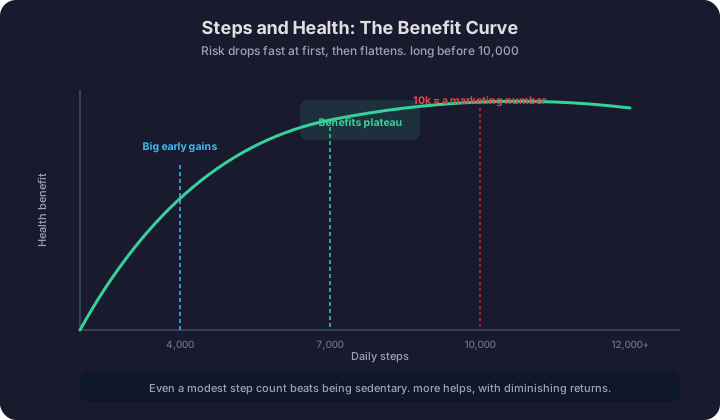
The pattern is a dose-response curve that rises steeply, then flattens:
- In a study of older women, taking roughly 4,400 steps a day cut mortality risk by about 40% compared to around 2,700, and the benefit kept rising until it plateaued at about 7,500 steps3.
- In a large study of US adults over 40, walking 8,000 steps a day versus 4,000 was associated with roughly half the risk of dying (about a 50% reduction). More steps helped further, but with diminishing returns4.
- A meta-analysis pooling 15 international cohorts found mortality risk dropped progressively with more steps and leveled off around 6,000 to 8,000 steps for older adults, and 8,000 to 10,000 for younger adults5.
That meta-analysis was blunt about the famous target: 10,000 steps "is widely promoted," it noted, but "there is little evidence to support this recommendation"5. The real message is that meaningful benefits begin far below 10,000, and the optimal number depends on your age.
It's About Total Steps, Not Speed
Another myth worth clearing: you don't have to power-walk. Two of the major studies specifically tested whether intensity (how fast you step) mattered, and in both, once total daily steps were accounted for, step intensity was not independently associated with living longer34. It's the total volume of walking that carries the benefit, not how briskly you do it.
That's liberating. A leisurely stroll counts. Steps accumulated across errands, walking the dog, and pacing on calls all add up the same as a dedicated brisk walk.
So What Should You Aim For?
The honest, evidence-based targets:
- If you're mostly sedentary, the biggest wins are the first few thousand steps. Going from ~3,000 to ~5,000-6,000 a day is where risk drops most steeply53. Don't let 10,000 intimidate you out of starting.
- Somewhere around 7,000-8,000 steps a day captures most of the benefit for most adults, with the sweet spot a bit lower for older adults and a bit higher for younger ones534.
- More is still slightly better, up to around 10,000-12,000, but with clearly diminishing returns4. Chase it if you enjoy it, but don't stress if you fall short.
Walking also happens to be a great way to meet official activity guidelines, which call for 150 to 300 minutes of moderate activity per week6. It's simply moderate-intensity aerobic exercise you can do anywhere, for free.
The Takeaway
- 10,000 steps is a marketing number from 1965, not a scientific threshold12.
- Major health benefits kick in well below 10,000, often by 4,000 to 8,000 steps a day534.
- Total steps matter more than speed. a casual walk counts just as much34.
- If you're sedentary, just move more. the first few thousand extra steps are the most valuable ones you'll take5.
Don't let a made-up number discourage you. Walking is one of the most accessible, well-evidenced things you can do for your health, and you're getting real benefits long before your watch lights up. Pair a daily walk with some smart coaching strength work and you've covered the two most important bases for a longer, stronger life.
References
Footnotes
-
Calechman S (2019). 10,000 steps a day. Or fewer? Harvard Health Publishing (Harvard Medical School). https://www.health.harvard.edu/blog/10000-steps-a-day-or-fewer-2019071117305
-
Denworth L (2023). You don't really need 10,000 daily steps to stay healthy. Scientific American. https://www.scientificamerican.com/article/you-dont-really-need-10-000-daily-steps-to-stay-healthy/
-
Lee IM, Shiroma EJ, Kamada M, Bassett DR, Matthews CE, Buring JE (2019). Association of step volume and intensity with all-cause mortality in older women. JAMA Internal Medicine, 179(8), 1105-1112. https://doi.org/10.1001/jamainternmed.2019.0899
-
Saint-Maurice PF, Troiano RP, Bassett DR, et al. (2020). Association of daily step count and step intensity with mortality among US adults. JAMA, 323(12), 1151-1160. https://doi.org/10.1001/jama.2020.1382
-
Paluch AE, Bajpai S, Bassett DR, et al. (2022). Daily steps and all-cause mortality: a meta-analysis of 15 international cohorts. The Lancet Public Health, 7(3), e219-e228. https://doi.org/10.1016/S2468-2667(21)00302-9
-
Bull FC, Al-Ansari SS, Biddle S, et al. (2020). World Health Organization 2020 guidelines on physical activity and sedentary behaviour. British Journal of Sports Medicine, 54(24), 1451-1462. https://doi.org/10.1136/bjsports-2020-102955
More field notes.

Hydration and Exercise Performance: How Much Water Do You Really Need?
Dehydration can quietly sabotage your workout, but chugging gallons isn't the answer either, and can even be dangerous. Here's the evidence-based truth about hydration for training.

Grip Strength: A Surprising Marker of Health and Longevity
How hard you can squeeze turns out to be one of the best simple predictors of how long you'll live. Here's the science behind grip strength, and how to build it.

Bone Density: How Resistance Training Builds Stronger Bones
Muscle gets all the attention, but lifting weights is also one of the only things that actively builds bone. Here's how loading your skeleton makes it stronger, and why it matters for life.
More on HyperBody