EducationSep 17, 202610 min read
Lire en français·Auf Deutsch lesen·Leer en español·Przeczytaj po polsku
Bone Density: How Resistance Training Builds Stronger Bones
Muscle gets all the attention, but lifting weights is also one of the only things that actively builds bone. Here's how loading your skeleton makes it stronger, and why it matters for life.
Reviewed by the HyperBody team

When you think about what strength training does, you probably picture muscle. But underneath that muscle, something just as important is happening: your bones are getting denser and stronger. Bone isn't the inert scaffolding people imagine. It's living, adaptive tissue that responds to load much like muscle does. And resistance training is one of the very few things that actively builds bone rather than just slowing its loss.
This matters more than most people realize, because the bone you build now is protection against fractures, frailty, and lost independence later. Here's the science.
Bone Is Alive, and It Responds to Load
The foundational principle is often called Wolff's law, refined into the modern "mechanostat" model: bone adjusts its mass and architecture in response to the mechanical strain placed on it. Load a bone hard enough, above a certain threshold, and specialized cells sense that strain and signal for more bone to be built. Leave it unloaded, and bone is lost1.
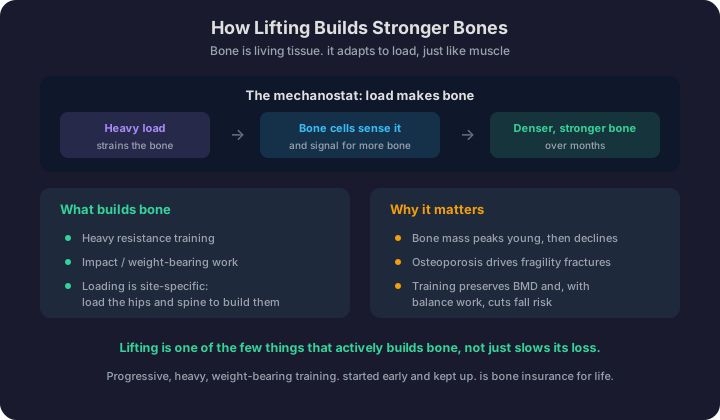
This is exactly why resistance training works for bone. Heavy lifting places significant, purposeful strain on your skeleton, triggering the adaptation response. It's the same stimulus-and-adaptation loop that builds muscle, running in parallel in your bones.
The Evidence: Lifting Builds and Preserves Bone
This isn't theoretical. A systematic review and meta-analysis found that progressive resistance training produces concurrent gains in both muscle strength and bone mineral density (BMD) in older adults2. Two problems of aging, addressed by one intervention.
The effect is especially well-documented in postmenopausal women, who are at high risk of bone loss. A meta-analysis found that resistance training preserves and can improve BMD, with the strongest effects at the two sites that matter most for serious fractures: the femoral neck (hip) and the lumbar spine3.
Perhaps the most striking evidence comes from the LIFTMOR trial, which had postmenopausal women with osteopenia and osteoporosis (low bone mass) perform brief, twice-weekly, supervised high-intensity resistance and impact training. The result: improved BMD at the spine and hip, better physical function, and, importantly, it was safe and well-tolerated4. This counters the common fear that heavy lifting is dangerous for fragile bones. Under proper guidance, it was exactly what those bones needed.
Bone Adaptation Is Site-Specific
One key principle shapes how you should train for bone: the adaptation happens where you load it. Bone strengthens specifically at the sites placed under strain, not globally.
The cleanest demonstration comes from tennis players: the bone in their racquet arm carries substantially more mass than their non-dominant arm (same person, same genetics, same nutrition); the difference is purely the loading5. The practical lesson is that to protect the bones that matter most (hips and spine), you need exercises that actually load them: squats, deadlifts, presses, rows, and weight-bearing movement. Curls alone won't protect your hip.
Why This Is Worth Caring About
The stakes here are high. Osteoporotic fractures are a massive burden: an estimated 9 million occurred worldwide in a single year, including 1.6 million hip fractures, costing millions of years of healthy life6. Hip fractures in particular are life-altering, often marking the end of independent living.
Two levers reduce that risk, and training hits both:
- Stronger bone is harder to break. resistance training directly builds BMD234.
- Fewer falls means fewer fracture opportunities. Exercise, particularly programs including balance and strength work, reduces the rate of falls in older adults7. Since most fragility fractures come from falls, this is a second, independent line of defense.
It's a Long Game. Start Early, Keep Going
Two timing facts should shape your approach. First, your bone mass peaks when you're young and roughly 20 to 40% of your adult peak bone mass is influenced by modifiable lifestyle factors, including physical activity. Weight-bearing exercise in childhood and adolescence builds a higher peak to draw down from later8. Second, because bone is lost under disuse, you have to keep loading it to maintain the gains, not just to build them1.
In other words, this is a lifelong practice. The earlier you start building bone and the more consistently you keep training, the bigger your buffer against age-related bone loss.
The Bottom Line
- Bone is living tissue that gets stronger when you load it. the mechanostat principle1.
- Resistance training builds and preserves bone density, even in people who already have osteoporosis, and it's safe when done properly234.
- Adaptation is site-specific, so train the hips and spine with real compound, weight-bearing lifts5.
- It cuts fracture risk two ways: stronger bones and fewer falls67.
- Start early, and never fully stop. peak bone mass is built young and maintained through continued loading81.
Every time you pick up a heavy weight, you're not just training muscle. You're making a deposit in a bone bank you'll be very glad to have later. A progressive smart coaching program loads the right movements to build strength and bone together, for the long haul.
References
Footnotes
-
Frost HM (2003). Bone's mechanostat: a 2003 update. The Anatomical Record Part A, 275A(2), 1081-1101. https://doi.org/10.1002/ar.a.10119
-
O'Bryan SJ, Giuliano C, Woessner MN, et al. (2022). Progressive resistance training for concomitant increases in muscle strength and bone mineral density in older adults: a systematic review and meta-analysis. Sports Medicine, 52(8), 1939-1960. https://doi.org/10.1007/s40279-022-01675-2
-
Zhao R, Zhao M, Xu Z (2015). The effects of differing resistance training modes on the preservation of bone mineral density in postmenopausal women: a meta-analysis. Osteoporosis International, 26(5), 1605-1618. https://doi.org/10.1007/s00198-015-3034-0
-
Watson SL, Weeks BK, Weis LJ, Harding AT, Horan SA, Beck BR (2018). High-intensity resistance and impact training improves bone mineral density and physical function in postmenopausal women with osteopenia and osteoporosis: the LIFTMOR randomized controlled trial. Journal of Bone and Mineral Research, 33(2), 211-220. https://doi.org/10.1002/jbmr.3284
-
Ducher G, Tournaire N, Meddahi-Pellé A, Benhamou CL, Courteix D (2006). Short-term and long-term site-specific effects of tennis playing on trabecular and cortical bone at the distal radius. Journal of Bone and Mineral Metabolism, 24(6), 484-490. https://doi.org/10.1007/s00774-006-0710-3
-
Johnell O, Kanis JA (2006). An estimate of the worldwide prevalence and disability associated with osteoporotic fractures. Osteoporosis International, 17(12), 1726-1733. https://doi.org/10.1007/s00198-006-0172-4
-
Sherrington C, Fairhall NJ, Wallbank GK, et al. (2019). Exercise for preventing falls in older people living in the community. Cochrane Database of Systematic Reviews, 1, CD012424. https://doi.org/10.1002/14651858.CD012424.pub2
-
Weaver CM, Gordon CM, Janz KF, et al. (2016). The National Osteoporosis Foundation's position statement on peak bone mass development and lifestyle factors: a systematic review and implementation recommendations. Osteoporosis International, 27(4), 1281-1386. https://doi.org/10.1007/s00198-015-3440-3
More field notes.

Grip Strength: A Surprising Marker of Health and Longevity
How hard you can squeeze turns out to be one of the best simple predictors of how long you'll live. Here's the science behind grip strength, and how to build it.

Walking for Fitness: Do You Really Need 10,000 Steps?
The 10,000-step goal is everywhere, baked into every fitness tracker. It's also not based on science. Here's where the number came from, and how many steps actually move the needle on your health.

Sarcopenia: How to Fight Age-Related Muscle Loss
Muscle isn't just about looking good. It's your armor for aging. Here's the science of sarcopenia, why muscle fades over time, and exactly how to hold on to it for decades.
More on HyperBody