EducationOct 22, 202610 min read
Lire en français·Auf Deutsch lesen·Leer en español·Przeczytaj po polsku
How to Improve Your VO2 Max (and Why It Matters)
VO2 max is the size of your aerobic engine, and it's one of the strongest predictors of how long you'll live. Here's what it is, why it matters so much, and exactly how to raise it.
Reviewed by the HyperBody team

If you could track just one number for your long-term health, a strong case says it should be your VO2 max. It's a measure of how powerful your aerobic engine is, and research keeps finding that it predicts longevity better than almost anything else. The best part: unlike your genes or your age, it's something you can actively improve. Here's what VO2 max is, why it matters, and how to raise it.
What VO2 Max Actually Is
VO2 max is the maximum rate at which your body can take in and use oxygen during hard exercise. Think of it as the size of your aerobic engine: the bigger it is, the more work you can sustain. Physiologically, it's primarily limited by how much oxygen-rich blood your heart can pump (your cardiac output), rather than by your muscles' ability to use that oxygen1.
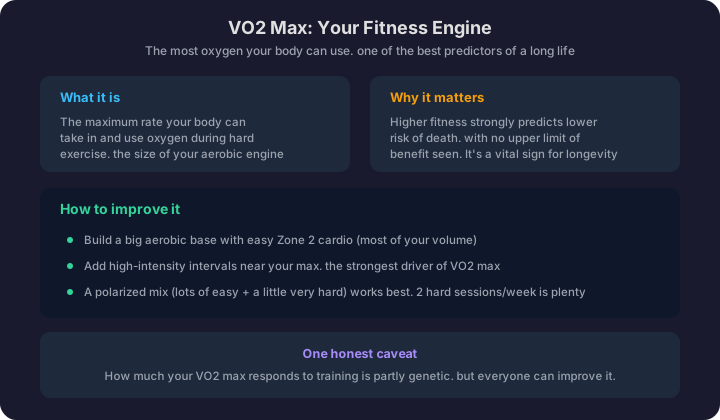
A higher VO2 max means everything aerobic feels easier: climbing stairs, playing with your kids, recovering between hard efforts in the gym. It's one of the clearest single markers of overall physical capacity1.
Why It Matters So Much: Longevity
Here's what elevates VO2 max from a performance metric to a health priority. In a study of over 122,000 people, higher cardiorespiratory fitness was associated with lower risk of dying from any cause. with no observed upper limit to the benefit2. Fitter was better, all the way up. The mortality gap between the least-fit and the most-fit rivaled or exceeded the risk of conditions like coronary artery disease, diabetes, and smoking2.
This isn't one outlier study. A meta-analysis found that each one-MET increase in fitness (a meaningful but achievable improvement) corresponds to a substantial reduction in mortality and cardiovascular events3. The evidence is strong enough that the American Heart Association formally recommends treating cardiorespiratory fitness as a "clinical vital sign," noting it can predict mortality better than smoking, high blood pressure, high cholesterol, or type 2 diabetes4.
In short: improving your VO2 max may be one of the highest-leverage things you can do for a longer, healthier life.
How to Improve It
The good news is that VO2 max responds well to the right training. Two ingredients matter most.
1. Build a big aerobic base. The foundation is a large volume of easy, low-intensity cardio. Zone 2 work. This develops the cardiovascular and mitochondrial machinery that underpins your engine, and it's sustainable enough to do a lot of.
2. Add high-intensity intervals. This is the strongest single driver of VO2 max. A meta-analysis found that while both interval training and steady continuous training raise VO2 max, HIIT produced roughly 2.5 times the improvement (about 4.9 vs 1.9 mL/kg/min) in healthy adults5. Intervals reliably push VO2 max up6, and protocols using longer intervals performed near your VO2 max intensity produce the biggest gains6.
The most effective approach combines the two. A polarized model of mostly easy work plus a smaller dose of very hard intervals. Just two high-intensity sessions per week, on top of your easy cardio, is enough to drive meaningful improvement.
It's Time-Efficient, Too
If time is your barrier, intervals are especially valuable. Research on low-volume HIIT shows it can produce cardiorespiratory and metabolic adaptations comparable to much higher volumes of traditional endurance training, in a fraction of the total exercise time7. A handful of hard intervals can deliver a lot of VO2 max benefit for the time invested.
An Honest Caveat: Genetics
One reality worth setting expectations around: how much your VO2 max improves from training is partly genetic. The HERITAGE Family Study found that the response to an identical training program varied enormously between people, from almost no change to increases over a liter per minute, and that roughly 47% of that variation in trainability was attributable to family/genetic factors8.
This means two people doing the same program can see quite different gains. Don't compare your numbers to someone else's; compare them to your own past. Everyone can improve their VO2 max with training: the rate just varies.
Your VO2 Max Plan
- Do mostly easy cardio to build your aerobic base (Zone 2).
- Add ~2 high-intensity interval sessions per week, using longer intervals near your max effort: the biggest driver of VO2 max56.
- Be consistent. the adaptations come from repeated exposure over weeks and months.
- Track your own progress, and set realistic expectations. Genetics affects your rate of improvement8.
- Remember the payoff. you're not just getting fitter, you're investing in a longer, healthier life24.
VO2 max is the rare metric that captures both performance and longevity in a single number. It's also trainable at essentially any age. Build your aerobic base, sprinkle in hard intervals, and stay consistent, and pair it with the strength work in a smart coaching plan for a body that's both powerful and built to last.
References
Footnotes
-
Bassett DR Jr, Howley ET (2000). Limiting factors for maximum oxygen uptake and determinants of endurance performance. Medicine & Science in Sports & Exercise, 32(1), 70-84. https://doi.org/10.1097/00005768-200001000-00012
-
Mandsager K, Harb S, Cremer P, Phelan D, Nissen SE, Jaber W (2018). Association of cardiorespiratory fitness with long-term mortality among adults undergoing exercise treadmill testing. JAMA Network Open, 1(6), e183605. https://doi.org/10.1001/jamanetworkopen.2018.3605
-
Kodama S, Saito K, Tanaka S, et al. (2009). Cardiorespiratory fitness as a quantitative predictor of all-cause mortality and cardiovascular events in healthy men and women: a meta-analysis. JAMA, 301(19), 2024-2035. https://doi.org/10.1001/jama.2009.681
-
Ross R, Blair SN, Arena R, et al. (2016). Importance of assessing cardiorespiratory fitness in clinical practice: a case for fitness as a clinical vital sign: a scientific statement from the American Heart Association. Circulation, 134(24), e653-e699. https://doi.org/10.1161/CIR.0000000000000461
-
Milanović Z, Sporiš G, Weston M (2015). Effectiveness of high-intensity interval training (HIT) and continuous endurance training for VO2max improvements: a systematic review and meta-analysis of controlled trials. Sports Medicine, 45(10), 1469-1481. https://doi.org/10.1007/s40279-015-0365-0
-
Bacon AP, Carter RE, Ogle EA, Joyner MJ (2013). VO2max trainability and high intensity interval training in humans: a meta-analysis. PLOS ONE, 8(9), e73182. https://doi.org/10.1371/journal.pone.0073182
-
Gibala MJ, Little JP, Macdonald MJ, Hawley JA (2012). Physiological adaptations to low-volume, high-intensity interval training in health and disease. The Journal of Physiology, 590(5), 1077-1084. https://doi.org/10.1113/jphysiol.2011.224725
-
Bouchard C, An P, Rice T, et al. (1999). Familial aggregation of VO2max response to exercise training: results from the HERITAGE Family Study. Journal of Applied Physiology, 87(3), 1003-1008. https://doi.org/10.1152/jappl.1999.87.3.1003
More field notes.

Walking for Fitness: Do You Really Need 10,000 Steps?
The 10,000-step goal is everywhere, baked into every fitness tracker. It's also not based on science. Here's where the number came from, and how many steps actually move the needle on your health.

Grip Strength: A Surprising Marker of Health and Longevity
How hard you can squeeze turns out to be one of the best simple predictors of how long you'll live. Here's the science behind grip strength, and how to build it.

Sarcopenia: How to Fight Age-Related Muscle Loss
Muscle isn't just about looking good. It's your armor for aging. Here's the science of sarcopenia, why muscle fades over time, and exactly how to hold on to it for decades.
More on HyperBody