EducationSep 7, 202610 min read
Lire en français·Auf Deutsch lesen·Leer en español·Przeczytaj po polsku
Sarcopenia: How to Fight Age-Related Muscle Loss
Muscle isn't just about looking good. It's your armor for aging. Here's the science of sarcopenia, why muscle fades over time, and exactly how to hold on to it for decades.
Reviewed by the HyperBody team

Here's a fact that reframes why training matters: the muscle you build today isn't only for how you look now. It's a buffer you'll draw on for the rest of your life. Starting in middle age, everyone begins losing muscle and strength in a process called sarcopenia. Left unchecked, it leads to frailty, falls, and lost independence. The good news is that it's one of the most preventable declines in all of aging, and the tools are things you already have access to.
What Sarcopenia Actually Is
Sarcopenia is the age-related loss of muscle mass, strength, and function. It's now formally recognized as a muscle disease, and in 2019 the leading European consensus redefined it around low muscle strength as the primary marker, not just muscle size, because strength turns out to better predict bad outcomes1.
That reframing matters. It tells you that the goal isn't only to preserve muscle mass, but to preserve what that muscle can do: get you out of a chair, catch yourself from a fall, carry groceries, stay independent.
The Timeline: A Slow Leak That Speeds Up
Muscle loss doesn't wait for old age to begin. Research shows muscle mass starts declining from middle age at a rate of roughly 1% per year, that's about 8 to 10% per decade, and the loss accelerates as you get older2. By your seventies, the yearly rate climbs further, and it tends to be faster in men2.
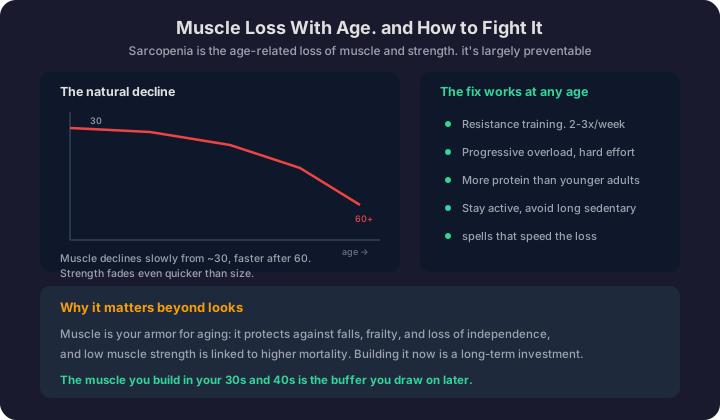
There's a crucial wrinkle: strength fades even faster than size. In a major longitudinal study, older adults lost strength more rapidly than muscle mass, and even those who maintained or gained muscle still lost strength: a decline in muscle quality3. This is why you can't be complacent just because the scale or the mirror looks stable. Function needs active defense.
Why Aging Muscle Is Harder to Build
Part of what drives sarcopenia is a phenomenon called anabolic resistance. As muscle ages, it mounts a blunted response to the usual growth signals. It's less sensitive to protein and to the stimulus of exercise than young muscle is4. Feed an older adult the same protein dose as a young one, and the older person's muscle builds less from it.
This isn't purely destiny, though. Anabolic resistance is driven partly by intrinsic changes in old muscle and partly by lifestyle: sedentary time and low protein intake make it worse4. Which points directly to the solution.
The Fix Works at Any Age
Here's the empowering part: sarcopenia is highly responsive to training, no matter when you start.
Resistance training rebuilds muscle in older adults. A meta-analysis of 49 studies found that resistance training produced an average gain of about 1.1 kg of lean body mass in aging adults5. That's older people, many in their 60s, 70s, and beyond, actively reversing part of the decline. Higher-volume programs produced greater gains, and starting earlier optimizes results5. Lifting weights is the single most effective intervention against sarcopenia.
Older adults need more protein. To overcome anabolic resistance, the evidence-based recommendation for older people is at least 1.0 to 1.2 grams of protein per kilogram of bodyweight per day: notably higher than the standard 0.8 g/kg RDA6. Pairing adequate protein with resistance training is what actually rebuilds the muscle.
Stay active and avoid long sedentary spells, which accelerate anabolic resistance and muscle loss4.
Why This Matters Beyond the Gym
It's tempting to file muscle under "vanity," but sarcopenia is fundamentally about healthspan. The consensus definition explicitly links it to falls, physical disability, loss of independence, and increased mortality1. Muscle is metabolically active, protective tissue. It's what keeps you strong, mobile, and self-sufficient as the decades pass.
Think of it as a retirement account for your body. Every bit of muscle and strength you build now is a deposit you'll be grateful for later, because you'll be drawing it down whether you contributed or not.
Your Anti-Sarcopenia Plan
- Lift weights 2-3 times a week, with progressive overload and genuine effort: this is the non-negotiable core5.
- Prioritize strength, not just size. train hard enough to actually get stronger over time13.
- Eat enough protein, and more as you age: at least 1.0-1.2 g/kg/day for older adults6.
- Start now, whatever your age. the decline begins in midlife, and training reverses it at any age25.
- Stay generally active to keep your muscle responsive4.
You can't stop getting older, but you have remarkable control over how much muscle and strength you carry into later life. The best time to start building your buffer was in your 30s; the second-best time is today. A structured smart coaching plan makes progressive resistance training simple to follow for the long haul, and a periodic physique analysis helps you track the muscle you're protecting.
References
Footnotes
-
Cruz-Jentoft AJ, Bahat G, Bauer J, et al. (2019). Sarcopenia: revised European consensus on definition and diagnosis. Age and Ageing, 48(1), 16-31. https://doi.org/10.1093/ageing/afy169
-
Wilkinson DJ, Piasecki M, Atherton PJ (2018). The age-related loss of skeletal muscle mass and function: measurement and physiology of muscle fibre atrophy and muscle fibre loss in humans. Ageing Research Reviews, 47, 123-132. https://doi.org/10.1016/j.arr.2018.07.005
-
Goodpaster BH, Park SW, Harris TB, et al. (2006). The loss of skeletal muscle strength, mass, and quality in older adults: the Health, Aging and Body Composition Study. The Journals of Gerontology: Series A, 61(10), 1059-1064. https://doi.org/10.1093/gerona/61.10.1059
-
Breen L, Phillips SM (2011). Skeletal muscle protein metabolism in the elderly: interventions to counteract the 'anabolic resistance' of ageing. Nutrition & Metabolism, 8, 68. https://doi.org/10.1186/1743-7075-8-68
-
Peterson MD, Sen A, Gordon PM (2011). Influence of resistance exercise on lean body mass in aging adults: a meta-analysis. Medicine & Science in Sports & Exercise, 43(2), 249-258. https://doi.org/10.1249/MSS.0b013e3181eb6265
-
Bauer J, Biolo G, Cederholm T, et al. (2013). Evidence-based recommendations for optimal dietary protein intake in older people: a position paper from the PROT-AGE study group. Journal of the American Medical Directors Association, 14(8), 542-559. https://doi.org/10.1016/j.jamda.2013.05.021
More field notes.

Grip Strength: A Surprising Marker of Health and Longevity
How hard you can squeeze turns out to be one of the best simple predictors of how long you'll live. Here's the science behind grip strength, and how to build it.

Bone Density: How Resistance Training Builds Stronger Bones
Muscle gets all the attention, but lifting weights is also one of the only things that actively builds bone. Here's how loading your skeleton makes it stronger, and why it matters for life.

How to Improve Your VO2 Max (and Why It Matters)
VO2 max is the size of your aerobic engine, and it's one of the strongest predictors of how long you'll live. Here's what it is, why it matters so much, and exactly how to raise it.
More on HyperBody