EducationAug 20, 202610 min read
Lire en français·Auf Deutsch lesen·Leer en español·Przeczytaj po polsku
Grip Strength: A Surprising Marker of Health and Longevity
How hard you can squeeze turns out to be one of the best simple predictors of how long you'll live. Here's the science behind grip strength, and how to build it.
Reviewed by the HyperBody team

Of all the numbers you could track about your health, one of the most powerful is also one of the simplest: how hard you can squeeze. Grip strength sounds trivial, but a growing body of research has found it to be a remarkably good predictor of your overall health and even how long you'll live. It's a window into your whole-body strength and vitality, measured with a single squeeze.
Here's why grip strength matters so much, and what you can do to build it.
A Squeeze That Predicts Mortality
The headline finding is striking. In the PURE study, which followed nearly 140,000 people across 17 countries, grip strength independently predicted both all-cause and cardiovascular mortality, and it was actually a stronger predictor of death than systolic blood pressure1. Every 5 kilogram decrease in grip strength was associated with a meaningfully higher risk of dying, having a heart attack, or having a stroke1.
This isn't a one-off result. A meta-analysis pooling 42 studies and over 3 million people found that each 5 kg drop in grip strength was linked to a 16% higher risk of all-cause mortality and a 21% higher risk of cardiovascular disease2. Looking at it from the positive side: in a healthy population of nearly 2 million adults, the strongest quartile had about a 31% lower risk of dying from any cause than the weakest3. The association even extends to cancer mortality4.
Why Would a Handshake Predict Health?
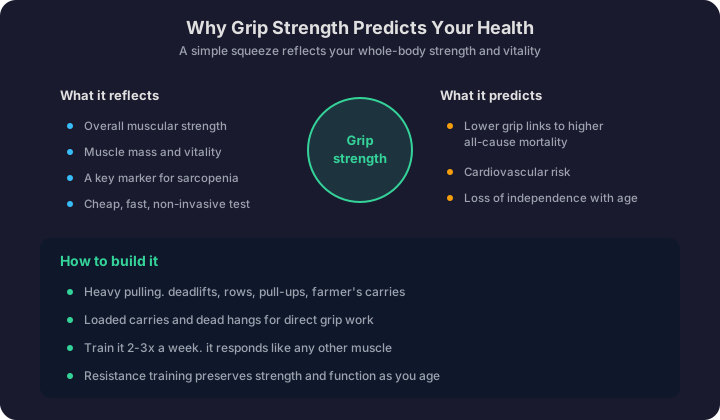
Grip strength isn't magic. It's a proxy. A hand dynamometer is really measuring a slice of your total muscular strength and, by extension, your overall muscle health and vitality. That's why it tracks so closely with broader outcomes: strength throughout your body tends to rise and fall together, and muscle is deeply tied to metabolic health, resilience, and function5.
This is exactly why clinicians have embraced it. Grip strength is now the primary parameter used to detect probable sarcopenia, the age-related loss of muscle, with formal cutoffs of below 27 kg for men and 16 kg for women6. It also correlates with bone density, fall and fracture risk, cognition, and quality of life, which is why one review called it "an indispensable biomarker for older adults"5. It's cheap, fast, and non-invasive, requiring nothing but a hand dynamometer15.
Marker, or Something You Can Change?
Here's the important question: is grip strength just a passive readout of your health, or something you can actually improve to your benefit? The encouraging answer is that strength is a modifiable trait, not a fixed one.
Resistance training reliably reverses strength loss, even in older adults. A meta-analysis found that resistance exercise produced strength gains of roughly 24 to 33% across major lifts in aging adults, with higher-intensity training yielding bigger improvements7. Your muscles, and your grip, respond to training at any age. So while grip strength predicts risk, it's not a sentence; it's a signal you can act on.
How to Build a Stronger Grip
The good news is that you don't need to train grip in isolation. Much of it comes free from smart, heavy training. To build it:
- Do heavy pulling. Deadlifts, barbell rows, and pull-ups load your grip hard by nature. These are the foundation.
- Add loaded carries. Farmer's carries, walking while holding heavy dumbbells or kettlebells, are one of the most effective and functional grip builders there is.
- Use dead hangs. Simply hanging from a pull-up bar for time trains your grip directly and is easy to progress.
- Train it regularly. Grip responds like any other muscle. Hit it two to three times a week and progressively increase the load or duration7.
- Skip the straps sometimes. Lifting straps are useful for very heavy pulls, but using them for everything means your grip never has to work. Go strapless on lighter sets.
The Bottom Line
- Grip strength is one of the best simple predictors of longevity, outperforming even blood pressure in a major study1.
- It works because it reflects your whole-body strength and muscle health, which is why it's used to screen for age-related muscle loss56.
- It's modifiable. resistance training builds strength at any age, so a weak grip is a signal to act on, not a fixed fate37.
- Build it with heavy pulls, loaded carries, and dead hangs, trained consistently.
Your grip is a low-tech dashboard for your overall strength and resilience. Keep it strong, and you're very likely keeping the rest of you strong too. Building overall strength is exactly what smart coaching is designed to do, and a periodic physique analysis helps you track the muscle behind the strength.
References
Footnotes
-
Leong DP, Teo KK, Rangarajan S, et al. (2015). Prognostic value of grip strength: findings from the Prospective Urban Rural Epidemiology (PURE) study. The Lancet, 386(9990), 266-273. https://doi.org/10.1016/S0140-6736(14)62000-6
-
Wu Y, Wang W, Liu T, Zhang D (2017). Association of grip strength with risk of all-cause mortality, cardiovascular diseases, and cancer in community-dwelling populations: a meta-analysis of prospective cohort studies. Journal of the American Medical Directors Association, 18(6), 551.e17-551.e35. https://doi.org/10.1016/j.jamda.2017.03.011
-
García-Hermoso A, Cavero-Redondo I, Ramírez-Vélez R, et al. (2018). Muscular strength as a predictor of all-cause mortality in an apparently healthy population: a systematic review and meta-analysis of data from approximately 2 million men and women. Archives of Physical Medicine and Rehabilitation, 99(10), 2100-2113. https://doi.org/10.1016/j.apmr.2018.01.008
-
García-Hermoso A, Cavero-Redondo I, Ramírez-Vélez R, et al. (2018). Handgrip and knee extension strength as predictors of cancer mortality: a systematic review and meta-analysis. Scandinavian Journal of Medicine & Science in Sports, 28(8), 1852-1858. https://doi.org/10.1111/sms.13206
-
Bohannon RW (2019). Grip strength: an indispensable biomarker for older adults. Clinical Interventions in Aging, 14, 1681-1691. https://doi.org/10.2147/CIA.S194543
-
Cruz-Jentoft AJ, Bahat G, Bauer J, et al. (2019). Sarcopenia: revised European consensus on definition and diagnosis. Age and Ageing, 48(1), 16-31. https://doi.org/10.1093/ageing/afy169
-
Peterson MD, Rhea MR, Sen A, Gordon PM (2010). Resistance exercise for muscular strength in older adults: a meta-analysis. Ageing Research Reviews, 9(3), 226-237. https://doi.org/10.1016/j.arr.2010.03.004
More field notes.

Sarcopenia: How to Fight Age-Related Muscle Loss
Muscle isn't just about looking good. It's your armor for aging. Here's the science of sarcopenia, why muscle fades over time, and exactly how to hold on to it for decades.

Bone Density: How Resistance Training Builds Stronger Bones
Muscle gets all the attention, but lifting weights is also one of the only things that actively builds bone. Here's how loading your skeleton makes it stronger, and why it matters for life.

Hydration and Exercise Performance: How Much Water Do You Really Need?
Dehydration can quietly sabotage your workout, but chugging gallons isn't the answer either, and can even be dangerous. Here's the evidence-based truth about hydration for training.
More on HyperBody