EducationOct 15, 202610 min read
Lire en français·Auf Deutsch lesen·Leer en español·Przeczytaj po polsku
Hydration and Exercise Performance: How Much Water Do You Really Need?
Dehydration can quietly sabotage your workout, but chugging gallons isn't the answer either, and can even be dangerous. Here's the evidence-based truth about hydration for training.
Reviewed by the HyperBody team

Hydration is one of those topics drowning in extremes. One camp treats water like a performance drug, hauling gallon jugs everywhere. The other barely drinks until they're parched. The evidence sits, sensibly, in the middle: being properly hydrated matters for performance, but more water isn't always better, and overdoing it can be genuinely dangerous. Here's what the science actually says about how much you need.
Dehydration Hurts Your Performance
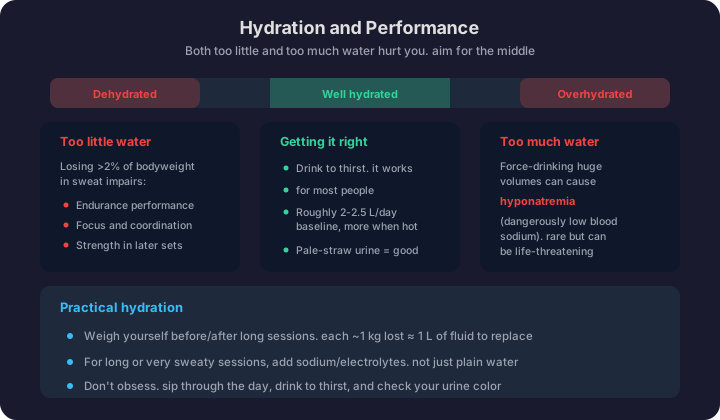
Let's start with why hydration matters. The ACSM's position stand on fluid replacement is clear: once you lose more than about 2% of your bodyweight in fluid, your aerobic and endurance performance measurably declines1. That's not a huge deficit. For an 80 kg person it's only about 1.6 kg of sweat, easily reached in a hard or hot session.
It's not just your muscles. Dehydration also impairs your brain. A meta-analysis found that being dehydrated produces a small but significant decline in cognitive performance, hitting attention, executive function, and coordination hardest, again around that 2% threshold2. So a dehydrated workout is worse both physically and mentally.
The effect on strength specifically is more mixed. Isolated single efforts like a max vertical jump are often preserved, but performance in multi-set resistance work tends to degrade in the later sets as dehydration builds3. Across the broader literature, hypohydration has been estimated to reduce strength by around 2%, power by around 3%, and high-intensity endurance by around 10%4. Not catastrophic for a single gym session, but a real, avoidable drag.
But More Isn't Better. Overhydration Is Dangerous
Here's the part the gallon-jug crowd misses: you can absolutely drink too much water. Forcing down large volumes of plain water, especially during prolonged exercise, can cause exercise-associated hyponatremia: a dangerous dilution of your blood sodium that, in serious cases, can be life-threatening5.
This is why the outdated advice to "drink as much as possible" has been abandoned. The consensus guidance is now the opposite: drink to thirst. Your body's thirst mechanism is a reliable guide for most people, and letting it lead, rather than forcing fixed large volumes, protects you from both dehydration and overhydration56.
How Much Should You Actually Drink?
The reassuring answer: for most people, most of the time, it's simple.
- Drink to thirst. Thirst-guided drinking is adequate for the majority of exercisers and athletes56.
- Baseline needs are modest. European food-safety guidance puts adequate total daily water intake (from drinks and food) at about 2.0 liters for women and 2.5 liters for men under moderate conditions, more in heat or with heavy exercise7.
- Check your urine color. It's a validated, practical at-home hydration marker. Pale straw means you're well hydrated; dark means drink more8.
That's it. No need to obsess over a rigid liter count. Sip through the day, respond to thirst, and glance at your urine color.
When You Need to Be More Deliberate
Casual training doesn't require a hydration strategy. But longer, hotter, or sweatier sessions do. In those cases:
- Estimate your sweat loss. Weigh yourself before and after a long session. Each ~1 kg lost is roughly 1 liter of fluid to replace6. This tells you how much you personally sweat.
- Add electrolytes for long or salty-sweat sessions. Sweat sodium losses vary enormously between people. Some are far "saltier" sweaters than others9. For prolonged exercise (roughly over an hour, or in heat), replacing sodium, not just plain water, matters, and it also helps protect against hyponatremia59.
- Aim to limit losses to under ~2% of bodyweight during exercise, rather than trying to replace every drop in real time1.
The Bottom Line
- Dehydration beyond ~2% of bodyweight impairs endurance, cognition, and strength in later sets124.
- But overdrinking is dangerous too. forcing large volumes of plain water can cause hyponatremia5.
- Drink to thirst. it's adequate and safe for most people56.
- Baseline is roughly 2-2.5 liters of total water a day, more with heat and hard training7.
- For long or sweaty sessions, gauge your sweat loss and add electrolytes69.
- Check urine color as a simple daily gauge. Pale straw is the target8.
Hydration isn't complicated once you drop the extremes. You don't need to carry a gallon jug, and you don't need to white-knuckle your thirst. Stay generally well hydrated, drink when you're thirsty, and be a bit more deliberate for long or hot sessions. Then put your energy into the training itself, which is what a smart coaching plan is built to optimize.
References
Footnotes
-
American College of Sports Medicine; Sawka MN, Burke LM, Eichner ER, et al. (2007). American College of Sports Medicine position stand. Exercise and fluid replacement. Medicine & Science in Sports & Exercise, 39(2), 377-390. https://doi.org/10.1249/mss.0b013e31802ca597
-
Wittbrodt MT, Millard-Stafford M (2018). Dehydration impairs cognitive performance: a meta-analysis. Medicine & Science in Sports & Exercise, 50(11), 2360-2368. https://doi.org/10.1249/MSS.0000000000001682
-
Judelson DA, Maresh CM, Farrell MJ, et al. (2007). Effect of hydration state on strength, power, and resistance exercise performance. Medicine & Science in Sports & Exercise, 39(10), 1817-1824. https://doi.org/10.1249/mss.0b013e3180de5f22
-
Judelson DA, Maresh CM, Anderson JM, et al. (2007). Hydration and muscular performance: does fluid balance affect strength, power and high-intensity endurance? Sports Medicine, 37(10), 907-921. https://doi.org/10.2165/00007256-200737100-00006
-
Hew-Butler T, Rosner MH, Fowkes-Godek S, et al. (2015). Statement of the Third International Exercise-Associated Hyponatremia Consensus Development Conference, Carlsbad, California, 2015. Clinical Journal of Sport Medicine, 25(4), 303-320. https://doi.org/10.1097/JSM.0000000000000221
-
McDermott BP, Anderson SA, Armstrong LE, et al. (2017). National Athletic Trainers' Association position statement: fluid replacement for the physically active. Journal of Athletic Training, 52(9), 877-895. https://doi.org/10.4085/1062-6050-52.9.02
-
EFSA Panel on Dietetic Products, Nutrition, and Allergies (2010). Scientific opinion on dietary reference values for water. EFSA Journal, 8(3), 1459. https://doi.org/10.2903/j.efsa.2010.1459
-
Kostelnik SB, Davy KP, Hedrick VE, Thomas DT, Davy BM (2021). The validity of urine color as a hydration biomarker within the general adult population and athletes: a systematic review. Journal of the American College of Nutrition, 40(2), 172-179. https://doi.org/10.1080/07315724.2020.1750073
-
Baker LB (2017). Sweating rate and sweat sodium concentration in athletes: a review of methodology and intra/interindividual variability. Sports Medicine, 47(Suppl 1), 111-128. https://doi.org/10.1007/s40279-017-0691-5
More field notes.

Walking for Fitness: Do You Really Need 10,000 Steps?
The 10,000-step goal is everywhere, baked into every fitness tracker. It's also not based on science. Here's where the number came from, and how many steps actually move the needle on your health.

Grip Strength: A Surprising Marker of Health and Longevity
How hard you can squeeze turns out to be one of the best simple predictors of how long you'll live. Here's the science behind grip strength, and how to build it.

Bone Density: How Resistance Training Builds Stronger Bones
Muscle gets all the attention, but lifting weights is also one of the only things that actively builds bone. Here's how loading your skeleton makes it stronger, and why it matters for life.
More on HyperBody