TrainingAug 10, 202611 min read
Lire en français·Auf Deutsch lesen·Leer en español·Przeczytaj po polsku
Workout Splits Explained: How to Structure Your Training Week
Full body, upper/lower, push-pull-legs, the bro split. Everyone argues about which is best. The research says you're asking the wrong question. Here's how to actually choose.
Reviewed by the HyperBody team

Ask ten lifters which training split is best and you'll get ten confident, contradictory answers. Push-pull-legs devotees swear by it. Full-body purists roll their eyes. Someone's uncle insists on "chest day." The truth, backed by the research, is refreshingly boring: the split itself is not the thing that grows muscle. How you fill it is.
Let's cut through the tribalism and look at how to actually structure your week.
The Only Two Variables That Really Matter
Before we compare splits, understand what a split is for. A split is just a way of distributing two things across your week: your weekly volume (total hard sets per muscle) and your frequency (how often you train each muscle). Those two variables, not the label on the split, are what drive growth.
On volume: there's a clear dose-response relationship, where more weekly sets per muscle generally produce more muscle, up to a point1. Direct trials confirm it. Lifters doing more sets per exercise grew more than those doing fewer2. A practical target is roughly 10 or more hard sets per muscle per week.
On frequency: here's the finding that dissolves most split debates. When weekly volume is held equal, training frequency doesn't meaningfully change how much muscle you build3. Whether you hit a muscle once or three times a week, if the total weekly sets are the same, growth is similar.
So Why Do Splits Matter at All?
If frequency doesn't change growth at equal volume, why not just do everything once a week? Because of a practical ceiling: cramming all of a muscle's weekly sets into a single session gets hard. Quality drops on your 15th set of chest, and fatigue piles up. Spreading that volume across more sessions keeps each session productive.
That's why higher-frequency structures tend to win in practice. In a head-to-head trial, a full-body routine trained three times a week produced greater muscle growth than a once-a-week-per-muscle split, at equated volume, largely because the volume was easier to perform well when spread out4. The split didn't have magic; it just made the volume more manageable.
The Splits, Ranked by Who They Suit
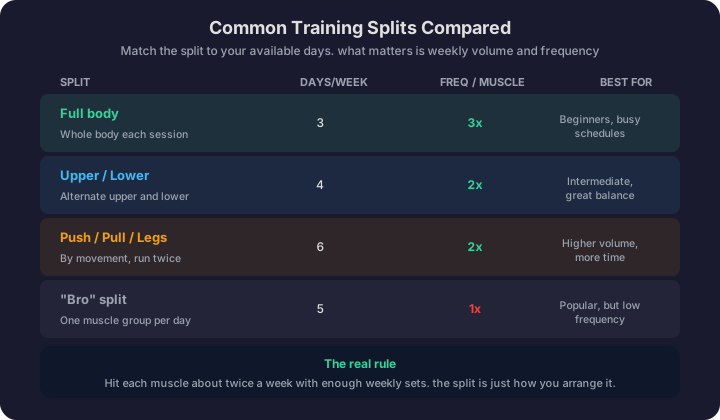
There's no single best split, only the best split for your schedule and recovery. Here's how the common options actually stack up.
Full body (3 days/week). Train all major muscles each session. This naturally gives you a 3x-per-week frequency at moderate per-session volume, and the research repeatedly shows it's excellent, especially for beginners and busy people34. If you can only train three days, this is almost always the answer.
Upper/Lower (4 days/week). Alternate upper- and lower-body days, hitting each muscle about twice a week. This is a fantastic intermediate structure: more per-session volume per muscle than full-body, while keeping frequency high35.
Push/Pull/Legs (6 days/week). Organize by movement (pushing, pulling, legs) and run it twice through for a 2x weekly frequency. Great for higher-volume lifters with time to train often. Run only three days, though, and it drops to once-per-week per muscle, which is fine only if your weekly volume stays high3.
The "bro split" (5 days, one muscle per day). Chest Monday, back Tuesday, and so on, much maligned, but not inherently useless. It works if your weekly volume per muscle is adequate3. The catch is that it forces all of a muscle's weekly sets into one session, which can push past the point where added sets are still productive.
What Matters More Than Your Split
Two principles matter regardless of which split you pick.
Effort. You don't need to train to absolute failure, but your sets need to be hard, close to failure, roughly one to three reps in reserve. Research shows training near failure produces similar growth to training to failure, and non-failure training matches failure training when volume is equated67. This is true on every split.
Progression and level. Program design should scale with experience: novices thrive on simple full-body structures, while intermediate and advanced lifters benefit from more structured splits and deliberate progression5. Whatever split you choose, you still have to add weight or reps over time.
How to Choose Yours
- Pick by your available days, not by dogma. 3 days, full body. 4 days, upper/lower. 5-6 days, push/pull/legs34.
- Make sure each muscle gets ~10+ hard sets a week, spread across your sessions12.
- Aim to hit each muscle about twice a week where practical, easy on upper/lower and 6-day PPL3.
- Train hard (1-3 reps in reserve) and progress over time67: that matters more than the split's name.
The best split is the one you can run consistently while getting your weekly volume in. Stop agonizing over which template is optimal and start filling whichever one fits your life. If you'd rather have the volume, frequency, and progression handled for you, smart coaching builds a split around your schedule and adjusts it as you advance.
References
Footnotes
-
Schoenfeld BJ, Ogborn D, Krieger JW (2017). Dose-response relationship between weekly resistance training volume and increases in muscle mass: a systematic review and meta-analysis. Journal of Sports Sciences, 35(11), 1073-1082. https://doi.org/10.1080/02640414.2016.1210197
-
Schoenfeld BJ, Contreras B, Krieger J, et al. (2019). Resistance training volume enhances muscle hypertrophy but not strength in trained men. Medicine & Science in Sports & Exercise, 51(1), 94-103. https://doi.org/10.1249/MSS.0000000000001764
-
Schoenfeld BJ, Grgic J, Krieger J (2019). How many times per week should a muscle be trained to maximize muscle hypertrophy? A systematic review and meta-analysis. Journal of Sports Sciences, 37(11), 1286-1295. https://doi.org/10.1080/02640414.2018.1555906
-
Schoenfeld BJ, Ratamess NA, Peterson MD, Contreras B, Tiryaki-Sonmez G (2015). Influence of resistance training frequency on muscular adaptations in well-trained men. Journal of Strength and Conditioning Research, 29(7), 1821-1829. https://doi.org/10.1519/JSC.0000000000000970
-
Ratamess NA, Alvar BA, Evetoch TK, et al. (2009). American College of Sports Medicine position stand. Progression models in resistance training for healthy adults. Medicine & Science in Sports & Exercise, 41(3), 687-708. https://doi.org/10.1249/MSS.0b013e3181915670
-
Refalo MC, Helms ER, Trexler ET, Hamilton DL, Fyfe JJ (2023). Influence of resistance training proximity-to-failure on skeletal muscle hypertrophy: a systematic review with meta-analysis. Sports Medicine, 53(3), 649-665. https://doi.org/10.1007/s40279-022-01784-y
-
Grgic J, Schoenfeld BJ, Orazem J, Sabol F (2022). Effects of resistance training performed to repetition failure or non-failure on muscular strength and hypertrophy: a systematic review and meta-analysis. Journal of Sport and Health Science, 11(2), 202-211. https://doi.org/10.1016/j.jshs.2021.01.007
More field notes.

Compound vs Isolation Exercises: Which Should You Prioritize?
Should you build your workouts around big lifts like squats and rows, or chase the pump with curls and extensions? The research gives a clear, nuanced answer: use both, in the right order.

How Long Should You Rest Between Sets?
Rushing between sets to 'keep the intensity up' might be quietly costing you muscle and strength. Here's what the research says about rest, and how long you should actually wait.

Free Weights vs Machines: Which Is Better for Muscle?
The barbell purists say machines are a waste of time. The machine crowd says free weights are just risky. The research settles it: for building muscle, they're about equal. What differs is everything else.
More on HyperBody