NutritionNov 12, 202610 min read
Lire en français·Auf Deutsch lesen·Leer en español·Przeczytaj po polsku
Alcohol and Your Gains: How Drinking Affects Muscle and Fat Loss
Can you drink and still make progress? The science is clearer than either the 'alcohol ruins everything' crowd or the 'it doesn't matter' crowd admits. It all comes down to dose.
Reviewed by the HyperBody team

It's the question every social lifter eventually asks: is that beer or glass of wine sabotaging my progress? The internet offers two unhelpful extremes. One camp says a single drink undoes your gains, the other says it doesn't matter at all. The truth, as usual, sits in between, and it hinges on one word: dose. An occasional drink has a modest impact. Regular heavy drinking genuinely works against your muscle, your fat loss, your recovery, and your next workout. Here's how alcohol actually affects your body.
It Blunts Muscle Building
The most direct hit is to muscle protein synthesis: the process that builds muscle after training. A well-controlled study had trained men do a workout, then consume alcohol along with protein. The result: muscle protein synthesis was suppressed by 24% even with protein, and by 37% when alcohol was paired with carbs, compared to protein alone1.
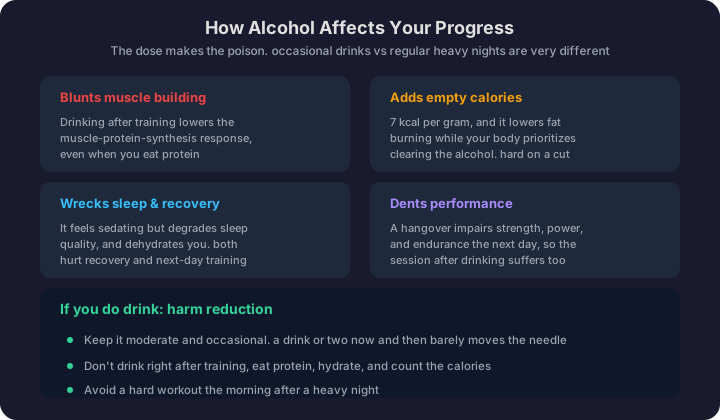
Two things to note honestly. First, this doesn't fully "rescue" with protein: the alcohol blunts the anabolic response regardless1. Second, the dose used was large: 1.5 grams per kilogram of bodyweight, roughly 8 to 10+ drinks for an average man1. So this is the effect of a heavy night, not a single beer. But the direction is clear: drinking, especially right after training, works against muscle building.
It Works Against Fat Loss
For anyone trying to lean out, alcohol is a double problem. First, it's calorie-dense: about 7 calories per gram, nearly as much as pure fat, and those calories are easy to overconsume because alcohol isn't well-regulated by appetite2.
Second, and more insidiously, alcohol suppresses fat burning. When you drink, your body prioritizes clearing the alcohol, and whole-body fat oxidation drops by roughly 31 to 36% over the following 24 hours2. So while your body deals with the alcohol, it burns less fat, and favors storing it. On a cut, this is a meaningful headwind.
It Sabotages Recovery
Alcohol undermines two pillars of recovery: sleep and hydration.
Sleep. Alcohol feels sedating and helps you fall asleep faster, but it degrades sleep quality. It fragments the second half of the night and reduces REM sleep at moderate-to-high doses3. So the sleep you get after drinking is less restorative, working against the recovery that makes you stronger.
Hydration. Alcohol suppresses vasopressin, the hormone that helps you retain water, triggering increased urination and next-day dehydration4. Since even mild dehydration impairs performance, this compounds the problem.
It Dents Your Next Workout and Your Hormones
The effects carry into the following day. Research on hangovers found that the same physical effort feels significantly more exhausting when you're hungover. An honest note: in that field study, objective endurance output wasn't clearly reduced, but the perceived exertion was much higher5. Training hungover feels harder and is easy to skip.
On hormones, dose again decides. A meta-analysis found that low-to-moderate acute intake produces small or mixed effects on testosterone, while heavy or chronic drinking disrupts the testosterone-LH-FSH axis6. A single drink isn't a "testosterone killer," but heavy sessions and habitual drinking are a real hormonal negative6.
The Verdict: It's All About Dose
Here's the reassuring part, backed by the research. The impact of alcohol on your training hinges on timing and dose. A review of alcohol and athletic recovery concluded that a low dose, around 0.5 grams per kilogram of bodyweight, roughly one to two drinks for many people, is unlikely to impair most aspects of recovery7. It's the heavy, frequent drinking that stacks up muscle, fat, sleep, hormone, and hydration penalties.
So you don't have to be a teetotaler to make progress. You just have to be sensible.
Harm Reduction: How to Drink Smarter
If you're going to drink, minimize the damage:
- Keep it moderate and occasional. A drink or two now and then barely moves the needle7. Regular heavy nights are the real problem.
- Don't drink right after training. That's when alcohol most directly blunts muscle protein synthesis. Give your post-workout recovery a clean window1.
- Eat protein and hydrate. Protein doesn't fully offset the effect but still supports recovery, and extra water helps counter the dehydration14.
- Count the calories. Especially on a cut, alcohol's calories are real and it suppresses fat burning. Budget for them2.
- Don't schedule a hard workout the morning after a heavy night. it'll feel brutal and you'll likely underperform5.
The Bottom Line
- Heavy drinking blunts muscle building, suppresses fat burning, and wrecks recovery123.
- But the impact is dose-dependent. an occasional drink or two has modest effects76.
- Timing matters. avoid alcohol right after training, and don't train hard hungover15.
- Be honest about the calories if you're trying to lean out2.
- Moderation is the whole game. you can drink socially and still progress, if you keep it in check.
You don't have to give up your social life to build a good physique. What you have to give up is regular heavy drinking. Enjoy the occasional drink, be smart about timing and quantity, and keep your training and nutrition consistent, which is exactly what a smart coaching plan helps you do.
References
Footnotes
-
Parr EB, Camera DM, Areta JL, et al. (2014). Alcohol ingestion impairs maximal post-exercise rates of myofibrillar protein synthesis following a single bout of concurrent training. PLOS ONE, 9(2), e88384. https://doi.org/10.1371/journal.pone.0088384
-
Suter PM, Schutz Y, Jequier E (1992). The effect of ethanol on fat storage in healthy subjects. New England Journal of Medicine, 326(15), 983-987. https://doi.org/10.1056/NEJM199204093261503
-
Ebrahim IO, Shapiro CM, Williams AJ, Fenwick PB (2013). Alcohol and sleep I: effects on normal sleep. Alcoholism: Clinical and Experimental Research, 37(4), 539-549. https://doi.org/10.1111/acer.12006
-
Taivainen H, Laitinen K, Tähtelä R, Kilanmaa K, Välimäki MJ (1995). Role of plasma vasopressin in changes of water balance accompanying acute alcohol intoxication. Alcoholism: Clinical and Experimental Research, 19(3), 759-762. https://pubmed.ncbi.nlm.nih.gov/7573805/
-
Verster JC, Anogeianaki A, Kruisselbrink D, Alford C, Stock A-K (2020). Relationship between alcohol hangover and physical endurance performance: walking the Samaria Gorge. Journal of Clinical Medicine, 9(1), 114. https://doi.org/10.3390/jcm9010114
-
Moosazadeh M, Heydari K, Rasouli K, et al. (2024). Association of the effect of alcohol consumption on luteinizing hormone, follicle-stimulating hormone, and testosterone hormones in men: a systematic review and meta-analysis. International Journal of Preventive Medicine, 15, 75. https://doi.org/10.4103/ijpvm.ijpvm_81_24
-
Barnes MJ (2014). Alcohol: impact on sports performance and recovery in male athletes. Sports Medicine, 44(7), 909-919. https://doi.org/10.1007/s40279-014-0192-8
More field notes.

Body Recomposition: Can You Build Muscle and Lose Fat at the Same Time?
Building muscle while losing fat sounds like having it both ways, but for several groups of lifters it is well documented. Here is who can realistically recomp, why it works, and how to tell it is working when the scale refuses to move.

Nutrition for Body Recomposition: A Practical Guide
Training builds the stimulus. Nutrition builds the body. Learn how to dial in your nutrition to support fat loss, muscle gain, and long-term body recomposition.

Why Cutting Calories Too Fast Destroys Your Metabolism
Aggressive dieting slows your metabolism more than you think. Learn why crash cuts backfire, how metabolic adaptation works, and the sustainable approach that actually keeps the weight off.
More on HyperBody