CoachingNov 5, 202610 min read
Lire en français·Auf Deutsch lesen·Leer en español·Przeczytaj po polsku
Minimalist Training: The Least You Can Do and Still Build Muscle
You don't need two hours in the gym six days a week. The research on the 'minimum effective dose' is genuinely liberating. Here's how little training it actually takes to build muscle and stay strong.
Reviewed by the HyperBody team

The fitness world loves to glorify grueling, high-volume training: two-hour sessions, six days a week, mountains of sets. It's intimidating, and for most people with jobs and lives, it's completely unsustainable. Here's the liberating truth the research supports: you can build a good physique on remarkably little training. Understanding the "minimum effective dose" might be the most practical thing you ever learn about lifting, because the program you actually do beats the perfect program you quit.
More Isn't Necessary (Even If It's Optimal)
Let's be honest about the trade-off up front. There is a dose-response relationship between training volume and muscle growth: more weekly sets generally produce more muscle1. So higher volume can be optimal if you can recover from and sustain it.
But "optimal" and "necessary" are very different things. The same research shows that meaningful muscle growth happens even at the low end of the volume curve1. A narrative review dedicated to minimal-dose training concluded that low volumes, low frequencies, and brief sessions still produce meaningful gains in muscle mass, strength, and physical function2. You don't need a lot. You need enough, done consistently.
Just How Little? The Numbers
The research gives surprisingly encouraging specifics:
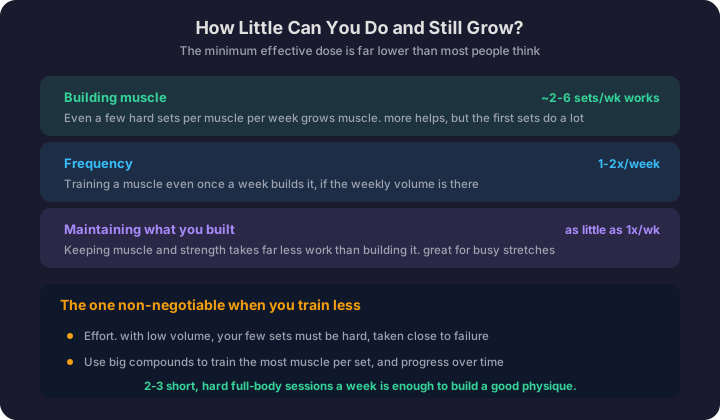
Even a single set works. A meta-analysis found that a single set per exercise builds muscle. Multiple sets build more (around 40% greater effect), but the first set delivers a large share of the benefit3. If you're short on time, one hard set per exercise is far from useless.
Once a week can be enough. When weekly volume is equated, training a muscle just once per week produces similar growth to training it two or three times45. Higher frequency helps mostly because it lets you fit in more total volume, but if your weekly volume is adequate, a single weekly session per muscle grows muscle.
Maintaining takes even less. Here's a gem for busy periods: preserving the muscle and strength you've already built requires far less work than building it. Research shows strength can be maintained with substantially reduced volume and frequency, as long as you keep the intensity high6. So during a hectic stretch, you can dial way back and keep your gains.
The One Thing You Can't Skimp On: Effort
Minimalism has a catch, and it's important. When you do fewer sets, each one has to count. The key stimulus that lets low volume work is effort: training close to failure. Research confirms that proximity to failure is a meaningful driver of muscle growth7, and this matters most precisely when your volume is low. You can't do two lazy sets and expect results; you need two hard sets.
So the minimalist trade is simple: fewer sets, but each one taken close to your limit, using big compound movements that train the most muscle per set.
It's Enough for Health, Too
If your goal is health rather than maximum muscle, the minimum is even more reassuring. A large meta-analysis found that muscle-strengthening activity of just 30 to 60 minutes per week, roughly one to two short sessions, was associated with a 10 to 20% lower risk of all-cause mortality and of diseases like heart disease, diabetes, and cancer8. A tiny dose of resistance training delivers an outsized health return.
A Minimalist Program That Works
Putting it together, here's how little you can get away with while still progressing:
- Train 2-3 times per week, full-body, 30-45 minutes per session.
- Use big compound lifts (squat, hinge, push, pull) to train the most muscle per exercise.
- Do 2-4 hard sets per movement, taken close to failure. Effort is non-negotiable when volume is low7.
- Progress over time by adding reps or weight (double progression makes this simple).
- During busy stretches, shift to maintenance. even one brief high-effort session a week preserves most of your gains6.
This is enough to build a genuinely good physique and strong body. It won't win you a bodybuilding show, but for the vast majority of people, it's the difference between real results and none.
The Bottom Line
- You don't need high volume to build muscle. meaningful growth happens at low doses12.
- A single set builds muscle; once-a-week training works if weekly volume is adequate34.
- Maintaining is far easier than building. you can hold your gains on minimal training6.
- Effort is the catch. with low volume, your few sets must be hard and near failure7.
- Even 30-60 minutes of lifting a week meaningfully improves health and longevity8.
The best program is the one you'll actually do. If two focused sessions a week is what fits your life, that's not a compromise. It's a legitimate, evidence-based path to a strong, muscular body. A smart coaching plan can build an efficient minimalist routine around your real schedule, so a busy life never has to mean no progress.
References
Footnotes
-
Schoenfeld BJ, Ogborn D, Krieger JW (2017). Dose-response relationship between weekly resistance training volume and increases in muscle mass: a systematic review and meta-analysis. Journal of Sports Sciences, 35(11), 1073-1082. https://doi.org/10.1080/02640414.2016.1210197
-
Fyfe JJ, Hamilton DL, Daly RM (2022). Minimal-dose resistance training for improving muscle mass, strength, and function: a narrative review of current evidence and practical considerations. Sports Medicine, 52(3), 463-479. https://doi.org/10.1007/s40279-021-01605-8
-
Krieger JW (2010). Single vs. multiple sets of resistance exercise for muscle hypertrophy: a meta-analysis. Journal of Strength and Conditioning Research, 24(4), 1150-1159. https://doi.org/10.1519/JSC.0b013e3181d4d436
-
Schoenfeld BJ, Grgic J, Krieger J (2019). How many times per week should a muscle be trained to maximize muscle hypertrophy? A systematic review and meta-analysis. Journal of Sports Sciences, 37(11), 1286-1295. https://doi.org/10.1080/02640414.2018.1555906
-
Schoenfeld BJ, Ogborn D, Krieger JW (2016). Effects of resistance training frequency on measures of muscle hypertrophy: a systematic review and meta-analysis. Sports Medicine, 46(11), 1689-1697. https://doi.org/10.1007/s40279-016-0543-8
-
Spiering BA, Mujika I, Sharp MA, Foulis SA (2021). Maintaining physical performance: the minimal dose of exercise needed to preserve endurance and strength over time. Journal of Strength and Conditioning Research, 35(5), 1449-1458. https://doi.org/10.1519/JSC.0000000000003964
-
Refalo MC, Helms ER, Trexler ET, Hamilton DL, Fyfe JJ (2023). Influence of resistance training proximity-to-failure on skeletal muscle hypertrophy: a systematic review with meta-analysis. Sports Medicine, 53(3), 649-665. https://doi.org/10.1007/s40279-022-01784-y
-
Momma H, Kawakami R, Honda T, Sawada SS (2022). Muscle-strengthening activities are associated with lower risk and mortality in major non-communicable diseases: a systematic review and meta-analysis of cohort studies. British Journal of Sports Medicine, 56(13), 755-763. https://doi.org/10.1136/bjsports-2021-105061
More field notes.

Online Fitness Coaching: Does Remote Coaching Actually Work?
Can a coach who isn't in the room really get you results? Here's what the research says about online coaching, in-person supervision, and why accountability matters more than location.

RPE and RIR: How to Gauge Training Effort Like a Coach
Percentages of your one-rep max look precise, but they ignore how you feel today. Here's how coaches use RPE and reps-in-reserve to autoregulate effort, and how to use them yourself.

Double Progression: The Simplest Way to Progress Your Lifts
Progressive overload is the rule that builds muscle, but 'add weight every session' falls apart fast. Double progression is the beginner-friendly method that makes steady progress almost automatic.
More on HyperBody