Body CompositionOct 29, 202610 min read
Lire en français·Auf Deutsch lesen·Leer en español·Przeczytaj po polsku
Skinny Fat: What It Is and How to Fix It
You're a 'normal' weight, but soft, undefined, and unhappy with the mirror. That's 'skinny fat,' and the way most people try to fix it makes it worse. Here's the approach that actually works.
Reviewed by the HyperBody team

You're not overweight. The scale says you're fine, your BMI is normal, and your friends would call you slim. But with your shirt off, the picture is different: soft, undefined, maybe a bit of belly and no real muscle to speak of. Welcome to the frustrating limbo of "skinny fat", and the reason your instinct to "just lose some weight" is exactly the wrong move.
Here's what skinny fat actually is, why it happens, and the counterintuitive fix that genuinely works.
What "Skinny Fat" Really Means
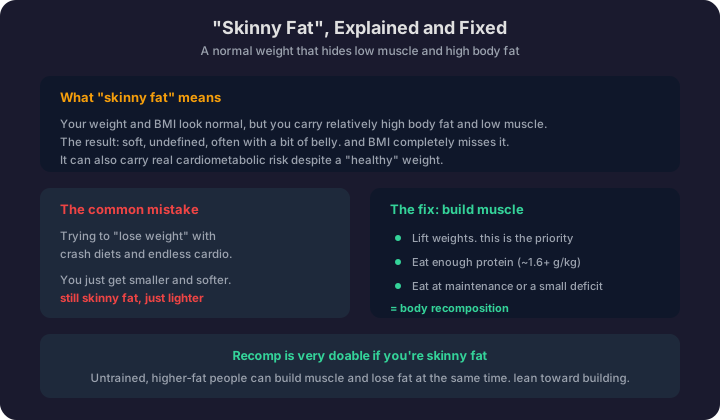
"Skinny fat" is the informal term for what researchers call normal weight obesity: having a normal body weight and BMI, but a high body fat percentage and low muscle mass1. You look thin in clothes because you're not heavy, but underneath, your body composition is closer to someone unfit than someone lean.
This is possible because. As we've covered before. BMI is a terrible measure of body composition. It's an indirect proxy that can't tell fat from muscle, and the relationship between BMI and actual body fat is loose and varies by sex2. So you can sit squarely in the "normal" BMI range while carrying too much fat and too little muscle.
And it's not just an aesthetic issue. Normal weight obesity carries real health consequences: research links it to a high prevalence of metabolic syndrome and, in women, to increased cardiovascular mortality1. The combination of low muscle and excess fat, sometimes called sarcopenic obesity, is a genuine "double metabolic burden" associated with higher risk of diabetes, heart disease, and functional decline3. So fixing skinny fat is about health, not just looks.
Why the Obvious Fix Backfires
Here's the trap. The natural reaction to feeling soft is to "lose weight": crash diet, cut calories hard, pile on the cardio. But think about what that does to a skinny-fat body. You already have low muscle. Aggressive dieting and endless cardio, without a strong muscle-building stimulus, strips away even more muscle along with some fat3.
The result? You get lighter, but you're still soft and undefined, just a smaller version. You've made the underlying problem, too little muscle, worse. This is why so many skinny-fat people diet down and still don't like what they see. They optimized the wrong variable.
The Real Fix: Build Muscle
The counterintuitive but correct solution is to shift your goal from "lose weight" to "build muscle and improve body composition." For a skinny-fat person, adding muscle is what fills out your frame, creates definition, and fixes the actual deficit3.
The great news is that your situation is ideal for body recomposition: building muscle and losing fat at the same time. Recomposition is well-documented, and it happens most readily in exactly your profile: untrained, returning, or over-fat individuals4. You have the most to gain.
A controlled trial makes the potential vivid. Men in a significant calorie deficit who did resistance and interval training with high protein gained about 1.2 kg of lean mass while losing nearly 5 kg of fat, in just four weeks5. That's the skinny-fat dream: less fat, more muscle, simultaneously.
Your Skinny-Fat Game Plan
The recipe is clear and evidence-based:
- Lift weights: this is the priority. Progressive resistance training is the non-negotiable stimulus that builds the muscle you're missing4. Not cardio, not dieting, lifting.
- Eat enough protein. Aim for at least 1.6 grams per kilogram of bodyweight (up to ~2.2 g/kg is fine), spread across your meals: this is what fuels muscle gain and protects muscle in a deficit567.
- Set calories near maintenance, or a slight deficit. You don't need an aggressive cut. Eating around maintenance (or a small deficit) with high protein and hard training is the classic recomposition setup7.
- Be patient and prioritize building. Since low muscle is the core problem, lean toward building. The definition you want comes from having muscle to reveal, not just from being lighter34.
- Track the right things. Ditch the scale as your main metric. Use waist-to-height ratio (keep your waist under half your height) as a better health gauge8, and judge progress by the mirror, photos, and how your clothes fit.
The Bottom Line
- Skinny fat = normal weight, high body fat, low muscle. and BMI hides it12.
- It carries real health risk, not just an aesthetic one13.
- Don't just "lose weight". crash dieting makes the muscle deficit worse3.
- Build muscle instead. lift, eat enough protein, and aim for recomposition45.
- Judge progress by composition and the mirror, not the scale8.
If you're skinny fat, the path forward is genuinely exciting, because you have so much room to transform. Stop trying to shrink, and start trying to build. A smart coaching plan built around resistance training, plus a periodic physique analysis to track your changing body composition, is exactly the toolkit for turning skinny fat into lean and strong.
References
Footnotes
-
Romero-Corral A, Somers VK, Sierra-Johnson J, et al. (2010). Normal weight obesity: a risk factor for cardiometabolic dysregulation and cardiovascular mortality. European Heart Journal, 31(6), 737-746. https://doi.org/10.1093/eurheartj/ehp487
-
Rothman KJ (2008). BMI-related errors in the measurement of obesity. International Journal of Obesity, 32(Suppl 3), S56-S59. https://doi.org/10.1038/ijo.2008.87
-
Roh E, Choi KM (2020). Health consequences of sarcopenic obesity: a narrative review. Frontiers in Endocrinology, 11, 332. https://doi.org/10.3389/fendo.2020.00332
-
Barakat C, Pearson J, Escalante G, Campbell B, De Souza EO (2020). Body recomposition: can trained individuals build muscle and lose fat at the same time? Strength and Conditioning Journal, 42(5), 7-21. https://doi.org/10.1519/SSC.0000000000000584
-
Longland TM, Oikawa SY, Mitchell CJ, Devries MC, Phillips SM (2016). Higher compared with lower dietary protein during an energy deficit combined with intense exercise promotes greater lean mass gain and fat mass loss: a randomized trial. The American Journal of Clinical Nutrition, 103(3), 738-746. https://doi.org/10.3945/ajcn.115.119339
-
Morton RW, Murphy KT, McKellar SR, et al. (2018). A systematic review, meta-analysis and meta-regression of the effect of protein supplementation on resistance training-induced gains in muscle mass and strength in healthy adults. British Journal of Sports Medicine, 52(6), 376-384. https://doi.org/10.1136/bjsports-2017-097608
-
Iraki J, Fitschen P, Espinar S, Helms E (2019). Nutrition recommendations for bodybuilders in the off-season: a narrative review. Sports, 7(7), 154. https://doi.org/10.3390/sports7070154
-
Ashwell M, Gunn P, Gibson S (2012). Waist-to-height ratio is a better screening tool than waist circumference and BMI for adult cardiometabolic risk factors: systematic review and meta-analysis. Obesity Reviews, 13(3), 275-286. https://doi.org/10.1111/j.1467-789X.2011.00952.x
More field notes.

Body Types Explained: Ectomorph, Mesomorph, Endomorph. What the Science Says
You've been told you have a body type that dictates how you should train and eat. The truth is more useful: your type describes your starting point, not your ceiling. Here's what the research actually shows.

Water Weight: Why the Scale Fluctuates (and When Not to Worry)
You did everything right, and the scale jumped 1.5 kg overnight. Before you panic, understand this: day-to-day weight swings are almost entirely water and food, not fat. Here's the science.

What Is a Physique Rating? Body Types, Scores, and How AI Does It
What a physique rating is, from the 9 body types on a body composition scale to AI photo ratings: what the scores measure, how they compare with DEXA and smart scales, and how to turn a rating into training priorities.
More on HyperBody