TrainingJul 27, 202610 min read
Lire en français·Auf Deutsch lesen·Leer en español·Przeczytaj po polsku
Exercise and Mental Health: How Training Changes Your Brain
The physical benefits of training get all the attention, but the mental ones may matter more. Here's the evidence for how exercise fights depression and anxiety, and literally reshapes your brain.
Reviewed by the HyperBody team

Most people start training to change how they look. Many of them keep training because of how it makes them feel. That isn't a vague, feel-good notion. It's one of the best-evidenced findings in all of exercise science. Physical activity measurably improves mental health, and it does so by changing the structure and chemistry of your brain.
If you've ever finished a hard session feeling clearer, calmer, and more capable than when you started, this is the biology behind it.
Exercise Fights Depression
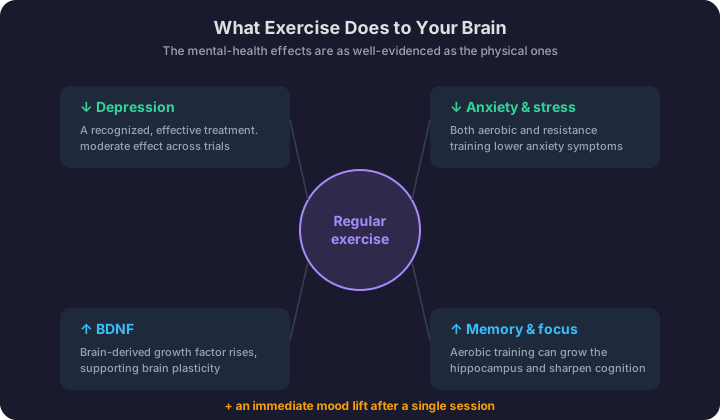
The evidence that exercise helps with depression is strong enough that it's treated as a genuine intervention, not just a nice add-on. A meta-analysis that specifically corrected for publication bias found exercise to be an effective treatment for depression, and notably, adjusting for that bias made the effect look larger, not smaller1.
This isn't limited to cardio. A meta-analysis of randomized trials in JAMA Psychiatry found that resistance training, lifting weights, significantly reduces depressive symptoms. Strikingly, the antidepressant effect held regardless of how healthy people were at baseline, how much training was prescribed, or even whether they got measurably stronger2. The act of training itself seems to be the medicine.
The broadest look confirms it. An umbrella review across 97 systematic reviews concluded that physical activity has medium-sized effects on reducing depression, anxiety, and psychological distress, and was often comparable to or better than usual care3.
Exercise Calms Anxiety
Anxiety responds too. A meta-analysis focused on people with diagnosed anxiety and stress-related disorders found that exercise produced a moderate, significant reduction in anxiety symptoms compared to control conditions4. Both aerobic work and resistance training show this calming effect, which is why "go for a walk" or "hit the gym" is advice that actually has teeth when you're wound up.
It Literally Reshapes Your Brain
Here's where it gets remarkable. Exercise doesn't just shift your mood in the moment. It changes your brain's physical structure.
In a landmark randomized controlled trial, one year of aerobic exercise increased the size of the hippocampus, the brain region central to memory, by about 2% in older adults, effectively reversing one to two years of age-related shrinkage. That growth came with measurable improvements in spatial memory5. Your brain, like your muscles, adapts to training.
A big part of the mechanism is a molecule called BDNF (brain-derived neurotrophic factor), which supports the growth, survival, and connection of neurons. A meta-analytic review found that exercise reliably raises BDNF, with the most robust effect being the spike right after a session6. More BDNF means a brain that's better at rewiring and repairing itself.
And it shows up in performance: across randomized trials, aerobic exercise produces modest but genuine improvements in executive function, attention, processing speed, and memory7. The "gym clears my head" effect is real and measurable.
The Truth About the "Runner's High"
One quick myth to correct, because it's everywhere. The pleasant, calm, slightly euphoric feeling after intense exercise, the "runner's high", is usually blamed on endorphins. The actual science points elsewhere: research found that the runner's high, its reduced anxiety and dampened pain, depends on the endocannabinoid system and cannabinoid receptors, not opioid (endorphin) receptors8. Your body is producing its own cannabis-like molecules, not just painkillers. Either way, the mood lift after a single session is real, and it's one of the fastest-acting benefits of training8.
How to Use This
You don't need to train like an athlete to get the mental-health payoff. The research points to a few practical takeaways:
- Consistency beats intensity. The mood and brain benefits come from regular activity over time, not heroic single efforts3.
- Both cardio and weights work. Resistance training fights depression2; aerobic training grows the hippocampus and sharpens cognition57. A mix covers all bases.
- Even one session helps. If you're feeling low or anxious today, a single bout of exercise can lift your mood right now8. Don't wait to "feel motivated" first.
- Count it as mental-health care. Framing your training as something you do for your mind, not just your body, is both accurate and, for many people, more motivating.
The physique is the visible result of training. The clearer, calmer, more resilient mind is the one you carry with you all day. If a better body is what gets you to the gym, let the better brain be what keeps you coming back. A structured plan like smart coaching makes the consistency, the part that actually delivers these benefits, far easier to sustain.
References
Footnotes
-
Schuch FB, Vancampfort D, Richards J, Rosenbaum S, Ward PB, Stubbs B (2016). Exercise as a treatment for depression: a meta-analysis adjusting for publication bias. Journal of Psychiatric Research, 77, 42-51. https://doi.org/10.1016/j.jpsychires.2016.02.023
-
Gordon BR, McDowell CP, Hallgren M, Meyer JD, Lyons M, Herring MP (2018). Association of efficacy of resistance exercise training with depressive symptoms: meta-analysis and meta-regression analysis of randomized clinical trials. JAMA Psychiatry, 75(6), 566-576. https://doi.org/10.1001/jamapsychiatry.2018.0572
-
Singh B, Olds T, Curtis R, et al. (2023). Effectiveness of physical activity interventions for improving depression, anxiety and distress: an overview of systematic reviews. British Journal of Sports Medicine, 57(18), 1203-1209. https://doi.org/10.1136/bjsports-2022-106195
-
Stubbs B, Vancampfort D, Rosenbaum S, et al. (2017). An examination of the anxiolytic effects of exercise for people with anxiety and stress-related disorders: a meta-analysis. Psychiatry Research, 249, 102-108. https://doi.org/10.1016/j.psychres.2016.12.020
-
Erickson KI, Voss MW, Prakash RS, et al. (2011). Exercise training increases size of hippocampus and improves memory. Proceedings of the National Academy of Sciences, 108(7), 3017-3022. https://doi.org/10.1073/pnas.1015950108
-
Szuhany KL, Bugatti M, Otto MW (2015). A meta-analytic review of the effects of exercise on brain-derived neurotrophic factor. Journal of Psychiatric Research, 60, 56-64. https://doi.org/10.1016/j.jpsychires.2014.10.003
-
Smith PJ, Blumenthal JA, Hoffman BM, et al. (2010). Aerobic exercise and neurocognitive performance: a meta-analytic review of randomized controlled trials. Psychosomatic Medicine, 72(3), 239-252. https://doi.org/10.1097/PSY.0b013e3181d14633
-
Fuss J, Steinle J, Bindila L, et al. (2015). A runner's high depends on cannabinoid receptors in mice. Proceedings of the National Academy of Sciences, 112(42), 13105-13108. https://doi.org/10.1073/pnas.1514996112
More field notes.

Workout Splits Explained: How to Structure Your Training Week
Full body, upper/lower, push-pull-legs, the bro split. Everyone argues about which is best. The research says you're asking the wrong question. Here's how to actually choose.

Compound vs Isolation Exercises: Which Should You Prioritize?
Should you build your workouts around big lifts like squats and rows, or chase the pump with curls and extensions? The research gives a clear, nuanced answer: use both, in the right order.

Free Weights vs Machines: Which Is Better for Muscle?
The barbell purists say machines are a waste of time. The machine crowd says free weights are just risky. The research settles it: for building muscle, they're about equal. What differs is everything else.
More on HyperBody