NutritionOct 11, 20269 min read
Lire en français·Auf Deutsch lesen·Leer en español·Przeczytaj po polsku
Maintenance Calories: How to Find Yours and Why They Matter
Every bulk, cut, and recomp is built on one number: the calories that hold your weight steady. Here is what maintenance actually is, why calculators only get you close, and the two-week method that finds your real number.
Reviewed by the HyperBody team

Almost every nutrition decision in fitness is built on a single number: your maintenance calories, the daily intake at which your body weight holds steady. Want to lose fat? Eat below it. Want to build muscle? Eat slightly above it. Want to hold a physique you are happy with? Eat at it.
Which makes it strange how few lifters actually know theirs. Most people either guess, or punch their stats into an online calculator and treat the output as truth. The first approach fails for obvious reasons. The second fails for a subtler one: calculators estimate the average person with your stats, and you are not the average person with your stats.
This article explains what maintenance calories actually are, why every calculator is only a starting point, and the simple two-to-three-week method that finds your real number with nothing but a food log and a bathroom scale.
What Maintenance Calories Actually Are
Your maintenance intake equals your total daily energy expenditure, usually shortened to TDEE: every calorie your body burns in a day. It has four components, and knowing them explains most of the surprises ahead.
Basal metabolic rate (BMR) is what your body burns just staying alive: heart, brain, liver, temperature regulation. For most people it is the largest share of the day's burn, roughly 60 to 70 percent.
Exercise activity is deliberate training: your lifting sessions, your runs. Most people dramatically overestimate this slice. A hard hour in the gym typically burns a few hundred calories, not the four-digit numbers fitness watches like to flash.
NEAT, non-exercise activity thermogenesis, is everything else you do with your body: walking, fidgeting, taking stairs, standing while you work. It is the most variable component between people and can differ by hundreds of calories per day between an active job and a desk job1.
The thermic effect of food (TEF) is the energy cost of digesting what you eat, around 10 percent of intake on a mixed diet, somewhat higher for protein.
Add the four together and you have your TDEE. Eat that amount and your weight trends flat. The catch is that none of the four components can be measured directly outside a lab, which brings us to calculators.
Why Calculators Are Only a Starting Point
Online TDEE calculators run a prediction equation, commonly the Mifflin-St Jeor equation, which estimates resting energy expenditure from your sex, age, height, and weight2, then multiply it by an activity factor you pick from a menu.
These equations are genuinely useful, and Mifflin-St Jeor performs respectably across populations. But they predict the average for people with your stats, and individuals scatter around that average: more or less muscle mass, different NEAT habits, different hormonal context. For a meaningful fraction of people, the estimate misses true resting expenditure by 10 percent or more in either direction. Then the activity multiplier, which you chose by gut feeling from descriptions like "moderately active", stacks its own error on top. Two honest people with identical lives will pick different multipliers and land 300 calories apart.
The result: a calculator gets most people within a few hundred calories of the truth. That is a fine launch point and a poor finish line, because a few hundred calories is the entire difference between a productive cut and an accidental bulk.
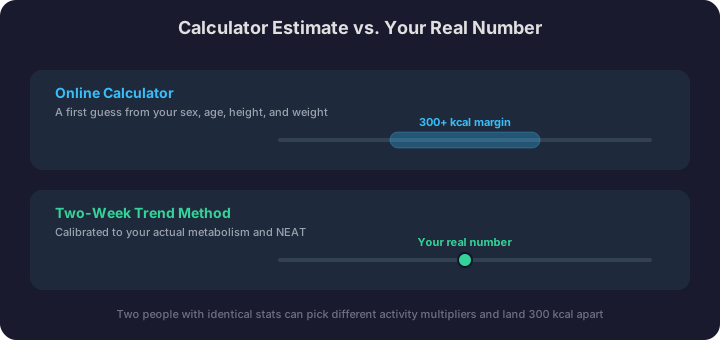
So use the calculator for what it is good at: the first guess. Then let your own body correct it.
The Method That Actually Works
Your body runs the only perfectly personalized TDEE experiment available: weight change over time at a known intake. The protocol is simple.
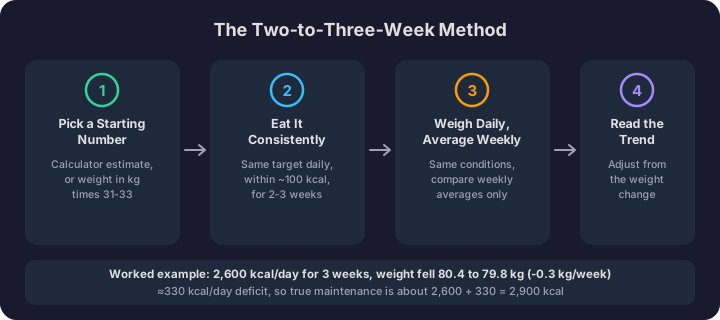
Step 1: pick a starting number. Take a calculator estimate, or simply multiply your body weight in kilograms by 31 to 33 for a rough middle-of-road figure. Precision does not matter yet.
Step 2: eat that number consistently for two to three weeks. Track your food honestly, weigh and log what you can, and hit the same daily target within about 100 calories, weekends included. Consistency is the entire experiment; a wildly varying intake produces uninterpretable results.
Step 3: weigh yourself every morning, then average by week. Same conditions every time: after the bathroom, before food or water, minimal clothing. Daily readings will bounce around with water, sodium, carbs, and digestive contents; that noise is normal and meaningless. The weekly average filters it out, which is why you compare weekly averages, never individual days.
Step 4: read the trend and adjust. Here is a worked example. Suppose you ate 2,600 calories a day for three weeks, and your weekly average weight went from 80.4 to 80.1 to 79.8 kilograms. You lost about 0.3 kilograms per week. A kilogram of body tissue represents very roughly 7,700 calories, so 0.3 kilograms per week is a daily deficit of about 330 calories. Your maintenance is therefore approximately 2,600 plus 330: call it 2,900 calories. If your average weight had climbed by the same amount instead, you would subtract: maintenance near 2,270. If weight held flat, congratulations, 2,600 is your number.
Skip the first few days of any new intake when reading the trend; switching intakes shifts water and gut content, and that initial jump or drop is not tissue.
That is the whole method. Two to three weeks of consistency buys you a number no calculator can give you, calibrated to your actual metabolism, your actual NEAT, and your actual logging habits.
Why Maintenance Matters So Much
Knowing your maintenance is not nutrition trivia. It is the anchor for every phase you will ever run.
Cuts and bulks become deliberate. A cut is maintenance minus 300 to 500. A lean bulk is maintenance plus 200 to 400. Without the anchor, those phases are guesses; people routinely "bulk" below maintenance and "cut" above it, then blame their genetics for the lack of results.
Diet breaks have a target. Spending a week or two at maintenance during a long cut gives you a psychological and practical reset. That only works if you know what maintenance is; otherwise the diet break becomes an unstructured drift upward.
Reverse dieting, honestly stated. After a long cut, gradually raising calories back toward maintenance is a sensible way to exit the diet without rebounding. The honest version: there is no strong evidence that creeping calories up slowly rebuilds your metabolism beyond what regaining tissue and moving more already do. Reverse dieting is best understood as a controlled, psychologically manageable return to maintenance, not a metabolic magic trick. Useful, yes. Magic, no.
Your Maintenance Is a Moving Target
One warning before you carve your number in stone: it will not stay still.
Maintenance changes when your weight changes, because a smaller body burns less and a bigger one burns more. It also changes when your behavior changes, and the sneakiest version of this happens during a cut: as the deficit bites, NEAT quietly drops. You fidget less, sit more, take the elevator, and your daily burn can fall by hundreds of calories without a single conscious decision. The deficit you set on paper shrinks in reality, progress stalls, and it looks like your metabolism broke. It did not; your movement budget did. We cover that adaptation, and how to manage it, in what happens when you cut calories too fast.
The practical consequence: re-run the two-week assessment every couple of months, or whenever your weight has moved by several kilograms. Maintenance is a number you maintain.
Making the Target Easier to Hit
Finding your number is the analytical half. Hitting it daily is the behavioral half, and it is where most plans actually fail, usually at 9 p.m. in front of an open fridge.
The single biggest lever is removing daily decisions. A rotation of meals you already know the calories for turns tracking from arithmetic into checkboxes. This is exactly what HyperBody's recipes are built for: meals generated to fit your calorie and macro targets, so a day that hits your number is assembled from parts that already add up, instead of reverse-engineered at midnight. However you implement it, the principle stands: the fewer real-time food decisions you make, the more consistent your intake, and consistency is what makes your maintenance number readable in the first place.
Common Mistakes
Changing the target every week. The method needs two to three weeks at one intake to produce a readable trend. People who adjust calories every four days based on the morning's weigh-in are steering by noise and will never get a clean signal.
Trusting a single weigh-in. One morning's weight is water, sodium, and yesterday's dinner wearing a number. Only weekly averages mean anything. A Thursday spike after a salty restaurant meal is not fat gain, and treating it as one leads to panic cuts that ruin the experiment.
Forgetting tracking error. Food logging is imprecise even when honest: oils, sauces, restaurant portions, and label rounding add up, and most people under-log. This is fine, as long as your error is consistent, because the method calibrates around it. Your measured "2,600" might truly be 2,850, but if you log the same way every day, the trend still tells you exactly how to adjust. The number you find is your number in your logging system, which is the only place you will ever use it.
Treating the calculator as the verdict. The estimate starts the process. Your scale trend finishes it. When the two disagree, the scale is right.
The Bottom Line
Maintenance calories are the foundation under every bulk, cut, recomp, and diet break, and finding yours takes two to three weeks, not a lab. Use a calculator for the first guess. Eat that number consistently, weigh every morning, average weekly, and let the trend correct the estimate: roughly 7,700 calories per kilogram of weekly change tells you how far off you were. Expect the number to drift as your weight and activity change, especially during a cut, and re-test every couple of months. Then make the target hittable with meals whose numbers you already know. None of this is glamorous. All of it is the difference between running your nutrition and guessing at it.
References
Footnotes
-
Levine JA (2002). Non-exercise activity thermogenesis (NEAT). Best Practice & Research Clinical Endocrinology & Metabolism, 16(4), 679-702. https://doi.org/10.1053/beem.2002.0227
-
Mifflin MD et al. (1990). A new predictive equation for resting energy expenditure in healthy individuals. American Journal of Clinical Nutrition, 51(2), 241-247. https://doi.org/10.1093/ajcn/51.2.241
More field notes.

Protein Timing: Does the Anabolic Window Really Matter?
You've been told to slam a shake within 30 minutes of training or lose your gains. The research tells a much more relaxed story. Here's what actually matters about when you eat protein.

Nutrition for Body Recomposition: A Practical Guide
Training builds the stimulus. Nutrition builds the body. Learn how to dial in your nutrition to support fat loss, muscle gain, and long-term body recomposition.

Why Cutting Calories Too Fast Destroys Your Metabolism
Aggressive dieting slows your metabolism more than you think. Learn why crash cuts backfire, how metabolic adaptation works, and the sustainable approach that actually keeps the weight off.
More on HyperBody