NutritionAug 27, 202610 min read
Lire en français·Auf Deutsch lesen·Leer en español·Przeczytaj po polsku
Caffeine and Exercise Performance: What the Science Says
Your pre-workout coffee isn't just a habit. It's one of the most well-researched, reliably effective performance aids there is. Here's how caffeine works, how much to take, and when.
Reviewed by the HyperBody team

Caffeine is the most widely used performance enhancer on earth, and unlike most things in the supplement aisle, it actually works. The evidence behind it is genuinely deep: dozens of meta-analyses, an official position stand, decades of research. This is one case where the popular habit and the science line up. Here's what caffeine does for your training, and how to use it well.
It Works, and the Evidence Is Deep
The strongest way to summarize caffeine's benefits is to zoom all the way out. An umbrella review, a study of studies, examined 21 separate meta-analyses and concluded that caffeine improves performance across muscular endurance, strength, anaerobic power, and aerobic endurance1. When 21 meta-analyses point the same direction, you can be confident the effect is real.
Breaking it down:
- Endurance: A meta-analysis of 46 studies found caffeine produces a small but consistent improvement in endurance and time-trial performance2. The aerobic benefit is the most robust of all1.
- Strength and power: A meta-analysis found caffeine significantly increases muscular strength and power3, and separate work shows it boosts anaerobic (sprint-style) power output4.
The effects aren't enormous, but they're reliable, and in training or competition, a small reliable edge is exactly what you want.
How Much, and When
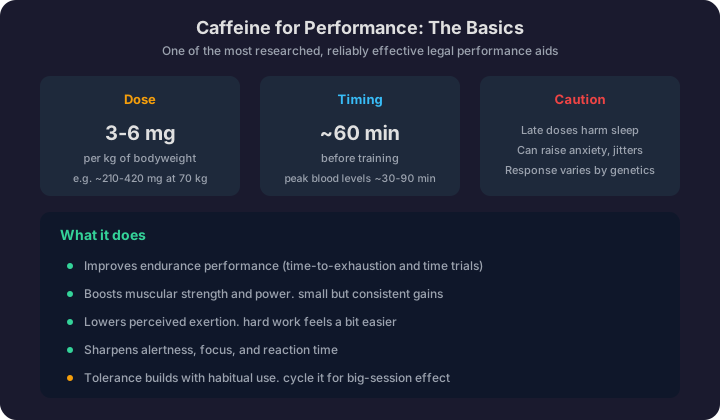
The research converges on clear, practical guidelines. The International Society of Sports Nutrition's position stand recommends a dose of 3 to 6 milligrams per kilogram of bodyweight, most commonly taken about 60 minutes before exercise5.
For a 70 kg person, that's roughly 210 to 420 mg, equivalent to something like two to four cups of coffee, or a standard pre-workout serving. The 60-minute window lines up with when blood caffeine levels peak, though faster-absorbing forms like caffeinated gum or gels act more quickly5. There's rarely a reason to exceed 6 mg/kg; more caffeine mostly means more side effects, not more performance.
Why It Works: Less Pain, More Push
Part of caffeine's magic is that it makes hard work feel easier. A meta-analysis found that caffeine reduces your rating of perceived exertion during exercise by around 5 to 6%6. The same effort registers as less taxing, so you can push a little harder or longer before your brain says stop. Combined with its well-known boost to alertness, focus, and reaction time, caffeine is working on your nervous system as much as your muscles.
The Honest Caveats
Good performance advice includes the limitations, and caffeine has a few worth knowing.
Your genes matter. People respond differently, and a chunk of that is genetic. Research on the CYP1A2 gene, which governs how fast you metabolize caffeine, found that the ergogenic effect varies by genotype: some people benefit clearly, while certain "slow metabolizer" genotypes saw impaired endurance performance at higher doses7. The ISSN stand explicitly attributes individual variability to these metabolic genetic differences5. If caffeine makes you feel worse or doesn't help, that may simply be your biology.
Tolerance builds. Regular heavy caffeine use blunts the effect over time. Many athletes cycle their intake. Keeping daily use modest so a targeted dose before a big session lands harder.
Mind the dose and the clock. A systematic review found that up to about 400 mg per day is not associated with adverse effects in healthy adults, but beyond that, or taken too late in the day, caffeine can trigger anxiety, jitters, and disrupted sleep8. And since sleep is one of your most important recovery tools, a late-afternoon pre-workout can quietly cost you more than it gives.
The research skews narrow. Most caffeine studies were done in young men, so the findings generalize less cleanly to women and older adults1.
Practical Takeaways
- Caffeine reliably improves endurance, strength, and power. it's one of the few supplements that genuinely earns its reputation231.
- Aim for 3-6 mg/kg, about an hour before training5.
- It works partly by making effort feel easier, letting you push harder6.
- Respond to your own body. genetics mean it helps some people more than others57.
- Keep total intake under ~400 mg/day and avoid late doses to protect your sleep8.
Your morning coffee before a workout isn't a guilty pleasure. It's an evidence-based edge. Used thoughtfully, caffeine is a simple, cheap, and legal way to get more out of the training you're already doing, and the training itself, guided by smart coaching, is still what drives the results.
References
Footnotes
-
Grgic J, Grgic I, Pickering C, Schoenfeld BJ, Bishop DJ, Pedisic Z (2020). Wake up and smell the coffee: caffeine supplementation and exercise performance. An umbrella review of 21 published meta-analyses. British Journal of Sports Medicine, 54(11), 681-688. https://doi.org/10.1136/bjsports-2018-100278
-
Southward K, Rutherfurd-Markwick KJ, Ali A (2018). The effect of acute caffeine ingestion on endurance performance: a systematic review and meta-analysis. Sports Medicine, 48(8), 1913-1928. https://doi.org/10.1007/s40279-018-0939-8
-
Grgic J, Trexler ET, Lazinica B, Pedisic Z (2018). Effects of caffeine intake on muscle strength and power: a systematic review and meta-analysis. Journal of the International Society of Sports Nutrition, 15, 11. https://doi.org/10.1186/s12970-018-0216-0
-
Grgic J (2018). Caffeine ingestion enhances Wingate performance: a meta-analysis. European Journal of Sport Science, 18(2), 219-225. https://doi.org/10.1080/17461391.2017.1394371
-
Guest NS, VanDusseldorp TA, Nelson MT, et al. (2021). International Society of Sports Nutrition position stand: caffeine and exercise performance. Journal of the International Society of Sports Nutrition, 18(1), 1. https://doi.org/10.1186/s12970-020-00383-4
-
Doherty M, Smith PM (2005). Effects of caffeine ingestion on rating of perceived exertion during and after exercise: a meta-analysis. Scandinavian Journal of Medicine & Science in Sports, 15(2), 69-78. https://doi.org/10.1111/j.1600-0838.2005.00445.x
-
Guest N, Corey P, Vescovi J, El-Sohemy A (2018). Caffeine, CYP1A2 genotype, and endurance performance in athletes. Medicine & Science in Sports & Exercise, 50(8), 1570-1578. https://doi.org/10.1249/MSS.0000000000001596
-
Wikoff D, Welsh BT, Henderson R, et al. (2017). Systematic review of the potential adverse effects of caffeine consumption in healthy adults, pregnant women, adolescents, and children. Food and Chemical Toxicology, 109(Pt 1), 585-648. https://doi.org/10.1016/j.fct.2017.04.002
More field notes.

Creatine: The Most Researched Supplement in Fitness
With hundreds of studies backing it, creatine is the gold standard of sports supplements. Here's everything you need to know. What it does, how to use it, and what it won't do.

Nutrition for Body Recomposition: A Practical Guide
Training builds the stimulus. Nutrition builds the body. Learn how to dial in your nutrition to support fat loss, muscle gain, and long-term body recomposition.

Why Cutting Calories Too Fast Destroys Your Metabolism
Aggressive dieting slows your metabolism more than you think. Learn why crash cuts backfire, how metabolic adaptation works, and the sustainable approach that actually keeps the weight off.
More on HyperBody