EducationJul 5, 20269 min read
Lire en français·Auf Deutsch lesen·Leer en español·Przeczytaj po polsku
How Much Does a Personal Trainer Cost in 2026? (And What AI Coaching Covers Instead)
Personal training runs 40 to 120 dollars per session in most US cities. Here's what that buys you, what it doesn't, and which parts AI coaching now covers for a fraction of the price.
Reviewed by the HyperBody team

Start with the math most people never do. Training with a personal trainer twice a week at 60 dollars per session comes to roughly 480 dollars a month, which is well over 5,000 dollars a year. That's a car payment. For many people it's the single largest line item in their fitness budget, bigger than the gym membership, the supplements, and the gear combined.
And yet the question "is a personal trainer worth it" almost never gets answered honestly, because it's the wrong question. A trainer isn't one product. It's a bundle: programming, form correction, accountability, assessment, motivation, and a standing appointment, all wrapped into one hourly rate. Some of those components are genuinely hard to replace. Others have become commodities. When you ask whether a trainer is worth 480 dollars a month, what you're really asking is which parts of that bundle you're actually paying for, and whether each part still needs to come from a human standing next to you.
That's the question this article answers. We'll lay out what training actually costs in 2026, what a great trainer provides, which of those functions AI coaching now covers, which it doesn't, and how to combine the two if you want most of the value at a fraction of the cost.
What Personal Training Costs in 2026
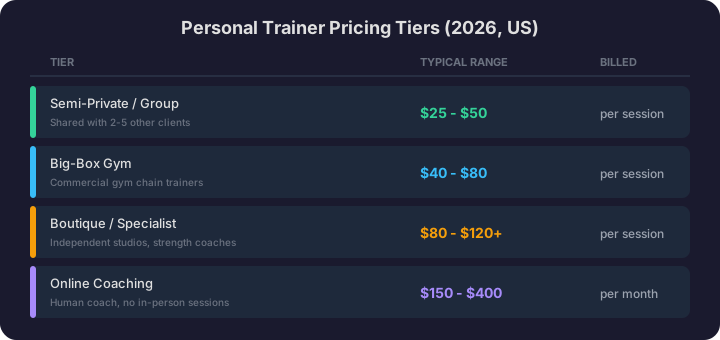
Personal training prices vary enormously by city, by gym, and by the trainer's experience, so treat everything below as typical US ranges rather than fixed quotes. A trainer in Manhattan or San Francisco will sit at or above the top of each range; a trainer in a smaller market will often sit below it.
Big-box gym trainers typically run 40 to 80 dollars per session. These are the trainers employed by large commercial gym chains. You're usually buying sessions in packs, the trainer is often early in their career, and a meaningful slice of your payment goes to the gym rather than the person coaching you. Quality varies widely: some big-box trainers are excellent and underpriced, others are working through a sales quota.
Boutique and specialist coaches commonly charge 80 to 120 dollars per session, and established names in major cities go well beyond that. This tier includes independent trainers with their own studios, strength coaches with competitive backgrounds, and specialists in things like powerlifting technique or post-rehab training. You're paying for experience and focus, and at this tier you usually get it.
Online coaching subscriptions with a human coach commonly run 150 to 400 dollars per month. You get a program, weekly or biweekly check-ins, and feedback on videos you send, but no in-person sessions. This model trades hands-on coaching for ongoing oversight at a lower monthly cost than twice-weekly in-person work.
Semi-private and small group training is the budget middle ground, typically 25 to 50 dollars per session. You share the trainer with two to five other people, which means less individual attention but a real coach watching your lifts at a price closer to a group class.
Whichever format you pick, the annual numbers add up fast. Even the cheapest option above, used twice a week, costs more per year than most people spend on every other part of their training combined.
What a Great Trainer Actually Provides
Before comparing anything to AI, it's worth being honest about what a genuinely good trainer delivers, because the bundle is more valuable than its reputation suggests.
Programming. A good trainer writes a plan that fits your goal, your schedule, your equipment, and your injury history, then progresses it over time. You never have to think about what to do on Tuesday; the thinking has been done for you, by someone who knows what week six should look like based on what happened in week five.
Real-time form correction. This is the most visible part of the job. A trainer watches every rep as it happens and intervenes immediately: a cue before the next rep, a hand on your upper back to fix your row, a "stop" when your deadlift starts rounding. You don't finish a bad set and find out later. The error gets caught mid-set, which is when it's cheapest to fix.
Autoregulation. Great trainers adjust the session to the person who actually showed up, not the person on the spreadsheet. Slept four hours? The top sets get lighter. Moving unusually well? Today's the day to push. This moment-to-moment calibration is subtle, it rarely shows up in the marketing, and it's one of the most genuinely skilled parts of the craft.
Accountability. An appointment with a human who is standing in the gym waiting for you is a powerful forcing function. Canceling on an app costs nothing. Canceling on a person costs an awkward text message and, usually, the session fee. For a lot of clients, this alone justifies the price: the trainer's real product is the fact that you showed up 100 times this year instead of 40.
The relationship. Over months, a trainer learns your tendencies, your stress patterns, your tells. They notice you're grinding reps you'd normally fly through and ask what's going on. That relationship has real value that doesn't reduce to any feature list.
If you can comfortably afford all of that and you enjoy it, this article won't talk you out of it. The interesting question is what happens when you price each component separately.
What AI Coaching Covers Today
Over the past few years, AI coaching platforms have absorbed a surprising share of that bundle. Here's the honest mapping, function by function, using HyperBody as the concrete example since it's the platform we build.
Assessment. A trainer assesses you visually in the first session: posture, proportions, obvious weak points, a rough read on body composition. An AI physique analysis does the same job from five standardized photos, returning a body fat estimate, muscle-by-muscle development scores, and a list of lagging areas. The photo-based version is arguably more repeatable, because the poses and conditions are standardized every time, and it produces a written record you can compare month over month instead of a trainer's mental note.
Programming. This is the function AI covers most completely. HyperBody generates adaptive training plans that run four to twenty weeks and are built from your assessment, so a lagging back actually gets more pulling volume instead of a generic split. As you log sets, reps, and RPE, the plan rebuilds itself around your actual performance: weights progress when you're moving well and back off when you're not. That's a meaningful share of what autoregulation does, delivered through your logged data rather than a coach's eye.
Form correction. AI covers this asynchronously rather than in real time. You record a set, upload it, and get rep-by-rep feedback: depth, bar path, joint angles, where rep four broke down compared to rep one. HyperBody's video form check covers fifteen common exercises this way. The feedback arrives after the set instead of during it, which matters for some things and not for others. For learning a movement pattern over weeks, reviewing your own footage with specific notes is effective. For catching a breakdown mid-set, it isn't, and we'll get to that below.
Nutrition direction. Most trainers give nutrition guidance in the margins of sessions: a calorie target, a protein goal, some habits. AI coaching does the same job systematically, setting macro targets matched to your goal and generating recipes that fit them, so a cut and a lean bulk don't get the same numbers.
The price difference for this stack is not subtle. AI coaching platforms typically cost about as much per month as a single session with a mid-range trainer. If the components above are the parts of the bundle you were paying for, the math gets hard to ignore. We've covered how these platforms compare with single-purpose apps in our guide to choosing an AI fitness app, but the short version is that the value comes from the components feeding each other: assessment shapes programming, logged performance reshapes the program, and form checks verify the execution.
What AI Does Not Replace
Now the honest part, because the comparison is useless without it.
A spotter's hands. No app spots a heavy bench press. If you train near failure on barbell lifts without a training partner, a trainer (or at minimum a gym with good safety equipment and a culture of asking for spots) provides something software cannot, full stop.
In-the-moment cueing. Asynchronous form feedback teaches you between sessions. It does not stop rep five from going wrong while it's happening. A trainer's mid-set cue can prevent a bad rep in real time; a video analysis can only explain it afterward. For experienced lifters this gap is small. For true beginners learning a hinge pattern from zero, real-time correction compresses the learning curve in a way replays don't fully match.
The motivational pull of a person. An appointment with a human who will notice your absence is a different psychological contract than a notification. Some people genuinely don't need this. Many people think they don't need it and discover otherwise around week three. If your training history is a string of strong starts and quiet fades, the accountability of a person waiting for you at 6 a.m. may be the single most valuable thing a trainer sells, and AI does not sell it.
Judgment around pain and injury. AI coaching adjusts to your logged performance, but it cannot palpate a shoulder, screen a movement in person, or make the call between "muscle soreness, keep going" and "stop and get this looked at." If something hurts in a way that worries you, that's a question for a qualified professional: a physician or a physical therapist, not an app and honestly not most trainers either.
The Hybrid Approach
The choice isn't binary, and the most cost-effective setup for many lifters is a deliberate combination: AI handles the continuous work, and a human handles the occasional high-value session.
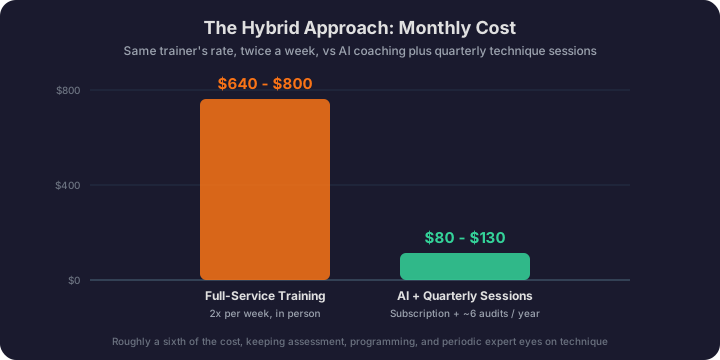
In practice that looks like this. The AI platform runs your monthly physique analysis, builds and adapts your program, checks your form on the lifts you upload, and sets your macros. Then once or twice a quarter, you book a single session with a good in-person trainer for a technique audit: bring your two or three most technical lifts, have an experienced coach watch them live, collect cues, and take those cues back into your daily training.
The math is striking. An AI coaching subscription plus, say, six one-off sessions a year at 80 to 100 dollars each lands somewhere around 80 to 130 dollars a month depending on the subscription. Full-service training twice a week at the same trainer's rate runs 640 to 800 dollars a month. You're keeping the assessment, the programming, the adaptation, and a periodic dose of expert eyes on your technique, for roughly a sixth of the cost.
Who does this fit? Lifters past the true-beginner stage who train alone, care about progress, and can show up without a human appointment forcing them to. Who shouldn't do this? Complete beginners who have never been coached through the basic patterns (spend your first five to ten sessions with a human, it's the highest-value coaching money you'll ever spend), anyone training around an injury, and anyone who knows from experience that without a standing appointment they simply won't go.
The Bottom Line
A personal trainer sells a bundle, and in 2026 the bundle has come apart: programming, assessment, adaptation, and form feedback are now covered well by AI coaching at roughly the cost of one training session per month, while spotting, real-time cueing, and human accountability still belong to humans. If you can afford full-service training and it keeps you showing up, it remains a good purchase. If you can't, or you'd rather not spend 5,000 dollars a year on it, an AI platform plus occasional in-person technique sessions covers most of the value at a fraction of the price. HyperBody's AI physique rater is free to start, so you can see the first piece of that stack for yourself before you spend anything at all.
More field notes.

FFMI Explained: How Much Muscle Can You Build Naturally?
FFMI puts a number on how much muscle you carry for your height, and it is the metric behind the famous claim that natural lifters top out around 25. Here is what it actually measures, what the research really showed, and how to estimate yours.

How Long Does It Take to Build Noticeable Muscle?
Muscle growth runs on a timeline that no amount of motivation can compress, and most lifters quit during the exact weeks it is quietly working. Here is what actually changes in your first weeks, months, and years of training, and how to see progress the mirror hides.

Smart Scales and BIA: How Accurate Are They Really?
Your smart scale says 18 percent body fat on Monday and 22 percent on Thursday, and you have not changed. Here is how bioelectrical impedance actually works, what the research says about its accuracy, and the narrow job it can still do well.
More on HyperBody