ComparisonsJul 2, 202611 min read
Lire en français·Auf Deutsch lesen·Leer en español·Przeczytaj po polsku
The Best AI Fitness Apps in 2026 (an Honest Comparison, Including Ours)
A bias-disclosed roundup of the leading AI fitness apps in 2026. We make this software, so we tell you exactly how to weigh our opinion, credit every competitor's real strengths, and use only verified pricing.
Reviewed by the HyperBody team
Key takeaways
- What is the best AI fitness app in 2026?
- There is no single best, because the tools answer different questions. Fitbod is the most mature algorithmic lifting engine, Caliber and Future win for human coaching, Juggernaut AI for powerlifting, Freeletics for bodyweight training, Boostcamp for free programs, and HyperBody for photo-based physique analysis with an adaptive plan.
- Which AI fitness apps have a free tier?
- Caliber's free self-guided tier is genuinely generous with 500-plus exercises, Boostcamp offers 130-plus proven programs free, Freeletics has a free tier, and HyperBody's free tier includes the first physique scan. Fitbod has no permanent free tier, only a 7-day trial before $15.99 per month.
- Are there AI fitness apps that analyze your physique from photos?
- Yes, and it is a category most roundups skip. Rate My Physique returns a quick AI rating and muscle breakdown from photo uploads. HyperBody uses a five-photo protocol to estimate a body fat range, score 14 muscle groups, rank weak points, and build a 4 to 20 week adaptive plan.
- Is an AI fitness app a replacement for a personal trainer?
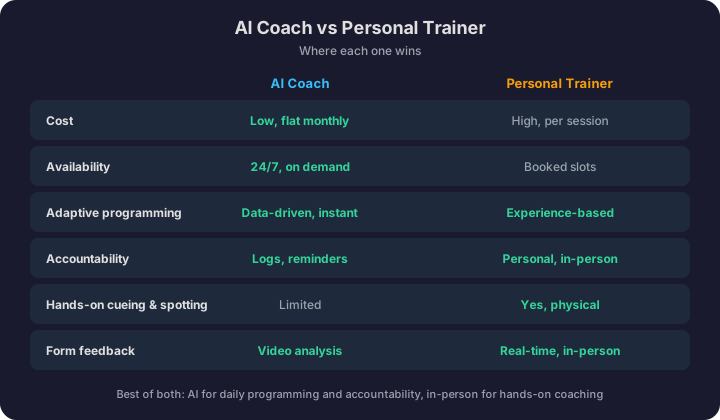
- For form correction and accountability, a good in-person coach still wins. AI form checks and photo analysis are affordable, always-available complements rather than a full substitute. If human accountability is what you need, coaching apps like Caliber or Future fit better than pure AI products.
Let's get the awkward part out of the way first: we make one of the apps on this list. HyperBody is our product, so a roundup like this from us is not neutral, and you should not treat it as if it were. Almost every "best AI fitness apps" article you will find is written by a company that then ranks itself number one. We are not going to pretend we are different by not appearing at all. Instead, we are going to be honest about our bias, tell you precisely how to discount our opinion, and give every other app on this list a genuine, fair hearing including the things they do better than us.
Here is how to read this piece. When we describe a competitor's strength, take it at face value: we have no incentive to invent good things about rival products. When we describe HyperBody, mentally apply a discount, because we are the house team. And when we get to the verdict, we tell you the specific cases where a competitor is the better pick, not us. If we cannot do that credibly, this whole article is worthless.
How we compared
We looked at the apps that actually show up when people search for AI fitness coaching in 2026, plus a category most roundups ignore entirely (more on that below). For each app we pulled pricing from the company's own official pages or App Store listing, never from memory or marketing hearsay. Where a price could not be verified from a primary source, we say so plainly rather than guess. Any criticism is attributed to a named source, because "some users report" with a link is fair, and vague swipes are not.
We are also deliberately covering something the existing roundups miss. Of the six major "best AI fitness apps 2026" lists we reviewed, five were written by companies ranking themselves first, and none of them treated photo-based physique analysis as its own category. That is a real gap, and it happens to be the category we live in, so we flag our interest openly and explain why it deserves a seat at the table.
Fitbod
What it is: A fully algorithmic strength-training app. No human coach, no large-language-model layer. It builds and rotates your workouts based on muscle-fatigue tracking. IOS and Android only, with no web app.
Pricing: $15.99/month or $95.99/year with a 7-day trial and no free tier, per Fitbod's official FAQ.
Standout strength: Fitbod's adaptive engine is mature and well regarded. Its muscle-fatigue rotation and offline mode are genuinely useful for lifters who train in patchy-signal gyms, and its store ratings are strong (4.8 on the App Store, 4.6 on Google Play).
Honest limitation: Some users report that the first ten to fifteen workouts feel generic before the algorithm learns you, and that the exercise demos are brief clips rather than real form coaching, per an Indie Hackers 2026 review aggregating Trustpilot feedback. It also has no photo features at all; Fitbod's own blog tells users to take progress photos outside the app.
Who it fits: Intermediate lifters who want a proven auto-generating workout engine and do not care about photos or form video. If that is you, our full HyperBody vs Fitbod comparison goes deeper on the trade-offs.
Caliber
What it is: A human-coach model built around real trainers, with a strong free self-guided tier underneath. IOS and Android only.
Pricing: A genuinely generous free tier (500-plus exercises, ad-free). Pro group coaching is $19/month, $49/quarter, or $169/year per Caliber's official help center. Premium 1:1 coaching starts from around $200/month (package figures vary, so we quote only the floor). There is a 30-day money-back guarantee.
Standout strength: Real, vetted human coaches and a Trustpilot rating of 4.9 across roughly 450 reviews. Its Strength Score metric is a clean way to track progress, and the free tier is one of the most usable in the category.
Honest limitation: The Premium 1:1 tier is, per BarBend's review, "significantly higher than many competitors," and its nutrition coaches are not registered dietitians. Garage Gym Reviews notes that submitting photos or video to your coach is clunky, "one photo at a time, can't add any text." Note also that photo review here is done by a human coach, not automated analysis.
Who it fits: People who specifically want a human in the loop and will pay for it, or anyone who just wants a solid free strength tracker. See our HyperBody vs Caliber comparison for the human-versus-AI trade-off in detail.
Future
What it is: A premium human 1:1 coaching app. Notably, Future pulled the plug on its AI personal-training beta in February 2026 and recommitted to human coaches, which is worth knowing if you specifically wanted an AI product from them.
Pricing: Around $149 to $199 per month (verify the current figure live before subscribing, as premium human coaching prices move).
Standout strength: A dedicated real coach who messages you, adjusts your plan, and holds you accountable. For people who need human accountability, that is the whole ballgame.
Honest limitation: It is expensive relative to software-only options, and it deliberately has no AI physique or form features after retiring its AI beta.
Who it fits: Those who want and will pay for consistent human accountability, and who do not need photo analysis.
Freeletics
What it is: An algorithmic "AI Coach" focused on bodyweight and HIIT training, useful for training with little or no equipment.
Pricing: Term-based plans in the range of roughly $34.99 per three months to $79.99 per year, and a free tier exists (verify the current SKU before buying, as term pricing shifts by region).
Standout strength: Excellent for bodyweight and conditioning work you can do anywhere, with a coaching engine that adjusts intensity over time.
Honest limitation: It is not built for barbell strength progression, has no wearable integration, and no photo features.
Who it fits: Home and travel exercisers who want structured bodyweight and HIIT sessions rather than a gym-based lifting plan.
Juggernaut AI
What it is: A powerlifting-focused app built around periodization and RPE autoregulation from a respected strength lineage.
Pricing: $34.99/month or $349.99/year, per Juggernaut's official pricing page.
Standout strength: Serious, well-designed periodization for squat, bench, and deadlift, with autoregulation that responds to how your lifts actually feel day to day.
Honest limitation: It is expensive and deliberately niche. If you are not chasing a bigger total on the three powerlifts, most of its value does not apply to you, and it has no photo features.
Who it fits: Committed powerlifters who want programming built specifically around competition lifts.
Boostcamp
What it is: A library of proven training programs plus a workout tracker, leaning on established templates rather than a generative engine.
Pricing: A free program library of 130-plus programs, with Pro at $14.99/month or $59.99/year, per Boostcamp's official premium page.
Standout strength: Access to a large set of well-known, structured programs for free is a genuinely good deal, and the tracker is clean.
Honest limitation: Per BarBend, its programs are fixed templates rather than adaptive plans that rewrite themselves around your logged performance, it is strength-focused, and it has no photo features.
Who it fits: Lifters who already know which program they want to run and just need a great free tracker to run it.
Photo-based physique analysis is its own category
Here is the part every other roundup skips, and yes, this is the category we compete in, so weigh it accordingly. Almost all the apps above answer the question "what workout should I do today?" Very few answer "what does my body actually look like right now, where am I weak, and is it changing?" That second question is what photo-based physique analysis exists to solve, and it is different enough to be its own category rather than a footnote.
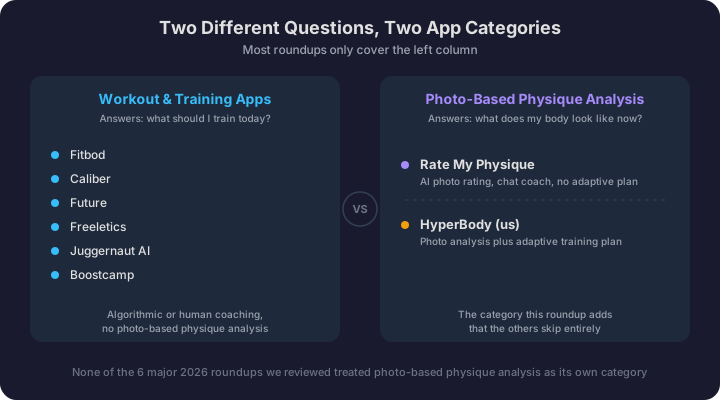
Two apps in this space are worth naming.
Rate My Physique (MagFit) is a pure AI photo-rating app: you upload a photo and it returns a physique rating, a muscle breakdown, a chat coach, and a "Future You" image. There is no human review. It is built around individual photo uploads (we will not claim more than that, since its multi-angle behavior is unconfirmed). Pricing is a free download with analysis paywalled, and the App Store listing shows in-app purchases from $1.99 to $39.99. Its standout strength is speed and novelty: a quick, fun rating and a motivating future-self image. Its honest limitation is scope: it centers on rating and chat rather than a full multi-week adaptive training plan, and it has no form-check video feature. If you want the head-to-head, we wrote a HyperBody vs Rate My Physique comparison.
HyperBody (that's us) uses a five-photo protocol (front relaxed, front flexed, side, back relaxed, back flexed) to estimate a body-fat range and score 14 muscle groups from 1 to 10, rank your weak points, and then generate a personalized training plan of 4 to 20 weeks that adapts weekly from your logged sets, reps, and RPE. It adds a video form check across 15 exercises with pose detection and rep-by-rep feedback, AI recipes with macros, and free calculators (TDEE, FFMI, body fat, 1RM) plus a bulk-or-cut quiz with no signup. It runs as a web app in English, French, German, Spanish, and Polish. Free tier; Pro at $7.50 per month billed annually, or $15 month-to-month. To be straight with you about the limitation: we have no human coaches, full stop. If human accountability is what you need, Caliber or Future is a better fit than we are. One more honesty note: our body-fat range and muscle-group scores are AI estimates generated from your photos, not clinical measurements, and a DEXA scan remains the precision benchmark if you need lab-grade numbers.
Comparison summary
| App | Model | Verified pricing | Photo analysis | Best for |
|---|---|---|---|---|
| HyperBody | AI physique + adaptive plan | Free tier; Pro $7.50/mo billed annually ($15 month-to-month) | Yes (5-photo + form video) | Seeing and tracking your physique |
| Fitbod | Algorithmic | $15.99/mo, $95.99/yr, no free tier | No | Proven auto-generated lifting |
| Caliber | Human coach + free tier | Free; Pro $19/mo; Premium from ~$200/mo | Human-reviewed | Human coaching or a free tracker |
| Future | Human 1:1 | ~$149-199/mo (verify live) | No | Human accountability |
| Freeletics | Algorithmic | Free tier; ~$34.99/3mo-$79.99/yr | No | Bodyweight and HIIT anywhere |
| Juggernaut AI | Algorithmic periodization | $34.99/mo, $349.99/yr | No | Dedicated powerlifting |
| Boostcamp | Program library | Free; Pro $14.99/mo, $59.99/yr | No | Running a known program free |
| Rate My Physique | AI photo rating | IAP $1.99-$39.99 (App Store) | Yes (photo rating) | Quick physique rating |
The verdict, kept honest
There is no single best AI fitness app, because these tools answer different questions. So here is where we send you elsewhere:
- Want a human coach and will pay for it? Choose Caliber or Future, not us.
- Want a proven, purely algorithmic lifting engine and do not care about photos? Fitbod is excellent.
- Chasing a bigger powerlifting total? Juggernaut AI is built for exactly that.
- Training with bodyweight at home or traveling? Freeletics fits better than any barbell app here.
- Just want a great free program tracker? Boostcamp is hard to beat on price.
Pick HyperBody when the question you care about is your physique itself: seeing your body-fat range and muscle-group scores, knowing your weak points, and getting a plan that adapts as those numbers change, with a form check to keep your lifts clean. That is the category we built for, and we think we do it well, but you now know exactly why we would say that.
A few honest questions people ask
Is any of these apps a replacement for a real trainer? For form correction and accountability, a good in-person coach still wins. AI form checks and photo analysis are useful, affordable, always-available complements, not a full substitute.
Which is cheapest? Among paid subscriptions here, HyperBody Pro at $7.50 per month billed annually (or $15 month-to-month) has the lowest price among the apps here that include physique analysis and coaching, while Boostcamp's $59.99 per year is the lowest paid price overall. Several apps (Caliber, Freeletics, Boostcamp) also have real free tiers. Price should not be your only filter, though. Match the tool to the question you are trying to answer.
Why should I trust a comparison written by one of the competitors? You should trust it only as far as we have earned it, which is why we disclosed our bias up front, credited every rival's real strengths, used only verified pricing, and told you the specific cases where a competitor beats us. If you want to check our category claims yourself, try our free physique analysis and see whether the photo-based approach actually answers a question the others do not.
Sources
- Fitbod official FAQ (pricing)
- Fitbod blog: how to take progress photos
- Indie Hackers: Fitbod app review 2026
- Caliber help center: pricing
- BarBend: Caliber fitness app review
- Garage Gym Reviews: Caliber app review
- Athletech News: Future recommits to human coaches
- Juggernaut AI official pricing
- Boostcamp official premium page
- Rate My Physique App Store listing
More field notes.

The Best AI Physique Analysis Apps in 2026, Compared Honestly
Six apps that use AI for physique analysis, workout generation, or recovery, compared on what they actually measure, what they cost, and who each one fits, with sources for every claim.

AI Fitness Apps in 2026: Choosing Between Physique Raters, Form Checkers, and Full Coaching Platforms
The AI fitness space has split into single-purpose tools and full coaching platforms. Here's a clear map of what each category does well, where each falls short, and how to pick for your goal.

What Is a Physique Rating? Body Types, Scores, and How AI Does It
What a physique rating is, from the 9 body types on a body composition scale to AI photo ratings: what the scores measure, how they compare with DEXA and smart scales, and how to turn a rating into training priorities.
More on HyperBody