


How hard should you train? It's the most important programming question after "what exercises should I do?" and "how many sets?" — and there are two major systems for answering it.
Percentage-based training prescribes loads as a percentage of your one-rep max (1RM). If your 1RM bench press is 225 lbs, "80% x 5" means 180 lbs for 5 reps.
RPE (Rate of Perceived Exertion) uses a subjective scale to prescribe intensity based on how hard a set feels. An RPE 8 means you could have done 2 more reps. An RPE 9 means you had 1 rep left.
Both systems have passionate advocates. Both have real limitations. And the best approach for most people involves elements of both.
The RPE Scale Explained
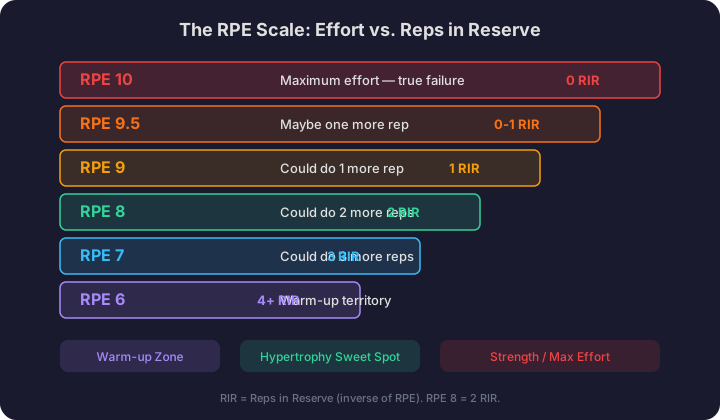
The modern RPE scale used in strength training runs from 1-10:
- RPE 10 — Maximum effort. Could not have done another rep. (True failure)
- RPE 9.5 — Could maybe have done one more rep, but not confident
- RPE 9 — Could have done 1 more rep
- RPE 8 — Could have done 2 more reps
- RPE 7 — Could have done 3 more reps
- RPE 6 — Could have done 4+ more reps (warm-up territory)
The concept of "Reps in Reserve" (RIR) is the inverse: RPE 8 = 2 RIR. Some coaches and apps use RIR instead of RPE. They're functionally identical.
The Case for RPE
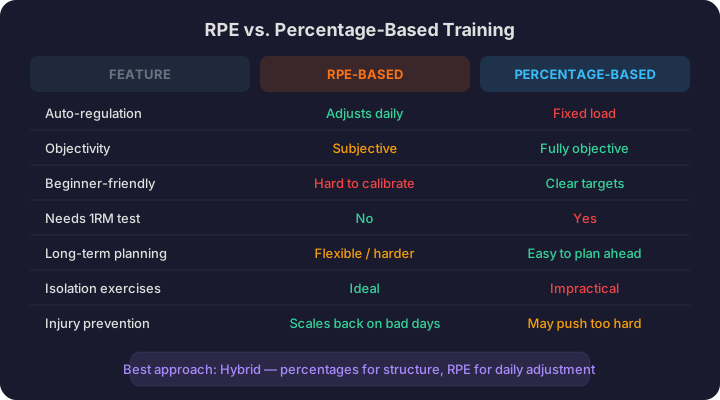
1. It auto-regulates to your daily readiness Your strength fluctuates day to day. Sleep, stress, nutrition, hydration, and accumulated fatigue all affect how strong you are on any given session.
Percentage-based training ignores this entirely. 80% of your max is 80% of your max regardless of whether you slept 4 hours or 8. RPE adjusts automatically — if you're having a bad day, RPE 8 might be 10 lbs lighter than usual. If you're having a great day, it might be 10 lbs heavier. Either way, the training stimulus is appropriate.
2. It accounts for rep-dependent strength Your 80% for 5 reps might feel like RPE 7 on a good day and RPE 9 on a bad day. For someone who's naturally better at high-rep work, 80% for 5 might be easy. For someone who's a fast-twitch dominant lifter, it might be brutal.
RPE captures this individual variation. Percentages don't.
3. It works without a recent 1RM Percentage-based training requires knowing your one-rep max. But true 1RM testing is fatiguing, carries injury risk, and needs to be retested as you get stronger. RPE doesn't require any baseline — you can start using it immediately.
4. It prevents over-reaching on bad days With percentage-based training, you might push through a prescribed 85% session when your body is screaming for a lighter day. With RPE, you'd naturally adjust downward. This reduces injury risk and accumulated fatigue.
The Case for Percentages
1. It's objective and removes guesswork "Bench 185 for 3x5" is clear, unambiguous, and requires zero self-assessment. For people who struggle with gauging their effort or who tend to either sandbag or push too hard, percentages provide guardrails.
2. Beginners can't accurately judge RPE Research shows that beginners are poor at estimating their RIR. A beginner who thinks they have "2 reps left" might actually have 5. Or they might have 0. The skill of accurately gauging RPE takes months to develop.
In the meantime, percentage-based training ensures beginners are working at appropriate intensities even when their self-assessment is off.
3. It enables long-term planning Periodized programs with percentages can be mapped out months in advance. Week 1: 70%, Week 4: 80%, Week 8: 90%. The progression is visible, predictable, and structured.
RPE-based programming is inherently more flexible, which is its strength — but it also means you can't plan exact loads far in advance.
4. It's easier to track objective progress If you benched 185 for 3x5 last month and 195 for 3x5 this month, that's clear, measurable progress. With RPE, if you benched RPE 8 both times but the weight went up, you're making progress — but it requires more careful logging to see the trend.
The Hybrid Approach (What Actually Works Best)
Most experienced coaches and evidence-based programs use a combination of both systems. Here's how:
Use percentages for programming structure: Plan your mesocycle with percentage-based targets. This gives you a roadmap: Week 1 starts at 72%, Week 4 hits 82%, etc.
Use RPE for daily adjustment: On training day, let RPE guide your actual working weight. If the prescribed 80% feels like RPE 9 today, stay there or reduce slightly. If it feels like RPE 7, consider adding weight.
Use RPE caps to prevent over-reaching: Prescribe "80% for 3x5, RPE cap 9." This means: aim for 80%, but if any set exceeds RPE 9, stop adding weight or reduce.
Use RPE for isolation and accessory work: Nobody knows their 1RM on lateral raises. For isolation exercises, RPE is the practical choice. "3x12 at RPE 8" is perfectly clear and much more useful than trying to calculate percentages for cable flyes.
RPE for Different Training Goals
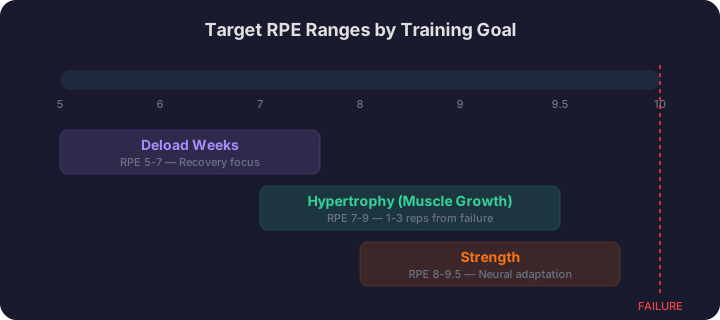
Hypertrophy (Muscle Growth): RPE 7-9 on most sets. The research suggests that training 1-3 reps from failure is the sweet spot for hypertrophy. Training to actual failure (RPE 10) on every set creates excessive fatigue without proportional muscle growth benefit.
Strength: RPE 8-9.5 on primary lifts. Heavy enough to drive neural adaptation, but with enough margin to maintain technique. Going to true failure on heavy compounds (RPE 10) is risky and not necessary for strength development.
Deload Weeks: RPE 5-7. The weights should feel light and easy. The purpose is recovery, not stimulus. If your deload feels hard, it's not a deload.
Common RPE Mistakes
Rating every set RPE 8 without thinking Many trainees default to "RPE 8" regardless of actual effort. Be honest with yourself. If the last rep was a grinder, that's RPE 9-10, not 8.
Not developing the skill intentionally RPE accuracy improves with practice. After every set, pause and genuinely ask: "How many more reps could I have done with good form?" Compare your estimate to reality on your last set (take it closer to failure to calibrate).
Ignoring RPE on warm-up sets Track RPE on your build-up sets too. If your warm-ups feel heavier than expected, that's valuable information about your readiness for the session.
Using RPE as an excuse to go easy Auto-regulation means adjusting in both directions. If RPE 8 today is 10 lbs heavier than last week, that's great — go with it. RPE is a calibration tool, not a permission slip to coast.
How HyperBody Implements Intensity Management
HyperBody uses an RPE-based system for exercise prescription. Each exercise in your program comes with a target RPE range, so you always know how hard each set should feel.
The app's RPE table helps you translate effort levels into practical weight selections. As you log your sets with both weight and RPE, the system learns your strength levels and can provide increasingly accurate weight suggestions over time.
This hybrid approach gives you the structure of a planned program with the flexibility to adjust based on how you're performing on any given day.
Whether you prefer percentages, RPE, or a mix of both, the key is consistency: pick a system, learn to use it well, and apply it systematically. The worst approach is no system at all — just loading whatever weight feels right and hoping for the best.