


Supersets are one of the most popular training techniques in any gym. Pair two exercises back to back with no rest, crush more work in less time, and leave the gym feeling like you've accomplished something. Sounds great in theory.
In practice, supersets are a tool — and like any tool, they're only useful when applied correctly. Used well, they save time, increase training density, and can even enhance performance. Used poorly, they compromise your best sets and limit your progress on the exercises that matter most.
What Is a Superset?
A superset is two exercises performed consecutively with minimal or no rest between them. After completing both exercises, you take a rest period before repeating.
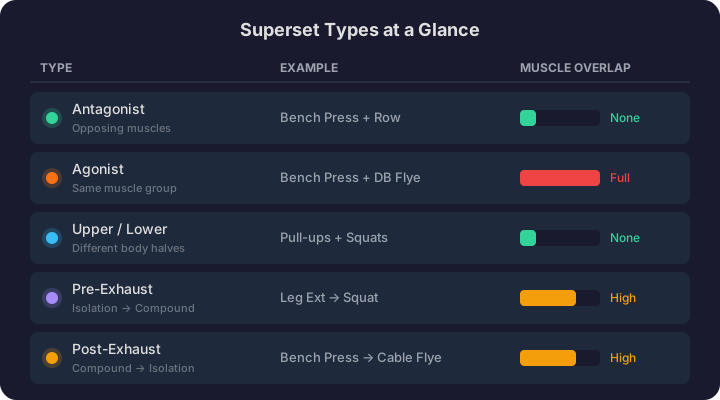
There are several types:
Antagonist Supersets — Pairing opposing muscle groups (e.g., bench press + barbell row, bicep curl + tricep extension). The muscles used in one exercise rest while you perform the other.
Agonist Supersets — Pairing exercises for the same muscle group (e.g., bench press + dumbbell flye, squat + leg extension). This pre-exhausts or further fatigues the target muscle.
Upper/Lower Supersets — Pairing an upper body and lower body exercise (e.g., pull-ups + squats). Almost no muscle overlap, allowing near-full recovery between exercises.
Pre-Exhaust Supersets — An isolation exercise followed by a compound (e.g., leg extension then squat). Targets a specific muscle before it gets "help" from synergists in the compound.
Post-Exhaust Supersets — A compound exercise followed by an isolation (e.g., bench press then cable flye). Uses the isolation to further fatigue the target muscle after the compound.
When Supersets Work
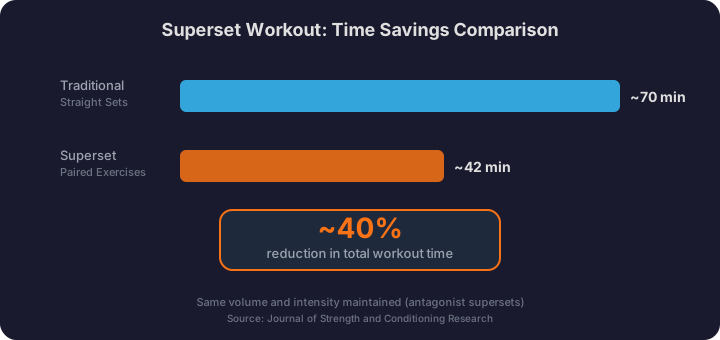
1. Time-Efficient Training The primary benefit of supersets is time savings. If you have 45 minutes instead of 90, supersets let you maintain training volume by compressing rest periods.
A study in the Journal of Strength and Conditioning Research found that antagonist supersets reduced total workout time by approximately 40% while maintaining the same volume and intensity as traditional sets. That's significant.
2. Antagonist Supersets for Performance Research consistently shows that antagonist supersets don't just save time — they can actually enhance performance. Performing a bench press after a row (or vice versa) can increase force production compared to performing the exercise alone.
The mechanism is reciprocal inhibition: when you contract one muscle, the opposing muscle relaxes more fully. This enhanced relaxation can lead to slightly greater force production on the subsequent set.
3. Upper/Lower Supersets for Conditioning Pairing upper and lower body exercises with minimal rest creates a cardiovascular demand that builds work capacity alongside muscle. This is excellent for general fitness and can serve as a form of concurrent conditioning training.
4. Isolation Supersets for Pump and Volume Superset curls with tricep extensions, lateral raises with face pulls, leg extensions with leg curls. For isolation work where maximum load isn't the priority, supersets are almost always a smart choice. They save time without meaningfully compromising the stimulus.
When Supersets Hurt Your Progress
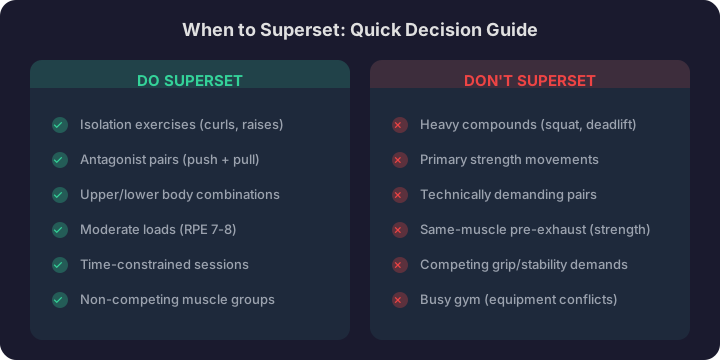
1. Heavy Compound Supersets Supersetting heavy squats with heavy deadlifts is a recipe for compromised performance on both exercises. Heavy compound movements require full neural recovery between sets — typically 3-5 minutes. Cutting that rest period by inserting another demanding exercise means you'll be weaker on your primary lift.
If your goal is to get as strong as possible on a specific lift, don't superset it.
2. Same-Muscle Agonist Supersets for Strength Pre-exhaust supersets (e.g., leg extension into squat) sound logical — fatigue the quads first, then force them to work harder in the squat. But research shows this primarily reduces the weight you can use on the compound, without increasing muscle activation proportionally.
You're essentially making yourself weaker on the exercise that matters most. For hypertrophy-focused training with moderate loads, this can work. For strength development, it's counterproductive.
3. When Fatigue Degrades Form If the second exercise in a superset requires significant technical skill, accumulated fatigue from the first exercise can degrade your form. Bad form means less effective muscle stimulation and higher injury risk.
For example: supersetting heavy Romanian deadlifts with barbell squats. Both are technically demanding. Fatigue from one will compromise execution of the other.
4. When Equipment Availability Is an Issue In a busy gym, tying up two pieces of equipment simultaneously is often impractical and inconsiderate. If you can't reliably secure both stations, you'll end up resting too long between exercises anyway — defeating the purpose.
How to Program Supersets Effectively
Rule 1: Superset isolation work freely Biceps/triceps, lateral raises/face pulls, leg extensions/leg curls — these are all excellent candidates. Low technical demand, no equipment conflicts, great time savings.
Rule 2: Antagonist superset compound movements carefully Bench + row, OHP + pull-up — these work well because the muscles used in each exercise get to rest while you perform the other. Keep the loads moderate (RPE 7-8) and the rep ranges in the hypertrophy zone (6-12 reps).
Rule 3: Don't superset your primary strength movements If you're running a program with a main lift for the day (e.g., squat day starts with heavy squats), do those straight sets with full rest. Save supersets for accessory and isolation work later in the session.
Rule 4: Match exercise demands Pair exercises that don't compete for grip, stability, or energy systems. Deadlift + pull-ups is a bad superset (both heavily tax the grip and back). Dumbbell press + face pulls is a good one (different muscles, different demands).
Rule 5: Keep the total session time reasonable Supersets are a tool for maintaining quality within a time constraint. If your superset-heavy workout is still taking 90+ minutes, you're probably doing too much total volume. The point is efficiency.
A Practical Superset Workout
Here's a time-efficient upper body session using intelligent superset programming:
Block 1 (Straight Sets — Primary Lift) Bench Press: 4x6-8, 3 min rest
Block 2 (Antagonist Superset) A1: Dumbbell Row 3x10 A2: Incline DB Press 3x10 Rest 90 sec between supersets
Block 3 (Isolation Superset) B1: Bicep Curl 3x12 B2: Tricep Pushdown 3x12 Rest 60 sec between supersets
Block 4 (Isolation Superset) C1: Lateral Raise 3x15 C2: Face Pull 3x15 Rest 60 sec between supersets
Total time: approximately 40-45 minutes. Total volume: equivalent to a 70-minute straight-set workout.
How HyperBody Uses Supersets
HyperBody's smart coaching programs supersets based on the principles above. When your program includes supersets, they're placed strategically:
- Primary lifts are always performed as straight sets with appropriate rest
- Antagonist supersets are used for complementary compound movements
- Isolation supersets pair non-competing muscles for time efficiency
- The app groups superset exercises together so you can see both movements at a glance and log them seamlessly
The result is a program that uses supersets where they help and avoids them where they'd hurt — without you needing to make those decisions yourself.
Supersets aren't inherently good or bad. They're a programming tool with specific use cases. Apply them intelligently and they'll make your training more efficient. Apply them randomly and they'll make your training worse. Know the difference, and you'll get better results in less time.