


There's a difference between a workout and a training program. A workout is what you do today. A training program is a structured plan that connects today's session to last week's and next month's — with a clear progression path that drives adaptation over time.
Most gym-goers have workouts. Very few have programs. And that gap is the primary reason most people plateau after their initial beginner gains.
The Three Pillars of Program Design
Every effective training program is built on three pillars. Miss one, and the whole structure weakens.
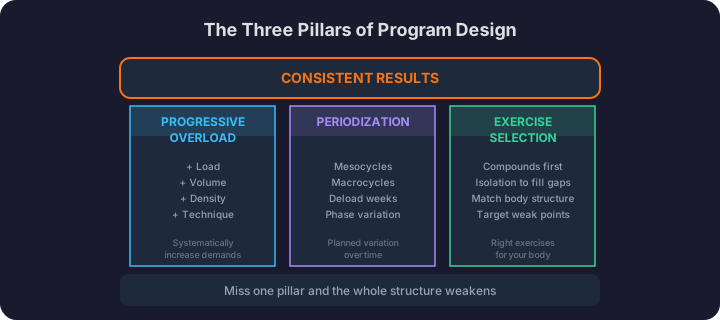
Pillar 1: Progressive Overload
Your body adapts to the demands you place on it — and then stops adapting. To keep building muscle and strength, you need to systematically increase those demands. This is progressive overload, and it's non-negotiable.
The four primary overload methods:
Load Progression — Adding weight to the bar. The most intuitive form of overload. If you benched 135 for 3x8 last week, try 140 for 3x8 this week. When you can complete all prescribed reps with good form, increase the weight.
Volume Progression — Adding sets or reps. If you did 3x8 last week, try 3x9 or 4x8 this week. This is especially useful when adding weight isn't practical (cables, machines, isolation work).
Density Progression — Doing the same work in less time. If your 4x10 squats took 12 minutes with 3-minute rests, try completing them in 10 minutes by reducing rest to 2.5 minutes.
Technique Progression — Better execution. Slower eccentrics, longer pauses, fuller range of motion. Same weight, same reps, but harder and more effective.
The mistake most people make: trying to progress every single session. This works for the first few months of training. After that, progress happens week to week and month to month, not session to session. Patience is a progression tool.
Pillar 2: Periodization
Periodization is the planned variation of training variables over time. Without it, you either stagnate (doing the same thing forever) or regress (training too hard for too long without recovery).
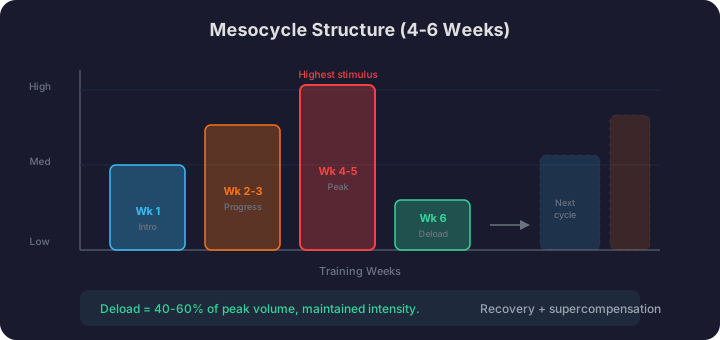
Mesocycle Structure (4-6 weeks) A mesocycle is a training block with a specific focus. A typical mesocycle looks like this:
- Week 1: Introduction — moderate volume, moderate intensity. Learn the movements, establish baselines.
- Week 2-3: Progression — volume or intensity increases. The productive training weeks.
- Week 4-5: Peak — highest training stimulus. This is where adaptation is driven.
- Week 6: Deload — reduced volume (40-60% of peak), maintained intensity. Recovery and supercompensation.
Macrocycle Structure (12-20 weeks) A macrocycle chains mesocycles together, each with a different emphasis:
- Block 1 (6 weeks): Hypertrophy focus — higher reps (8-15), moderate weight, higher volume
- Block 2 (6 weeks): Strength focus — lower reps (4-8), heavier weight, moderate volume
- Block 3 (4 weeks): Peaking/intensification — low reps (1-5), heavy weight, lower volume
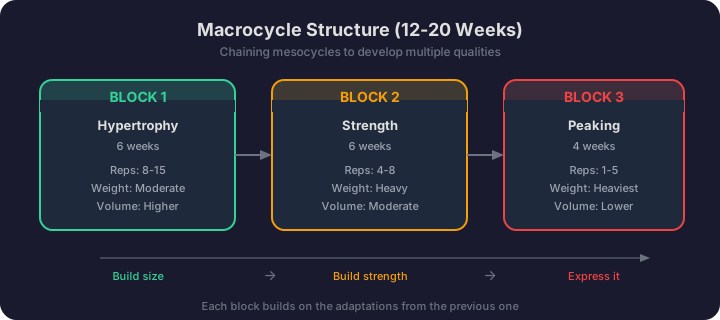
This ensures you're developing multiple qualities (size, strength, work capacity) rather than just hammering one dimension endlessly.
Pillar 3: Exercise Selection
Not all exercises are equal — and the best exercises for you depend on your body structure, experience level, and weak points.
Compound movements should form the backbone of any program. Squats, deadlifts, presses, rows, and pull-ups hit multiple muscle groups and allow for heavy loading. They're the most efficient muscle and strength builders.
Isolation movements fill in the gaps. They target specific muscles that compounds might not fully develop — lateral delts, biceps, calves, rear delts, hamstrings.
Exercise selection for your body:
- Shoulder-dominant pressers might need more incline work and less flat bench
- Long-armed lifters might benefit from floor press or board press for chest development
- People with lagging hamstrings might swap conventional deadlifts for Romanian deadlifts
This is where physique analysis becomes valuable. Knowing which muscles are underdeveloped lets you select exercises that specifically address those weak points.
Sample Program Structure
Here's a practical 4-day upper/lower split structured for progression:
Week 1-3 (Accumulation)
- Upper A: Bench Press 3x10, Row 3x10, OHP 3x10, Curl 3x12, Tricep Extension 3x12
- Lower A: Squat 3x10, RDL 3x10, Leg Press 3x12, Leg Curl 3x12, Calf Raise 3x15
- Upper B: Incline DB Press 3x10, Pull-up 3x8, Cable Row 3x12, Lateral Raise 3x15, Face Pull 3x15
- Lower B: Deadlift 3x8, Bulgarian Split Squat 3x10, Leg Extension 3x12, Leg Curl 3x12, Calf Raise 3x15
Week 4-6 (Intensification) Same exercises, but: add 1 set to main compounds (4x10), increase weight 5-10% on all movements, reduce reps on compounds to 8 if needed.
Week 7 (Deload) Return to Week 1 volumes, maintain Week 4-6 weights but with 2 fewer reps per set. Focus on form and recovery.
Week 8-13 New mesocycle. Change 2-3 exercises per day (keep main compounds if they're working), reset volume to Week 1 levels, increase starting weights.
The Deload: Why It Matters
Skipping deloads is one of the most common programming mistakes. Training creates fatigue alongside fitness. Over time, accumulated fatigue masks your progress and eventually causes regression.
A deload week every 4-6 weeks allows fatigue to dissipate while maintaining the fitness you've built. You'll come back to the next training block feeling stronger, not weaker.
Signs you need a deload:
- Strength is declining despite consistent training
- You feel flat, unmotivated, or drained
- Sleep quality has dropped
- Joint aches are increasing
- Workout quality has noticeably decreased
Don't wait for these signs to appear — program deloads proactively.
How HyperBody Programs for You
Building a well-structured program requires understanding periodization, exercise selection, and your body's specific needs. HyperBody automates this process:
- Your physique analysis identifies weak points and muscle imbalances
- Exercise selection is tailored to your structure and goals
- Progressive overload is programmed into every training block
- Deloads are scheduled at appropriate intervals
- The program evolves as you re-analyze and your body changes
The result is a program that applies all the principles above without requiring you to become a programming expert. You focus on training hard; the system handles the planning.
The Bottom Line
A real training program isn't a random list of exercises you enjoy doing. It's a structured, periodized plan with built-in progression and purposeful exercise selection. Build yours on the three pillars — progressive overload, periodization, and smart exercise selection — and you'll make more progress in the next six months than most people make in two years of aimless gym sessions.