


"I stretch all the time but still can't squat properly." Sound familiar? The issue is almost certainly a mobility problem — not a flexibility problem. And yes, those are different things.
Understanding this distinction is critical for any lifter who wants to train safely through a full range of motion and maximize the effectiveness of their exercises.
Flexibility vs. Mobility: The Difference
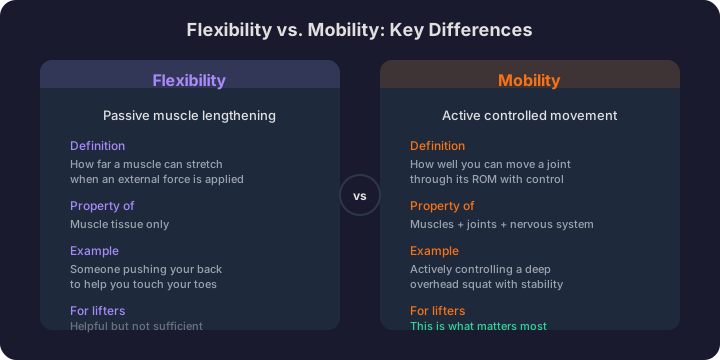
Flexibility is the passive ability of a muscle to lengthen. Think of touching your toes — if someone pushes your back and you reach further, that's flexibility. It's a property of the muscle tissue itself.
Mobility is the active ability to move a joint through its range of motion with control and strength. It combines flexibility with stability, motor control, and strength at end ranges. It's a property of the entire movement system — muscles, joints, nervous system, and coordination working together.
You can be flexible without being mobile (a gymnast who can do splits but can't control a deep overhead squat), and you can be somewhat inflexible but still have excellent functional mobility for your sport.
For lifters, mobility is what matters most. You need the ability to actively control your body through the full range of motion of your exercises — not just passively reach a position.
Why Mobility Matters for Lifting
Full Range of Motion = More Growth Research consistently shows that training through a full range of motion produces more muscle growth than partial reps. Deep squats build more quad muscle than half squats. Full-depth bench press builds more chest than partial reps. If poor mobility limits your ROM, you're leaving gains on the table.
Joint Health Restricted mobility forces compensation patterns. If your ankles are stiff, your squat will shift more stress to your lower back. If your thoracic spine is immobile, your shoulders pay the price during overhead pressing. Over time, these compensations lead to pain and injury.
Technical Proficiency Good mobility allows you to achieve and maintain proper positions during heavy lifts. A lifter with good hip and ankle mobility can maintain an upright torso in the squat. One without it will lean forward excessively, changing the loading pattern entirely.
Common Mobility Restrictions and Their Impact
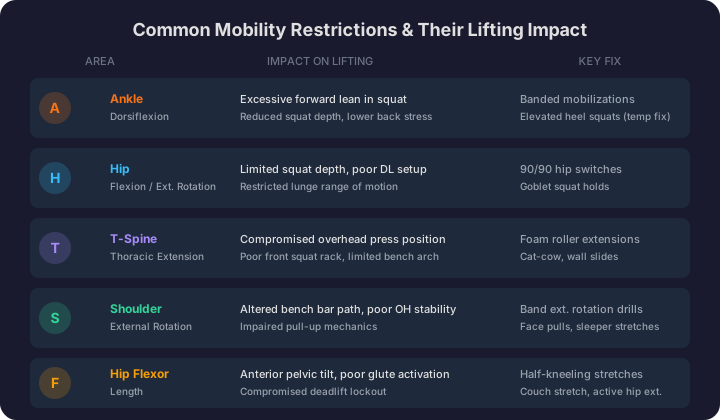
Ankle Dorsiflexion
- Test: Kneel with your toe 10cm from a wall. Can your knee touch the wall without your heel lifting?
- Impact: Limited ankle mobility forces excessive forward lean in squats and reduces squat depth
- Fix: Banded ankle mobilizations, weighted ankle stretches, elevated heel squatting as a temporary accommodation
Hip Flexion / External Rotation
- Test: Can you comfortably sit in a deep bodyweight squat with heels flat?
- Impact: Poor hip mobility limits squat depth, deadlift setup position, and lunge range
- Fix: 90/90 hip switches, pigeon stretches (active, not passive holds), goblet squat holds
Thoracic Extension
- Test: Sit against a wall with your lower back flat. Can you raise your arms fully overhead and touch the wall?
- Impact: Poor thoracic mobility compromises overhead pressing, front squat rack position, and bench press arch
- Fix: Foam roller thoracic extensions, cat-cow variations, wall slides
Shoulder External Rotation
- Test: Lie on your back, elbow at 90 degrees, and let your forearm rotate back. Can it reach the floor?
- Impact: Limited external rotation affects bench press bar path, pull-up mechanics, and overhead stability
- Fix: Sleeper stretches (active), band external rotation drills, face pulls
Hip Flexor Length
- Test: Thomas test — lie on a table edge, pull one knee to chest. Does the other thigh rise above horizontal?
- Impact: Short hip flexors cause anterior pelvic tilt, compromise glute activation, and affect deadlift lockout
- Fix: Half-kneeling hip flexor stretches (with posterior pelvic tilt), couch stretches, active hip extension drills
Building a Mobility Routine
You don't need to spend 30 minutes on mobility work every day. A targeted approach is more effective:
Daily (5 minutes):
- Pick 2-3 mobility drills targeting your personal restrictions
- Perform them as part of your morning routine or warm-up
- Focus on active movements, not passive holds
Pre-Training (3-5 minutes):
- Dynamic mobility work specific to the session's movements (as covered in the warm-up article)
- This is movement preparation, not deep stretching
Post-Training or Off Days (10-15 minutes):
- This is where longer holds (30-60 seconds) and deeper stretching are appropriate
- Focus on muscles trained that day or known tight areas
- Combine with foam rolling for tissue quality work
Foam Rolling: What It Actually Does
Foam rolling (self-myofascial release) doesn't "break up fascia" or "release knots" despite what many claim. What it does do:
- Temporarily increases range of motion (10-15 minutes of improved mobility)
- Reduces perception of muscle tightness and soreness
- Increases blood flow to the area
- May improve parasympathetic nervous system activity (relaxation response)
It's a useful pre-training tool to temporarily improve ROM before a session, and a decent post-training tool for perceived recovery. But it doesn't replace actual mobility work.
Use it as a warm-up supplement: 30-60 seconds per muscle group before dynamic mobility drills.
The Minimum Effective Mobility Routine for Lifters
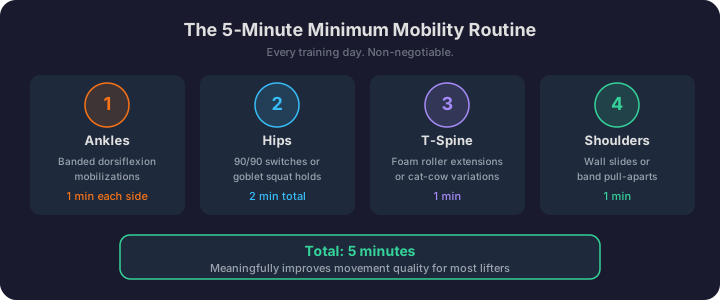
If you do nothing else, address these four areas regularly:
- Ankles — Banded dorsiflexion mobilizations (1 min each side)
- Hips — 90/90 switches or deep goblet squat holds (2 min total)
- Thoracic spine — Foam roller extensions or cat-cow (1 min)
- Shoulders — Wall slides or band pull-aparts (1 min)
Five minutes. Every training day. This alone will meaningfully improve most lifters' movement quality.
When to Seek Professional Help
If mobility restrictions persist despite 4-6 weeks of consistent work, or if you experience pain (not discomfort) during mobility drills, consider seeing a sports physiotherapist. Some restrictions are structural (bone shape, joint capsule tightness) rather than muscular and may need professional assessment and manual therapy.
The Bottom Line
Mobility is the foundation that enables everything else in your training. Without adequate mobility, you can't achieve proper positions, train through full ranges of motion, or distribute forces safely across your joints. It's not glamorous, it doesn't get likes on social media, and most people skip it — which is exactly why most people have movement limitations that hold back their progress.
Five minutes a day. Target your specific restrictions. Be consistent. Your lifts — and your joints — will thank you.