


"Just do more sets." It's the default advice for anyone who wants to grow. And to a point, it's correct — training volume is the primary driver of hypertrophy. But there's a critical nuance that gets overlooked: more volume works until it doesn't.
Understanding the dose-response relationship between volume and growth is one of the most important things you can learn as a lifter.
What Counts as a "Set"?
First, let's define terms. When researchers talk about training volume, they typically mean hard working sets — sets performed with sufficient intensity (within about 3 reps of failure) to stimulate growth. This excludes:
- Warm-up sets
- Sets stopped far from failure (RIR 5+)
- Feeder sets or activation sets at very light loads
A set of bench press at your working weight for 8 reps at RIR 2 counts. Your warm-up with the empty bar does not.
The Dose-Response Relationship
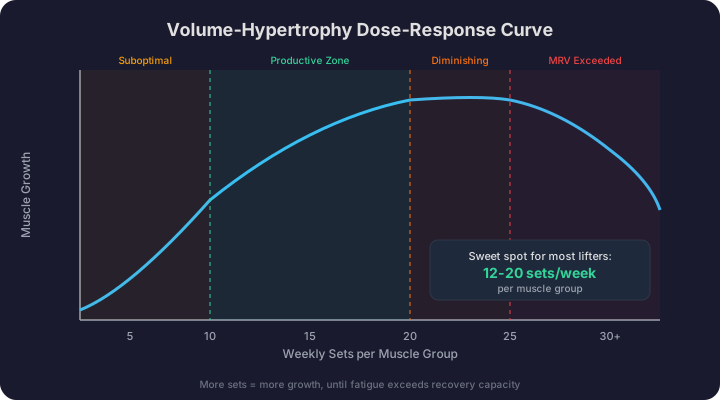
Research consistently shows a dose-response relationship between weekly set volume per muscle group and hypertrophy — but with diminishing returns:
Below 10 sets/week: Muscle growth occurs but is suboptimal. This is the minimum effective volume for most trained individuals.
10-20 sets/week: The "productive zone" for most people. Each additional set contributes meaningfully to growth, though the marginal benefit decreases as you approach 20 sets.
20+ sets/week: Diminishing returns accelerate sharply. Some advanced lifters benefit from 20-25 sets per muscle group, but the additional growth from sets beyond 20 is minimal for most people.
30+ sets/week: For most individuals, this exceeds Maximum Recoverable Volume (MRV) — meaning the fatigue generated by additional sets outweighs the growth stimulus they provide. Performance declines, recovery suffers, and injury risk increases.
Finding Your Optimal Volume
The optimal volume for any individual depends on several factors:
Training Experience
- Beginners: 10-12 sets per muscle group per week
- Intermediate: 12-18 sets per muscle group per week
- Advanced: 16-22+ sets per muscle group per week
Recovery Capacity
- Good sleep, low stress, adequate nutrition → higher end of range
- Poor sleep, high stress, caloric deficit → lower end of range
Training Intensity
- If you train very close to failure (RIR 0-1), you need fewer sets because each set provides more stimulus
- If you train further from failure (RIR 2-3), you may benefit from more sets to compensate
Muscle Group Size
- Large muscle groups (quads, back) generally tolerate and benefit from higher volumes
- Small muscle groups (biceps, triceps, rear delts) often grow well with 10-14 sets because they also receive indirect stimulus from compound movements
How to Count Volume Accurately
This is where most people get confused. Consider a typical "Push" day:
- Bench Press — 4 sets (chest, front delts, triceps)
- Incline Dumbbell Press — 3 sets (chest, front delts, triceps)
- Cable Fly — 3 sets (chest)
- Lateral Raise — 4 sets (side delts)
- Triceps Pushdown — 3 sets (triceps)
- Overhead Extension — 3 sets (triceps)
Volume count for this session:
- Chest: 10 sets (bench 4 + incline 3 + fly 3)
- Side delts: 4 sets (lateral raise only; bench/incline don't meaningfully target side delts)
- Front delts: ~7 sets (bench 4 + incline 3, though these are indirect)
- Triceps: 6 direct sets + ~7 indirect sets from pressing
If you do this twice per week, your chest gets approximately 20 sets — which is plenty. Your side delts get 8 — which might be insufficient if they're a priority.
The key insight: Track volume per muscle group, not per exercise.
Volume Landmarks
Dr. Mike Israetel popularized a useful framework with four volume landmarks:
Minimum Effective Volume (MEV): The lowest volume that still produces measurable growth. Typically 6-8 sets per muscle group per week. Useful during deloads or maintenance phases.
Minimum Adaptive Volume (MAV): The volume at which you start seeing meaningful progress. Usually 10-14 sets for most muscle groups.
Maximum Adaptive Volume (MAV ceiling): The upper range where you're still benefiting from additional sets. Typically 18-22 sets for most people.
Maximum Recoverable Volume (MRV): The highest volume you can recover from. Beyond this, performance drops and injury risk increases. Varies widely by individual but is usually 22-30 sets.
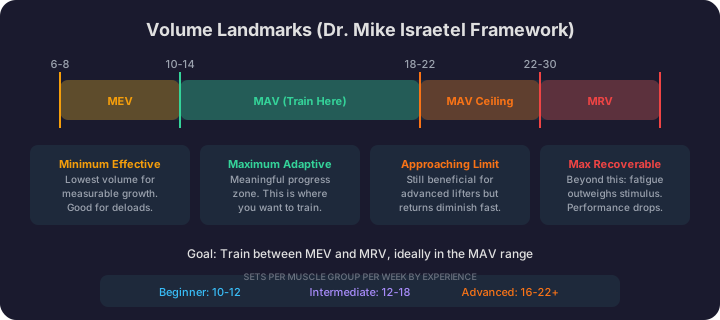
Your goal is to train in the MAV range — above MEV, below MRV.
How to Progress Volume Over Time
Volume progression is one of the most underused forms of progressive overload:
Week 1: 12 sets per muscle group Week 2: 14 sets per muscle group Week 3: 16 sets per muscle group Week 4: 18 sets per muscle group Week 5: Deload to 8-10 sets per muscle group
Each week, you add 1-2 sets to your exercises. Over 4 weeks, volume climbs from the bottom of your productive range to the top. Then you deload to clear fatigue and start a new progression.
This is called a volume accumulation block and it's one of the most effective training structures for intermediate and advanced lifters.
Signs You're Doing Too Much
- Performance is declining despite consistent effort
- Persistent soreness that doesn't resolve between sessions
- Sleep quality is worsening
- Joint pain that wasn't present at lower volumes
- Workouts take excessively long (90+ minutes of hard training)
- Motivation and enthusiasm for training drops
If you notice these signs, reduce volume by 20-30% and reassess after 2-3 weeks.
Signs You're Not Doing Enough
- You never feel challenged during workouts
- You recover fully within 24 hours with zero soreness
- Progress has been flat for 4+ weeks
- Your training sessions take 30-40 minutes
If this describes your training, add 2-4 sets per muscle group per week and monitor the response.
The Bottom Line
Training volume is the primary driver of hypertrophy — but it operates on a curve with diminishing returns. For most lifters, 12-20 hard working sets per muscle group per week, distributed across 2+ sessions, is the productive zone. Track your volume by muscle group, progress it over training blocks, and respect the signals that indicate you've reached your current ceiling.
More isn't always better. But enough always matters.