


If you could only take one supplement for the rest of your training life, the answer would almost certainly be creatine monohydrate. No other supplement has as much scientific evidence supporting its effectiveness, safety, and accessibility.
Yet misconceptions about creatine persist. Let's clear them up.
What Creatine Actually Does
Creatine is a naturally occurring compound found in muscle cells. Your body produces about 1-2g per day from amino acids, and you get additional creatine from dietary sources (primarily red meat and fish).
In your muscles, creatine is stored as phosphocreatine (PCr). During intense, short-duration efforts — think heavy sets of squats, sprints, or explosive movements — your muscles use the ATP-PCr energy system as their primary fuel source.
ATP (adenosine triphosphate) is the direct energy currency of muscle contraction. When ATP is used, it loses a phosphate group and becomes ADP. Phosphocreatine donates its phosphate back to ADP, regenerating ATP so your muscles can keep contracting.
The practical translation: More creatine in your muscles = more phosphocreatine = faster ATP regeneration = more reps, more power, more strength.
What the Research Shows
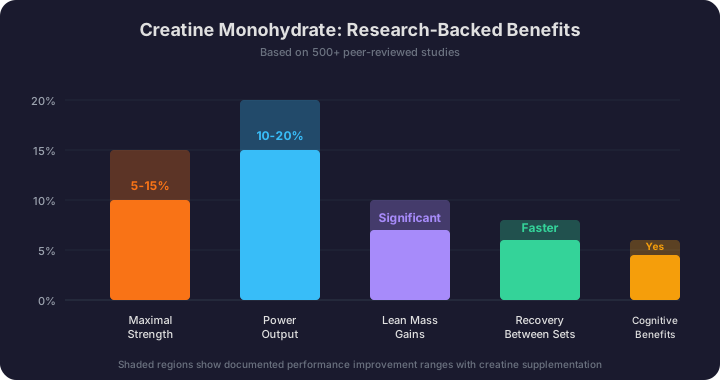
Creatine is backed by over 500 peer-reviewed studies. Here's what they consistently demonstrate:
Strength and Power
- 5-15% increase in maximal strength on compound lifts
- 10-20% improvement in power output during explosive efforts
- Enhanced performance in repeated high-intensity bouts (multiple heavy sets)
Muscle Growth
- Greater lean mass gains when combined with resistance training
- The hypertrophy benefit comes from the ability to train with more volume and intensity — creatine doesn't directly cause muscle growth, but it lets you do more productive work
Recovery
- Reduced muscle damage markers after intense training
- Faster recovery between sets and between sessions
Cognitive Benefits
- Improved cognitive performance, especially under stress or sleep deprivation
- The brain also uses the ATP-PCr system for high-demand cognitive tasks
How to Take It
The research is clear on dosing:
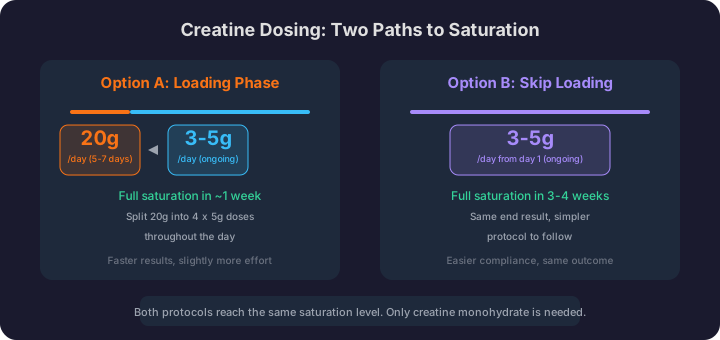
Loading Phase (Optional) 20g per day (split into 4x5g doses) for 5-7 days. This fully saturates muscle creatine stores quickly.
Maintenance Phase 3-5g per day, every day. This maintains saturated stores.
Skip the Loading (Also Fine) If you just take 3-5g daily from the start, you'll reach full saturation in about 3-4 weeks. The only difference is timing — loading gets you there faster.
Timing It doesn't matter much. Creatine works through saturation, not acute timing. Some research suggests a slight benefit to taking it post-workout with carbohydrates (which enhance creatine uptake), but the effect is minor. Just take it consistently at whatever time is easiest for you.
With What Mix it in water, juice, a protein shake — anything. Creatine monohydrate dissolves reasonably well in liquid and has minimal taste.
Which Type to Buy
Creatine Monohydrate — This is the only form you need. It's the most studied, most effective, and cheapest form. Every other variant (creatine HCl, creatine ethyl ester, buffered creatine, creatine nitrate) is a marketing play. None have been shown to be more effective than monohydrate.
Look for a product that is third-party tested (look for NSF Certified for Sport, Informed Sport, or similar certifications). Creatine monohydrate should cost approximately $0.03-0.05 per gram — if you're paying significantly more, you're overpaying.
Common Myths Debunked
"Creatine causes kidney damage." No. This has been studied extensively in healthy individuals, including long-term studies spanning years. Creatine does not impair kidney function in people with healthy kidneys. Creatine increases creatinine levels (a kidney marker), which can cause a false flag on blood tests — but this is a measurement artifact, not actual kidney stress.
If you have pre-existing kidney disease, consult your doctor. For healthy individuals, creatine is safe.
"Creatine causes hair loss." This stems from a single 2009 study that found creatine supplementation increased DHT (dihydrotestosterone) levels. DHT is linked to male pattern baldness. However, no subsequent study has replicated this finding, and no study has directly shown creatine causing hair loss. The evidence is extremely weak.
"Creatine is a steroid." Creatine is not a steroid, not hormonal, and not banned by any major sports organization. It's a natural compound found in food.
"Creatine makes you bloated." Creatine increases intracellular water retention (water inside muscle cells), which makes muscles appear fuller — not bloated. The initial weight gain of 1-3kg in the first week of loading is water pulled into muscle cells. This is a positive effect that contributes to the anabolic environment.
"You need to cycle creatine." No. There is no evidence that cycling creatine on and off provides any benefit. Your body doesn't "adapt" to creatine in a way that requires cycling. Take it consistently.
Who Should Take Creatine
Almost everyone who trains can benefit:
- Strength athletes: Direct performance benefit on heavy lifts
- Bodybuilders: More training volume = more growth stimulus
- Endurance athletes: Benefits for repeated sprint performance and recovery
- Vegetarians/vegans: Tend to have lower baseline creatine stores and see even larger benefits from supplementation
- Older adults: Creatine combined with resistance training helps preserve muscle mass and strength during aging
Who Should Be Cautious
- Individuals with pre-existing kidney disease (consult your doctor)
- People taking medications that affect kidney function (consult your doctor)
- That's about it — the safety profile of creatine monohydrate is exceptionally strong
The Bottom Line
Creatine monohydrate is safe, effective, well-researched, and cheap. Take 3-5g daily, every day, mixed in whatever liquid is convenient. Buy monohydrate, ignore fancy variants. Expect modest but consistent improvements in strength, power, training volume, and — over time — muscle growth.
It's not magic. It won't transform your physique overnight. But it's the closest thing to a no-brainer supplement that exists in sports nutrition.