


You've been stuck at 100kg on bench press for six weeks. Every session you load the bar, grind through the same reps, and leave feeling like you've made zero progress. Welcome to the strength plateau — the most frustrating experience in resistance training.
The good news: plateaus aren't permanent. They're signals that something in your training, recovery, or nutrition needs to change. Here's how to identify the cause and break through.
Why Plateaus Happen
Adaptation Ceiling Your body has adapted to the current stimulus and needs a new one. Doing the same exercises, sets, reps, and weights week after week stops providing a reason for your body to get stronger.
Accumulated Fatigue You may have been training hard for too long without adequate recovery. Fatigue masks fitness — you might actually be stronger than your performance suggests, but accumulated fatigue is suppressing your output.
Technical Inefficiency As weights get heavier, small technical flaws become limiting factors. A slight forward lean in the squat, flared elbows on bench, or hip rise on deadlift — these issues might not matter at lighter weights but become performance-limiting at higher intensities.
Nutritional Deficit You can't build strength on insufficient fuel. Caloric deficits, inadequate protein, and poor nutrition timing all impair strength adaptations.
Recovery Gaps Poor sleep, high stress, and insufficient rest between sessions all reduce your capacity to adapt and perform.
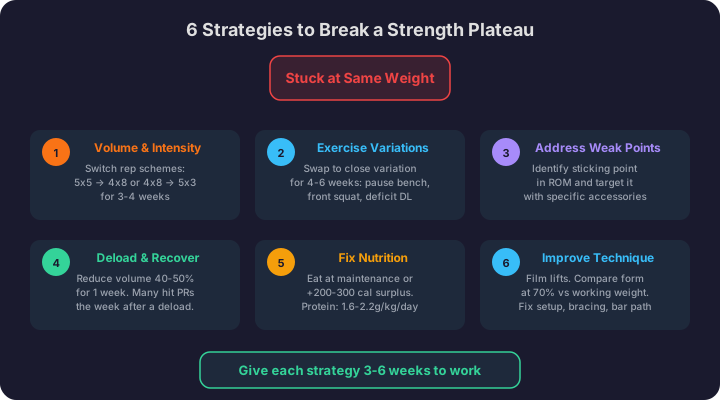
Strategy 1: Manipulate Volume and Intensity
If you've been training the same rep scheme for more than 6-8 weeks, it's time to change the stimulus:
If you've been doing 5x5: Switch to 4x8 at a lower weight for 3-4 weeks. Build volume and work capacity, then return to heavy work. The increased volume creates new growth, and the neural efficiency from previous heavy training will still be there.
If you've been doing 4x8-12: Switch to heavier work — 5x3 or 6x2 at higher intensity. The heavier loads improve neural drive and motor unit recruitment, which translates back to your moderate-rep work.
If you've been doing the same total sets: Add 1-2 sets per exercise per week for 3 weeks, then deload. The temporary volume increase can push past a plateau.
Strategy 2: Change Exercise Variations
Your body adapts not just to the load but to the specific movement pattern. Swapping to a close variation can provide a new stimulus while still training the same muscles:
- Stuck on flat bench? Switch to close-grip bench or pause bench for 4-6 weeks
- Stuck on back squat? Try front squats or pin squats
- Stuck on conventional deadlift? Train deficit deadlifts or Romanian deadlifts
- Stuck on overhead press? Use push press or Z-press
When you return to the original movement after 4-6 weeks, you'll often find your plateau has disappeared. The variation addressed a weakness or provided a novel stimulus that carried over.
Strategy 3: Address the Weak Point
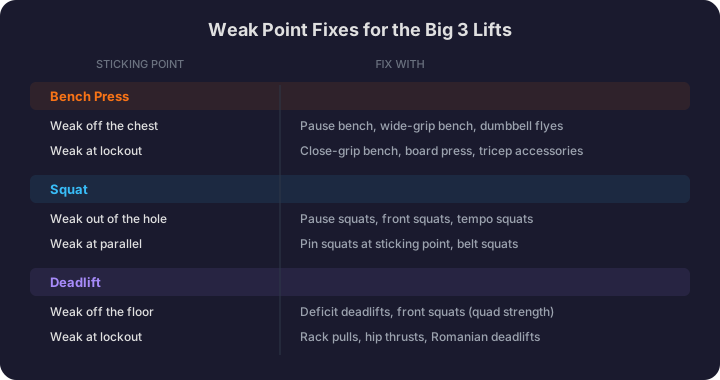
Every lift has a sticking point — a specific portion of the range of motion where you fail. Identifying and targeting that weak point is one of the most effective plateau-breaking strategies:
Bench Press:
- Weak off the chest → pause bench press, wide-grip bench, dumbbell flyes
- Weak at lockout → close-grip bench, board press, tricep-focused accessories
Squat:
- Weak out of the hole → pause squats, front squats, tempo squats
- Weak at parallel → pin squats at sticking point, belt squats
Deadlift:
- Weak off the floor → deficit deadlifts, front squats (quad strength)
- Weak at lockout → rack pulls, hip thrusts, Romanian deadlifts
HyperBody's physique analysis can help here too — identifying muscle groups that are underdeveloped relative to others gives you a roadmap for which weak points to prioritize.
Strategy 4: Deload and Recover
Sometimes the plateau isn't a training problem — it's a recovery problem. If you've been training hard for 6+ weeks without a deload, take one. Reduce volume by 40-50% for a week and focus on sleep, nutrition, and stress management.
Many lifters hit PRs in the first week after a deload. The strength was always there — fatigue was just hiding it.
Strategy 5: Fix Your Nutrition
Strength adaptations require energy. If you're in a caloric deficit or eating insufficient protein, your body doesn't have the resources to get stronger:
- Caloric intake: At minimum, eat at maintenance. A slight surplus (200-300 calories) is ideal for strength phases.
- Protein: 1.6-2.2g per kg of body weight per day, spread across 4-5 meals.
- Carbohydrates: Don't neglect carbs during strength phases. They fuel glycolytic energy systems and support training performance. 3-5g per kg of body weight is a good range.
- Pre-workout nutrition: Eating 1-2 hours before training ensures glycogen stores are topped up. A meal with protein and carbs (e.g., rice and chicken, oats and whey) is ideal.
Strategy 6: Improve Technique
Film your lifts and analyze them. Compare your form at your working weight to your form at 70-80%. If you see significant differences — bar path changes, tempo changes, body position shifts — those are efficiency losses that limit your strength output.
Common technical fixes that immediately improve performance:
- Tighter setup on bench press (retracted scapulae, leg drive, arch)
- Better bracing on squats and deadlifts (deep breath, brace against belt)
- Consistent bar path — every rep should look the same
- Controlled descent — don't dive-bomb your squats or free-fall your bench
HyperBody's exercise library includes form cues and video demonstrations for every exercise in your program. Review them periodically, especially when you're stuck.
When to Change Programs Entirely
If you've tried the strategies above and are still stuck after 4-6 more weeks, it may be time for a full program change. This doesn't mean your current program was bad — it means you've extracted its value and need a new periodization approach.
Switch to a different training methodology for 8-12 weeks (e.g., from a linear progression to an undulating or block periodization model), then reassess.
The Bottom Line
Plateaus are normal — every lifter experiences them. They're not signs of failure; they're signals that you've adapted to the current stimulus. Diagnose the cause (insufficient stimulus variation, fatigue, nutrition, technique), apply the appropriate fix, and give it 3-6 weeks. Progress will resume.