


Walk into any gym and you'll see dozens of people following the same handful of programs — the same exercises, the same rep schemes, the same weekly split. Some of them are making great progress. Most are not.
The difference usually isn't effort. It's fit. A training program that works brilliantly for one person can be mediocre — or even counterproductive — for another. Your body structure, training history, weak points, and goals all demand a program built for you. That's what smart training is about.
What Makes Training "Smart"?
Smart training isn't about complexity. It's about precision. A smart program accounts for four things:
1. Your Individual Body Your proportions, muscle distribution, and current physique directly influence which exercises will be most effective for you — and which might be a waste of your time.
2. Progressive Overload The program systematically increases the challenge over time. Without progression, your body has no reason to adapt.
3. Periodization Training is organized into phases with specific goals — not just random workouts strung together.
4. Weak Point Prioritization Instead of training everything equally, a smart program puts extra emphasis on the areas that need the most work.
Progressive Overload: The Non-Negotiable
If there's one principle that separates people who make consistent progress from those who spin their wheels, it's progressive overload. Simply put: you must systematically increase the demands on your muscles over time.
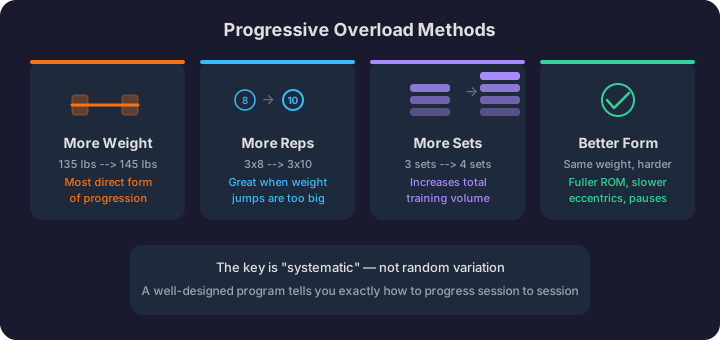
This doesn't mean adding weight to the bar every single session (though that's ideal when possible). Progressive overload can take many forms:
- More weight — the most straightforward form of progression
- More reps — doing 10 reps where you used to do 8
- More sets — increasing total training volume
- Better form — deeper range of motion, slower eccentrics, less momentum
The key word is "systematic." Random variation isn't progressive overload — it's just chaos. A well-designed program tells you exactly how to progress from session to session and week to week.
Why Your Body Structure Matters
This is where most generic programs fall short. They assume everyone's body works the same way — and it doesn't.
Consider the squat. Someone with short femurs and a long torso can squat upright with ease, hammering their quads effectively. Someone with long femurs and a short torso will naturally lean forward more, turning the squat into more of a hip-dominant movement. Neither is wrong, but they may need different squat variations — or entirely different exercises — to achieve the same training effect.
The same principle applies everywhere:
- Long arms make deadlifts easier but bench press harder
- Wide clavicles respond well to overhead pressing but may struggle with narrow-grip movements
- High vs. low muscle insertions affect how muscles look and which exercises build them most effectively
A program that accounts for your structure selects exercises that actually match your body — not exercises that look good on paper but don't fit your leverages.
Periodization Basics
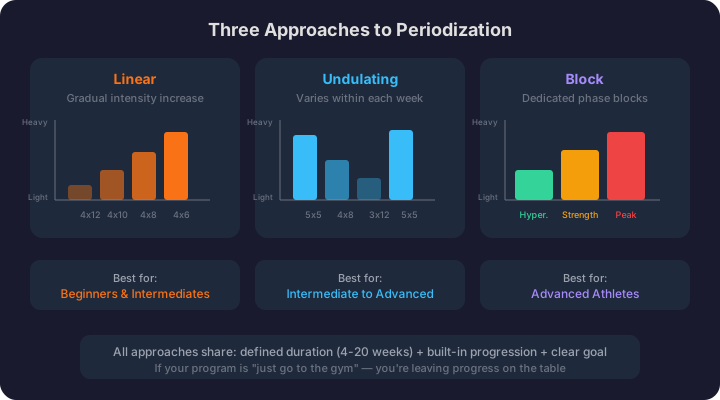
Periodization is how you organize your training over weeks and months. It prevents plateaus, manages fatigue, and ensures you're progressing toward a specific goal. There are three common approaches:
Linear Periodization Start with higher reps and lighter weight, then gradually increase intensity while decreasing volume over the training block. Simple, effective, and great for beginners and intermediates.
Example: Week 1-3 at 4x12, Week 4-6 at 4x10, Week 7-9 at 4x8, Week 10-12 at 4x6.
Undulating Periodization Varies intensity and volume within each week. You might do a heavy day (5x5), a moderate day (4x8), and a light day (3x12) in the same week. This keeps training stimulating and works well for intermediate to advanced lifters.
Block Periodization Dedicates entire training blocks (3-6 weeks each) to specific qualities — hypertrophy, strength, or peaking. Each block builds on the previous one.
The common thread: every good program has a defined duration (typically 4-20 weeks), a built-in progression scheme, and a clear goal. If your current program is "just go to the gym and do stuff," you're leaving progress on the table.
Form Matters More Than Weight
It's tempting to chase numbers. Adding plates to the bar feels like progress — and sometimes it is. But form degradation is one of the fastest ways to stall your progress and invite injury.
Proper technique ensures:
- The target muscle is actually doing the work (not momentum or compensating muscles)
- You're training through a full range of motion
- Joint stress is distributed safely
- Every rep counts toward actual muscle growth
This is an area where objective feedback makes a huge difference. HyperBody's video form analysis lets you upload a video of your set and receive rep-by-rep feedback on your technique — identifying form breakdowns, range of motion issues, and areas for improvement. It's like having a coach watching every rep.
How HyperBody Approaches Smart Coaching
HyperBody brings the principles above together into a single system. Here's how it works from your perspective:
- Start with your physique analysis — your body composition, muscle distribution, proportions, and weak points inform everything that follows
- Receive a personalized program — exercises are selected based on your body structure and goals, not pulled from a generic template
- Progressive overload is built in — the program tells you exactly what to do each session, with progression planned across the entire training block
- Weak points are addressed — areas identified in your analysis receive priority in your programming
- Log your workouts — track every set, rep, and weight directly in the app so your progress is documented and visible
- Re-analyze and evolve — monthly physique re-analysis updates your coaching, so your program adapts as you improve
The result is a training experience that gets smarter over time — because it's always responding to the latest data about your body and your performance.
Tips for Getting the Most Out of Any Program
Whether you're using HyperBody or following your own plan, these principles will help you get better results:
Be Consistent The best program in the world fails if you don't show up. Consistency beats intensity every time. Three solid sessions per week for 12 months will outperform six sessions per week for 2 months.
Track Your Workouts If you're not logging your weights, reps, and sets, you have no way to ensure you're progressing. Write it down — every session.
Don't Skip Weak Points It's human nature to train what you're already good at. Resist the urge. Your weak points are your biggest opportunity for visible improvement.
Re-Assess Regularly Your body changes. Your program should change with it. Monthly check-ins — whether through physique analysis, strength benchmarks, or both — keep you on track and prevent stagnation.
Trust the Process Smart training isn't about having a perfect workout every day. It's about stacking consistent, progressive sessions over months and years. The results compound — but only if you stay the course.
The fitness industry loves to sell novelty — new exercises, new splits, new "secrets." But the fundamentals haven't changed: train consistently, progress systematically, match your program to your body, and track everything. Do those things, and the results will follow.