


Everyone wants to build muscle, but surprisingly few people understand what actually causes muscles to grow. The fitness industry is full of conflicting advice — heavy weights vs. light weights, high reps vs. low reps, machines vs. free weights — and most of it misses the fundamental science.
Let's fix that.
The Three Mechanisms
For decades, researchers have identified three primary mechanisms that contribute to muscle hypertrophy:
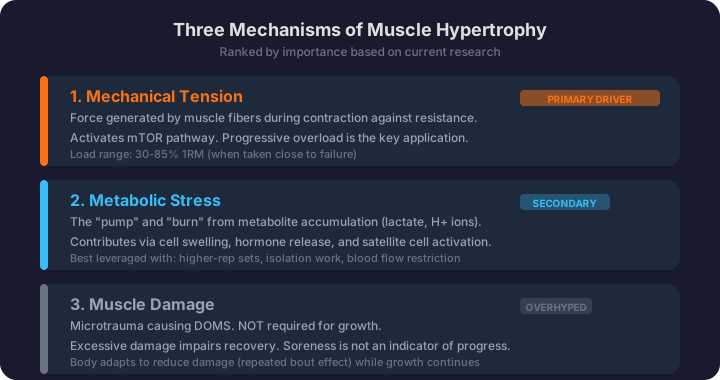
- Mechanical tension
- Metabolic stress
- Muscle damage
Recent research has clarified the relative importance of each — and the answer is more definitive than many people realize.
Mechanical Tension: The Primary Driver
Mechanical tension is the force generated by muscle fibers during contraction against resistance. It's the single most important factor for muscle growth.
When you load a muscle with sufficient resistance, mechanosensors on the muscle fibers detect the tension and trigger a cascade of molecular signaling — including the mTOR pathway, which is the master regulator of protein synthesis.
What this means practically:
- Progressive overload matters most. Gradually increasing the tension your muscles experience over time (more weight, more reps at the same weight, or more sets) is the primary driver of long-term muscle growth.
- The weight must be challenging. Research shows that loads of approximately 30-85% of your 1RM can all produce hypertrophy — but only when sets are performed close to failure. At lighter loads, you need more reps to recruit all motor units.
- Time under tension matters, but not how you think. It's not about slow reps or specific tempos — it's about performing enough challenging reps to create sufficient total mechanical tension.
Metabolic Stress: The Secondary Factor
Metabolic stress refers to the accumulation of metabolic byproducts (lactate, hydrogen ions, inorganic phosphate) during sustained muscular contraction. This is the "pump" and "burn" you feel during higher-rep training.
Metabolic stress contributes to hypertrophy through several mechanisms:
- Cell swelling (the pump) may trigger anabolic signaling
- Hormone release (GH, IGF-1) is acutely elevated by metabolic stress
- Metabolite accumulation may enhance motor unit recruitment
- Reactive oxygen species from metabolic stress may activate satellite cells
However, recent research suggests metabolic stress is secondary to mechanical tension. Studies comparing high-load training (which produces less metabolic stress) to low-load training (which produces more metabolic stress) show similar hypertrophy when volume is equated — suggesting that mechanical tension, not the pump, is doing the heavy lifting.
That said, metabolic stress isn't worthless. It likely provides an additive effect on top of mechanical tension, especially for:
- Higher-rep finisher sets
- Isolation work
- Occlusion/blood flow restriction training
- Machine exercises where you can maintain tension at peak contraction
Muscle Damage: Largely Overhyped
Muscle damage — the microtrauma to muscle fibers that causes soreness (DOMS) — was long believed to be a necessary trigger for growth. The theory was that damage initiates a repair process that results in bigger, stronger fibers.
Modern research has largely debunked this:
- Muscle damage is not required for hypertrophy
- Excessive damage impairs recovery without providing additional growth stimulus
- The body adapts to reduce damage over time (the repeated bout effect), yet muscles continue to grow — proving damage isn't the driver
- Some of the most effective hypertrophy stimuli (e.g., occlusion training at light loads) produce minimal muscle damage
Soreness is not an indicator of a good workout. It's an indicator of novel stimulus — and novel doesn't mean better.
Practical Applications
Understanding these mechanisms changes how you should train:
Prioritize Progressive Overload Track your weights, reps, and sets. Your primary goal, session to session and week to week, should be to do slightly more work than before. This is what drives mechanical tension upward over time.
Use a Variety of Rep Ranges
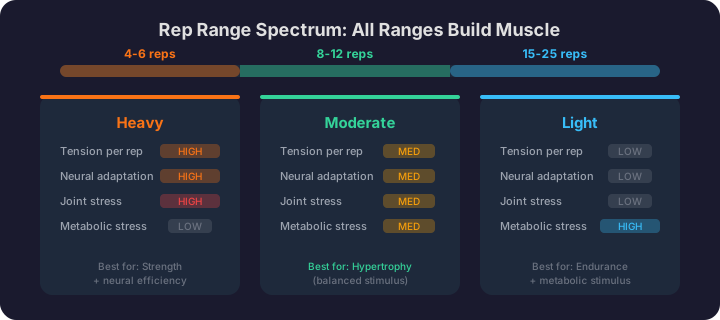
- Heavy (4-6 reps): High mechanical tension per rep, strong neural adaptations
- Moderate (8-12 reps): Good balance of tension and volume, the traditional "hypertrophy range"
- Light (15-25 reps): Higher metabolic stress, still effective for growth when taken near failure
All rep ranges build muscle. The moderate range is popular because it balances stimulus quality with practical volume — you can do enough sets without excessive joint stress (heavy) or cardiovascular fatigue (light).
Don't Chase Soreness If you're sore after every workout, you're probably creating excessive damage that hampers recovery. Some soreness is normal, especially when introducing new exercises. But chronic severe DOMS suggests your volume or novelty is too high.
Emphasize Full Range of Motion Training through a complete range of motion maximizes mechanical tension across the entire length of the muscle fiber. Partial reps have their place as an intensity technique, but full ROM should be your default.
Include Both Compounds and Isolation Compound movements (squats, presses, rows) provide high total mechanical tension across multiple muscle groups. Isolation movements (curls, extensions, raises) let you target specific muscles with focused tension and metabolic stress.
The Minimum Effective Dose
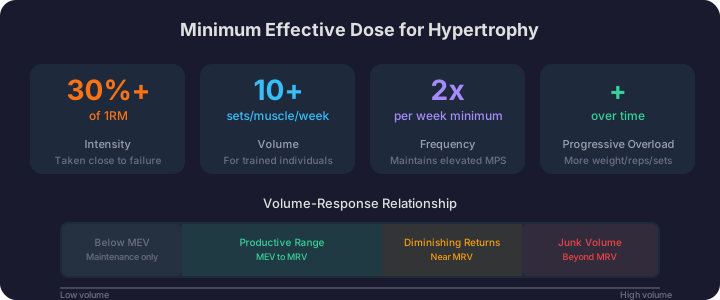
Research suggests the following minimums for hypertrophy:
- Intensity: At least 30% of 1RM, taken close to failure (RIR 0-3)
- Volume: At least 10 working sets per muscle group per week for trained individuals
- Frequency: Each muscle group at least 2x per week (to maintain elevated MPS)
- Progression: Some form of progressive overload over time
Beyond these minimums, more isn't always better. There's an upper limit of productive volume (often called Maximum Recoverable Volume) beyond which additional sets produce more fatigue than growth.
The Bottom Line
Muscle growth is primarily driven by mechanical tension applied progressively over time. Metabolic stress provides a useful secondary contribution, particularly in isolation and higher-rep work. Muscle damage is a side effect, not a goal.
Train with challenging loads, progress systematically, use full range of motion, and recover adequately. The science is clear — complexity is optional, consistency is not.