


There's something deeply satisfying about grinding out that last impossible rep. Your muscles are screaming, your face is contorted, and you physically cannot move the weight another inch. That's training to failure — and it's one of the most debated topics in strength training.
Some coaches swear by it. Others say it's overrated and counterproductive. The truth, as usual, is nuanced.
What "Failure" Actually Means
Muscular failure means you cannot complete another concentric repetition with proper form despite maximum effort. It's important to distinguish between:
- Technical failure — you can still move the weight, but your form breaks down significantly
- Muscular failure — you physically cannot complete the rep even with form breakdown
- Absolute failure — you've used drop sets, forced reps, or rest-pause to push beyond initial failure
Most research and practical recommendations refer to technical failure or muscular failure. Absolute failure involves extreme fatigue and has different recovery implications.
The Case FOR Training to Failure
Maximum Motor Unit Recruitment As a set progresses and fatigue accumulates, your body recruits increasingly larger motor units to maintain force output. At or near failure, virtually all available motor units are active — including the high-threshold units that drive the most muscle growth.
Reliable Effort Gauge Failure provides an objective endpoint. You know you gave everything. For people who tend to underestimate their effort or stop sets too early, training to failure ensures sufficient stimulus.
Effective at Lower Volumes Research shows that when training to failure, fewer total sets may be needed to stimulate growth. A 2021 meta-analysis found that training to failure was more effective per set for hypertrophy than stopping short of failure — but total volume moderated this effect.
The Case AGAINST Training to Failure
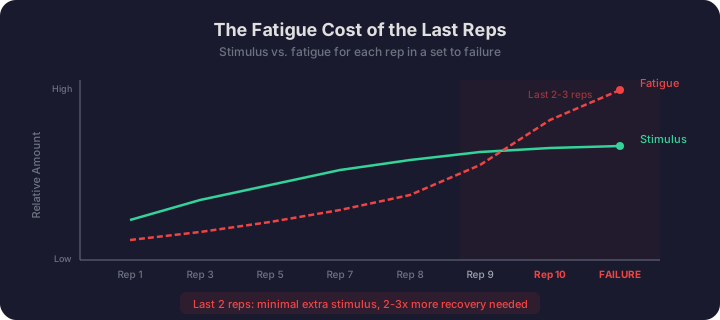
Massively Increased Fatigue The last 1-2 reps of a set to failure generate disproportionate fatigue relative to the stimulus they provide. Studies show that a set taken to failure can require 2-3 times longer to recover from than a set stopped 2-3 reps short.
Reduced Training Volume Because failure generates so much fatigue, you typically can't do as many total sets in a session or a week. Since total training volume is the primary driver of hypertrophy, excessive failure training can actually reduce your overall stimulus.
Form Breakdown Risk At or near failure, form degrades. This is especially problematic on compound lifts where poor mechanics increase injury risk. A sloppy deadlift rep at failure is a very different risk proposition than a sloppy bicep curl.
Neural Fatigue Training to failure on heavy compounds is extremely taxing on the nervous system. This accumulated neural fatigue can take days to dissipate and impacts performance on subsequent sessions.
The Practical Framework
Research and coaching experience converge on a balanced approach:
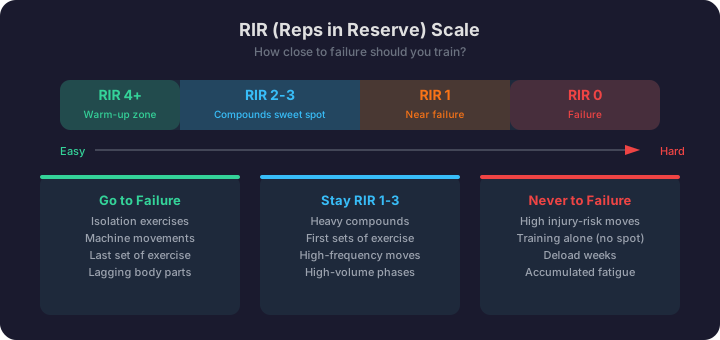
Go to failure on:
- Isolation exercises (curls, lateral raises, leg extensions)
- Machine exercises (where the movement path is fixed and safe)
- The last set of an exercise (after your working sets, push the final set to failure)
- Lagging body parts (the extra stimulus helps prioritize growth)
Stay 1-3 reps from failure (RIR 1-3) on:
- Heavy compound lifts (squat, bench, deadlift, overhead press)
- The first sets of multi-set exercises (preserve performance for later sets)
- High-frequency movements (exercises you repeat 2-3 times per week)
- During high-volume phases (when total weekly sets are already high)
Never go to failure on:
- Exercises with high injury potential at fatigue (heavy barbell rows, behind-the-neck press)
- When training alone without a spotter on risky movements
- During deload weeks
- When you're already showing signs of accumulated fatigue
RIR: Reps in Reserve
The most practical way to manage proximity to failure is the RIR (Reps in Reserve) system:
- RIR 0 = failure (zero reps left)
- RIR 1 = could do 1 more rep
- RIR 2 = could do 2 more reps
- RIR 3 = could do 3 more reps
For most hypertrophy training, working in the RIR 1-3 range on compounds and RIR 0-1 on isolation exercises provides the best balance of stimulus and recovery.
Learning to accurately gauge your RIR takes practice. Most beginners dramatically overestimate their proximity to failure — they think they're at RIR 1 when they're actually at RIR 4-5. Recording your sets and occasionally testing true failure (safely) helps calibrate this skill.
What About Advanced Techniques?
Drop sets, rest-pause sets, and forced reps are all methods of pushing beyond initial failure. These techniques have their place but should be used sparingly:
- Drop sets: Immediately reduce weight and continue. Effective for isolation exercises at the end of a workout. 1-2 drop sets per session maximum.
- Rest-pause: Hit failure, rest 10-15 seconds, do more reps. Excellent for maximizing stimulus in a time-efficient way.
- Forced reps: A spotter assists you past failure. Use only with a competent spotter and only on safe exercises.
These are intensity techniques, not everyday tools. Using them on every set of every workout is a recipe for burnout and injury.
The Bottom Line
Training to failure is a powerful tool — but like any powerful tool, it can cause damage if used carelessly. The optimal approach for most lifters is to train near failure on compounds (RIR 1-3) and to failure selectively on isolation and machine work.
Save your hardest efforts for the exercises and sets where they'll have the most impact — and recover from them adequately before your next session.