


"Squeeze the muscle." "Feel the contraction." "Think about the target muscle working."
If you've spent any time in a gym, you've heard these cues. The idea is that consciously focusing on the muscle you're training improves the training effect. Bodybuilders have championed this concept for decades. But is the mind-muscle connection real, or just gym folklore?
The research says: it's real — but with important caveats.
What the Research Shows
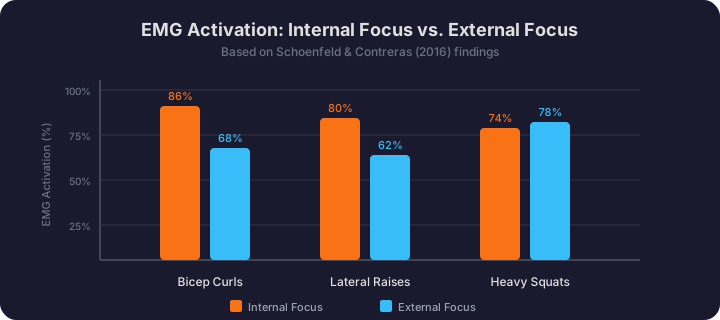
A landmark 2016 study by Schoenfeld and Contreras found that when trained lifters focused internally on the target muscle during bicep curls, EMG activity in the biceps increased significantly compared to when they focused on the external movement (moving the weight from point A to B).
A follow-up 2018 study took it further: subjects who were instructed to "squeeze and focus on the muscle" during training saw greater muscle hypertrophy over an 8-week training program compared to those who simply focused on moving the weight.
The effect was most pronounced in isolation exercises and single-joint movements. For heavy compound lifts, the benefit was less clear — and may even be counterproductive.
When It Works Best
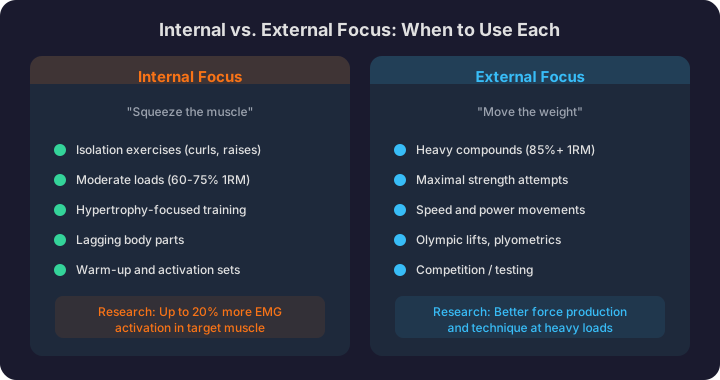
Isolation Exercises Bicep curls, lateral raises, leg extensions, cable flyes — exercises where one muscle group is the clear target. Internal focus helps increase activation of that specific muscle and reduces contribution from secondary movers.
Moderate Loads (60-75% 1RM) The mind-muscle connection is most effective at moderate intensities. When the weight is too heavy, your nervous system recruits everything available regardless of your mental focus. At moderate loads, there's room for conscious focus to influence recruitment patterns.
Hypertrophy Training If your goal is muscle growth, internal focus is valuable. The increased activation and time under tension translate to a stronger hypertrophic stimulus.
Lagging Body Parts Struggling to grow your rear delts? Can't feel your lats working during rows? Internal focus can help "wake up" muscles that you have poor neurological connection with.
When It Doesn't Help (or Hurts)
Heavy Compound Lifts During heavy squats, deadlifts, or bench press at 85%+ of your max, you should focus externally — on moving the bar, driving through the floor, pressing to lockout. Internal focus during maximal efforts can actually reduce force production and compromise technique.
Speed and Power Movements Olympic lifts, plyometrics, explosive work — these require external focus on the outcome (jump height, bar speed) rather than internal focus on individual muscles.
Very Light Loads Below about 50% of your max, there isn't enough mechanical tension for the mind-muscle connection to add meaningful benefit. The weight is too light to create a growth stimulus regardless of how hard you squeeze.
How to Develop It
If you struggle to "feel" certain muscles working — which is extremely common for back muscles, rear delts, and glutes — here's how to develop the connection:
Start with Isolation Before doing heavy compound back work, do a few light sets of straight-arm pulldowns or single-arm cable rows. Focus entirely on feeling the lat stretch and contract. This "primes" the neural pathway.
Use Slow Eccentrics Slowing down the lowering phase to 3-4 seconds forces you to maintain control and awareness of the target muscle throughout the movement.
Reduce the Weight If you can't feel the target muscle at your current working weight, the weight is too heavy for this purpose. Drop it 20-30% and rebuild with quality contractions.
Pause at Peak Contraction Hold the fully contracted position for 1-2 seconds. For example, at the top of a cable fly, squeeze your chest hard and hold before releasing. This builds the neurological association between the movement and the muscle.
Touch the Muscle This sounds odd but works remarkably well. Lightly touching the target muscle (or having a training partner do so) during the movement increases activation. Your nervous system responds to tactile feedback.
A Practical Framework
Here's how to integrate mind-muscle connection into your training without overthinking it:
- Warm-up sets and isolation work: Strong internal focus. Squeeze, feel, contract.
- Working sets at moderate loads (hypertrophy range): Internal focus, especially on the eccentric and peak contraction.
- Heavy compounds at high intensity: External focus. Move the weight. Don't think about squeezing your quads during a heavy squat — think about driving the floor away.
- Weak points and lagging muscles: Always use internal focus. This is where it pays the biggest dividends.
The Verdict
The mind-muscle connection is not bro science — it's supported by peer-reviewed research showing increased muscle activation and greater hypertrophy when used appropriately. But it's also not a magic bullet, and using it in the wrong context (heavy compounds, maximal efforts) can actually hurt performance.
Use it strategically: isolation work, moderate loads, lagging body parts. Your muscles will thank you.