


Stand sideways in front of a mirror. Don't adjust anything — just stand normally. What do you see?
If you're like most people who sit at a desk or look at a phone for hours daily, you probably see some combination of: head pushed forward, shoulders rounded, upper back curved, and lower back excessively arched. These aren't just aesthetic issues — they're a roadmap of your muscle imbalances.
Your posture is a live readout of the balance (or imbalance) between opposing muscle groups. Tight muscles pull your skeleton in one direction; weak muscles fail to pull it back. Over time, these imbalances become your default posture — and they affect everything from how you look to how you perform in the gym to your risk of injury.
The Four Most Common Postural Deviations
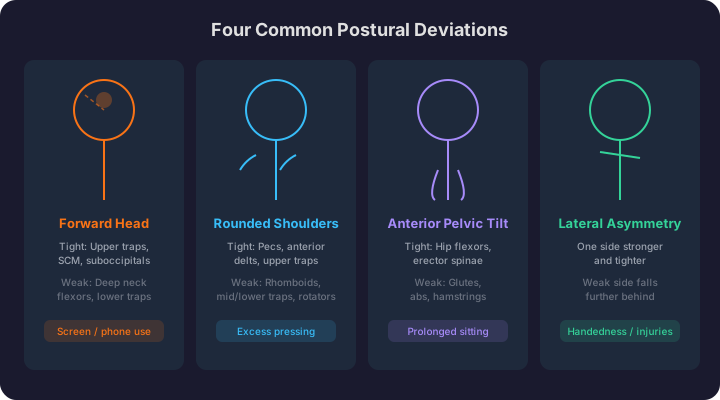
1. Forward Head Posture
What it looks like: Your head sits in front of your shoulders rather than directly above them. From the side, your ear is ahead of your shoulder joint.
What it tells you:
- Tight/overactive: Suboccipital muscles (base of skull), upper trapezius, levator scapulae, sternocleidomastoid
- Weak/underactive: Deep neck flexors, lower trapezius
Why it happens: Hours of looking down at phones, laptops, and books. The head gradually migrates forward, and the muscles at the front of the neck weaken while the muscles at the back shorten.
Impact on training: Forward head posture affects overhead pressing (reduced range of motion and shoulder impingement risk), pulling movements (upper traps dominate over mid and lower traps), and core stability (the shifted center of gravity alters spinal loading).
How to address it:
- Strengthen: Chin tucks (deep neck flexor activation), face pulls, prone Y-raises
- Stretch/release: Suboccipital release (tennis ball at base of skull), upper trap stretches, SCM stretches
- Habit change: Monitor head position during the day. Set hourly reminders to reset your head position over your shoulders.
2. Rounded Shoulders (Upper Crossed Syndrome)
What it looks like: Shoulders roll forward. Upper back is rounded (kyphotic). From the front, you can see the backs of your hands when standing with arms at your sides.
What it tells you:
- Tight/overactive: Pectorals (major and minor), anterior deltoids, upper trapezius
- Weak/underactive: Rhomboids, mid and lower trapezius, rotator cuff (external rotators), serratus anterior
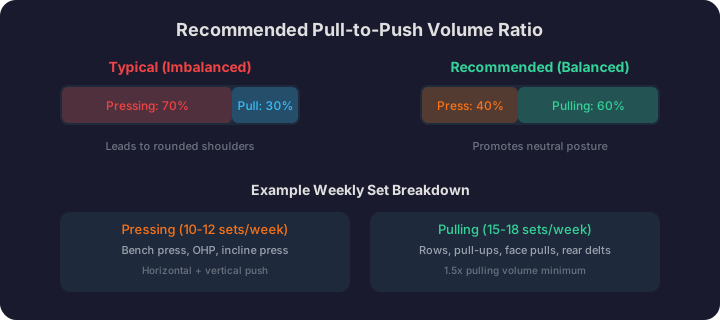
Why it happens: Desk work, excessive pressing without proportional pulling, and general anterior-dominant lifestyles. If you bench press twice a week but rarely do rows or face pulls, this pattern will develop.
Impact on training: This is one of the most impactful postural issues for lifters:
- Bench press: Rounded shoulders shift the load to the front delts and away from the chest
- Overhead press: Reduced overhead mobility increases impingement risk
- Rows: Upper traps compensate for weak mid-back muscles, reducing the effectiveness of back training
- Aesthetics: Rounded shoulders make your chest look smaller and your physique less impressive, even with good muscle mass
How to address it:
- Strengthen: Face pulls (3-4 sets, 3x per week), band pull-aparts, prone I-Y-T raises, external rotation work
- Stretch/release: Doorway pec stretches, foam rolling thoracic spine, lat stretches
- Program adjustment: Ensure your pulling volume is at least equal to (ideally 1.5x) your pressing volume
3. Anterior Pelvic Tilt
What it looks like: Your pelvis tilts forward, creating an exaggerated curve in your lower back. Your stomach pushes forward and your glutes push back, even if you don't have significant body fat.
What it tells you:
- Tight/overactive: Hip flexors (psoas, rectus femoris), erector spinae (lower back)
- Weak/underactive: Glutes, abdominals (particularly deep core/transverse abdominis), hamstrings
Why it happens: Sitting. Hours and hours of sitting. When you sit, your hip flexors are in a shortened position. Over time, they stay short even when you stand. Meanwhile, your glutes — which are dormant while sitting — weaken and fail to counteract the forward pull.
Impact on training:
- Squats: Excessive anterior tilt under load increases lumbar shear forces (lower back injury risk)
- Deadlifts: Difficulty maintaining neutral spine, especially at heavier loads
- Core work: Weak deep core muscles mean you're relying on your lower back for stability
- Aesthetics: Makes your stomach protrude even at low body fat percentages — often mistaken for belly fat
How to address it:
- Strengthen: Glute bridges and hip thrusts (prioritize glute activation), dead bugs, planks (focus on posterior pelvic tilt during the plank), reverse crunches
- Stretch/release: Hip flexor stretches (half-kneeling lunge stretch, couch stretch), foam rolling quads and hip flexors
- Movement cue: Practice a "posterior pelvic tilt" — tucking your pelvis slightly under. Use this cue during squats, deadlifts, and standing positions throughout the day.
4. Lateral Imbalances (Asymmetry)
What it looks like: One shoulder sits higher than the other. One hip appears higher or more prominent. When you squat or deadlift, the bar tilts to one side.
What it tells you:
- One side of your body is doing more work than the other
- Dominant-side muscles may be tighter and stronger
- Non-dominant side may have mobility or stability deficits
Why it happens: Handedness (favoring one side in daily life), old injuries that altered movement patterns, and bilateral exercises (barbell movements) that let the strong side compensate for the weak side.
Impact on training:
- Barbell exercises mask the imbalance — your strong side picks up the slack
- Over time, the weak side falls further behind, increasing injury risk
- Asymmetric loading creates uneven wear on joints
How to address it:
- Add unilateral work: Single-leg squats, single-arm rows, lunges, single-arm presses. Start with the weaker side and match the reps/weight with the stronger side.
- Video analysis: Film your bilateral lifts from the front to see if one side is doing more work
- Physique analysis: Body composition analysis can identify visual asymmetries in muscle development between sides
How Posture Connects to Your Physique
Here's what most people don't realize: postural issues directly affect how your physique looks, independent of muscle mass and body fat.
Rounded shoulders make your chest appear smaller and your physique less wide. Fix them, and you instantly look broader and more muscular — without gaining any muscle.
Anterior pelvic tilt makes your stomach protrude. People chase lower body fat to "lose the belly" when the real issue is pelvic position. Fix the tilt, and your midsection looks flatter immediately.
Forward head posture shortens the appearance of your neck and makes your upper back look hunched. Fix it, and you look taller and more athletic.
In many cases, addressing postural issues creates more visible physique improvement than months of additional training. It's the lowest-hanging fruit in physique development — and most people ignore it entirely.
Assessment: Check Your Own Posture
Wall test: Stand with your back against a wall. Touch the wall with your heels, glutes, upper back, and back of your head. If any point doesn't touch naturally, you have a deviation in that area.
Side photo: Take a photo from the side. Draw a vertical line from your ankle. Ideally, it should pass through your knee, hip, shoulder, and ear. Where does the line deviate?
Overhead reach: Stand with your back against a wall and raise both arms overhead, trying to touch the wall with your thumbs. If you can't without arching your lower back or your ribs flaring, you have mobility restrictions in your thoracic spine and/or shoulders.
How HyperBody Identifies Postural Issues
HyperBody's physique analysis evaluates your posture as part of the overall assessment. By analyzing your photos from multiple angles, it can identify:
- Shoulder position (rounded vs. neutral)
- Pelvic alignment (anterior tilt indicators)
- Left-right asymmetries in muscle development
- Upper back posture (kyphosis indicators)
These findings are incorporated into your training program recommendations. If your analysis reveals rounded shoulders and weak rear delts, your program will prioritize pulling work and external rotation exercises. If anterior pelvic tilt is identified, you'll see more glute activation and core work programmed in.
The takeaway: your posture isn't just about standing up straight. It's a diagnostic tool that reveals which muscles need work — and fixing those muscles improves both your health and your physique. Most people spend years chasing muscle growth without addressing the postural foundations that would make that muscle look and function better. Start with posture, and everything else improves.