


Every training program has a shelf life. The program that took you from zero to respectable will eventually stop delivering results. The program that broke your first plateau will eventually create your next one. This isn't a failure — it's how adaptation works.
The challenge is recognizing when your program has stopped working versus when you're just being impatient. Physique changes are slow, and the temptation to switch programs every few weeks is strong. But there are clear, objective signals that distinguish a genuine plateau from normal slow progress.
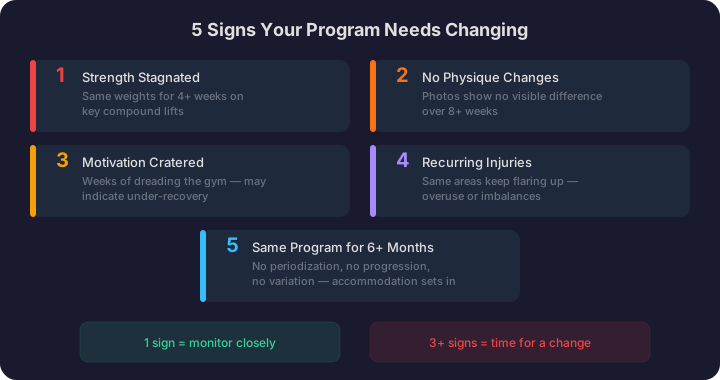
Sign 1: Your Strength Has Stagnated for 4+ Weeks
Strength is the most reliable leading indicator of muscle growth. If you're getting stronger over time, you're almost certainly building muscle. If your numbers have flatlined, something needs to change.
How to diagnose it: Look at your training log (you are keeping one, right?). Compare your working weights on key compound movements — squat, bench, deadlift, overhead press, rows — over the last 4-6 weeks.
- If weights are the same or declining across multiple exercises, you're plateaued
- If one exercise is stuck but others are progressing, that's an exercise-specific issue, not a program problem
- If everything has stalled, the program itself likely needs adjustment
What's NOT a plateau:
- One bad session after poor sleep. That's a bad day, not a plateau.
- Weights staying the same for 1-2 weeks. That's normal fluctuation.
- Isolation exercises not progressing (lateral raises don't go up the same way squats do).
What to change:
- If you've been running the same rep scheme for 6+ weeks, change it. Switch from 4x8 to 5x5, or from 3x6 to 4x10.
- If volume has been steadily increasing, you might be over-reaching. Take a deload week.
- If exercise selection has been identical for 12+ weeks, swap some movements for variations that target the same muscles from different angles.
Sign 2: Your Physique Photos Show No Change Over 8+ Weeks
Monthly photos are the gold standard for tracking visual progress. But "no change" needs context.
How to diagnose it: Compare photos from 8-12 weeks ago to today. Same lighting, same poses, same time of day.
- If there's genuinely no visible difference, your program may be insufficient
- If you see subtle changes in some areas but not others, your program might be fine overall but missing certain muscle groups
- If you look slightly worse (softer, smaller), you might be in a catabolic state from overtraining or under-eating
Important caveat: Progress slows dramatically as you advance. A beginner might see visible monthly changes. An intermediate might need 2-3 months to see noticeable differences. An advanced lifter might see meaningful changes only over 6-12 months.
Adjust your expectations based on your training age.
What to change:
- Run a body composition analysis to get objective data (visual assessment alone can be misleading)
- Review your nutrition — inadequate protein or calories can stall physique changes even with great training
- Consider whether your training volume is sufficient — advanced lifters need more volume than beginners
Sign 3: Your Motivation Has Cratered
This one is subtle but important. Sustained loss of training motivation — not a bad day, but weeks of dreading the gym — often indicates a physiological issue, not a psychological one.
The connection: Overtraining (more accurately, under-recovery) manifests as:
- Persistent fatigue that sleep doesn't fix
- Loss of enthusiasm for training
- Irritability and mood changes
- Decreased performance
- Increased injuries and joint aches
If you used to look forward to training and now you're forcing yourself through sessions, your body might be telling you that the accumulated training stress has exceeded your recovery capacity.
What to change:
- Take a full deload week (50% of normal volume, same intensity)
- Assess your sleep, nutrition, and stress levels outside the gym
- If symptoms persist after a deload, reduce overall training volume by 20-30% in your next mesocycle
- Consider whether your program has enough variety — monotony can also kill motivation independently of fatigue
Sign 4: You're Getting Injured More Often
Nagging injuries that keep recurring — shoulder tweaks, knee pain, lower back tightness — are often a sign of either:
- Overuse: too much volume on the same movement patterns without adequate recovery
- Imbalances: dominant muscles overpowering weaker stabilizers
- Poor movement quality: fatigue degrading your form without you realizing it
How to diagnose it: Track your injuries. If the same areas keep flaring up, look at your program for patterns:
- Shoulder issues → possibly too much pressing relative to pulling
- Knee pain → possibly too much quad-dominant work without enough hamstring/glute work
- Lower back → possibly too much spinal loading without adequate core work or deloading
What to change:
- Address the muscle balance: if you're pressing 3x per week and pulling 1x, that's a problem
- Add prehab work for the affected area (rotator cuff work for shoulders, hip mobility for knees)
- Swap problematic exercises for alternatives that train the same muscles with less joint stress
- Consider a physique analysis to identify muscle imbalances objectively
Sign 5: You're Doing the Same Thing You Did 6 Months Ago
This is the most common issue and the easiest to fix. Pull up your training log from six months ago. If today's workout looks essentially the same — same exercises, same rep schemes, same weights — you have a program that isn't programmed.
The problem: Your body adapts to repeated stimuli and stops responding. This is the principle of accommodation. Without systematic variation, you stagnate.
What "the same" looks like:
- Same exercises in the same order every week
- Same rep ranges (always 3x10, never varying)
- No periodization — no planned progression, no deload weeks, no phase changes
- Same training split running indefinitely
What to change: This requires a fundamental shift from "having a workout" to "following a program":
- Implement mesocycles (4-6 week training blocks with specific goals)
- Plan progressive overload (how will you progress from week 1 to week 6?)
- Schedule deloads (every 4-6 weeks)
- Rotate exercises every 1-2 mesocycles (keep the movement patterns, change the specific exercises)
- Vary rep ranges across blocks (a hypertrophy block at 8-12 reps, followed by a strength block at 4-6 reps)
When to Change vs. When to Be Patient
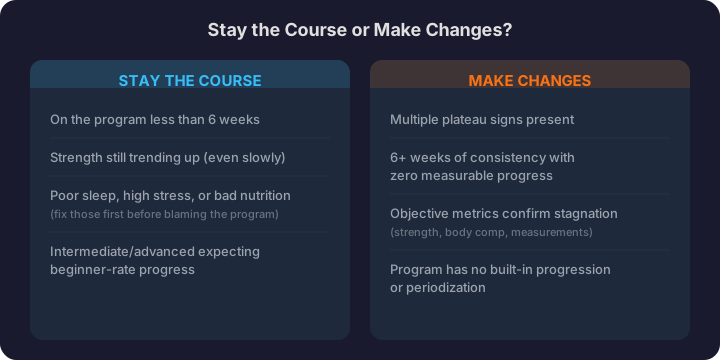
Not every slow period requires a program change. Here's a decision framework:
Stay the course if:
- You've been on the program less than 6 weeks
- Strength is still trending upward, even slowly
- You're sleeping poorly, stressed, or inconsistent with nutrition (fix those first)
- You're an intermediate/advanced lifter and expecting beginner-rate progress
Make changes if:
- Multiple signs from this list are present simultaneously
- You've been consistent with training, sleep, and nutrition for 6+ weeks with no progress
- Objective metrics (strength, measurements, body composition analysis) confirm stagnation
- You're following a program with no built-in progression or periodization
How HyperBody Prevents Stagnation
HyperBody's smart coaching is designed to address these issues proactively:
- Programs are periodized with built-in progression and deload weeks
- Exercise selection is refreshed each training block to prevent accommodation
- Monthly physique re-analysis detects stagnation early and triggers program adjustments
- Weak points identified in your analysis receive priority, reducing the imbalance-driven injury risk
The goal is to keep you progressing continuously rather than waiting for a plateau to hit and then reacting. Proactive programming beats reactive troubleshooting every time.
If you recognize three or more of these signs in your current training, it's time for a change. Not a random change — a structured, data-informed change. Analyze where you are, identify what's not working, and build a plan that addresses the specific issue. Random program hopping creates the illusion of action without solving the underlying problem.