


You uploaded your photos, waited for the analysis, and now you're staring at a report full of metrics, scores, and assessments. Some numbers look good. Some look concerning. Most of them, honestly, you're not sure how to interpret.
This is normal. A body composition analysis is only useful if you understand what it's telling you — and more importantly, what to do with the information. This guide walks you through each section of a typical analysis, explains what the numbers mean, and shows you how to turn data into action.
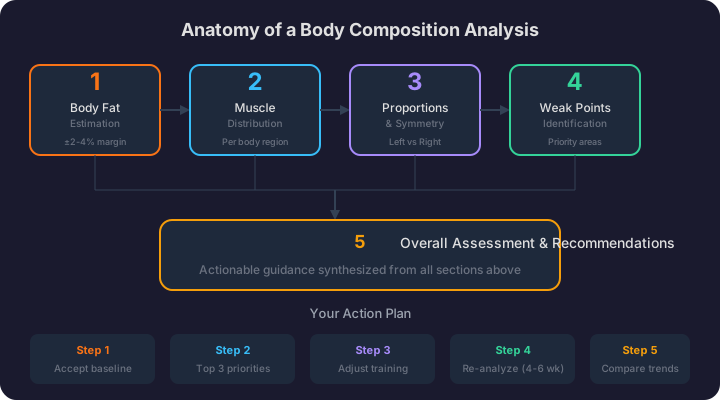
Section 1: Body Fat Estimation
This is usually the first number people look at, and the one they care about most.
What it means: Your body fat percentage is an estimate of how much of your total body weight comes from fat tissue. The rest — muscle, bone, organs, water — is your lean mass.
How to interpret it: Don't fixate on the absolute number. Photo-based estimates have a margin of error (typically 2-4 percentage points). What matters more is:
- Where you fall within general ranges (see our body fat percentage guide for visual references)
- How the number changes over time with consistent analysis methodology
- Whether the trend is moving in the direction you want
What to do with it:
- If your goal is fat loss, this number should trend downward over months
- If you're building muscle (bulking), expect this number to stay stable or rise slightly
- Use it alongside mirror photos — sometimes you'll look leaner while the number stays the same, because you've gained muscle
Common misunderstanding: "My analysis says 18% but my scale says 14%." Different methods give different numbers. The absolute value matters less than consistent tracking with the same method. If your photo analysis consistently shows your body fat decreasing, you're making progress regardless of the exact number.
Section 2: Muscle Distribution Scores
This is where the analysis gets really interesting — and uniquely valuable.
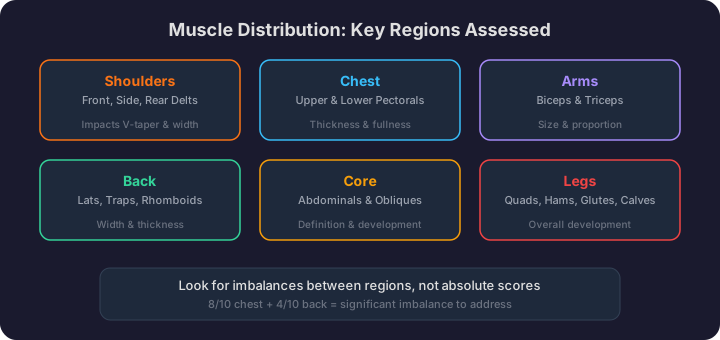
What it means: Muscle distribution breaks down how your muscle mass is spread across major body regions. Typically scored on a scale (e.g., 1-10 or descriptive ratings like "underdeveloped," "balanced," "well-developed").
Key areas assessed:
- Shoulders (Deltoids) — front, side, and rear heads
- Chest (Pectorals) — upper and lower regions
- Arms (Biceps & Triceps) — size and proportion relative to the body
- Back (Lats, Traps, Rhomboids) — width and thickness
- Core (Abdominals, Obliques) — definition and development
- Legs (Quads, Hamstrings, Glutes, Calves) — overall development
How to interpret it: Look for imbalances rather than absolute scores. A score of 6/10 on shoulders and 6/10 on legs means balanced development. A score of 8/10 on chest and 4/10 on back means you have a significant imbalance to address.
What to do with it:
- Identify your 2-3 lowest-scoring areas — these are your training priorities
- Compare scores to your training history: if you've been training chest heavily and it still scores low, your exercise selection or technique might need adjustment
- Use it to inform your training split: give weaker areas more volume, frequency, or priority placement in your sessions
Section 3: Proportions and Symmetry
What it means: Proportion assessment evaluates how your muscle groups relate to each other visually. Are your shoulders wide relative to your waist? Is your upper body proportional to your lower body? Are your left and right sides symmetrical?
Key proportions tracked:
- Shoulder-to-waist ratio — a wider ratio creates a more athletic, V-taper appearance
- Upper vs. lower body balance — many lifters overdevelop either upper or lower body
- Left-right symmetry — size differences between sides
How to interpret it: Minor asymmetries are normal — everyone has a slightly dominant side. Significant asymmetries (noticeable visual difference between left and right) deserve attention because they can indicate compensatory patterns that may lead to injury.
Proportional imbalances are aesthetic preferences to some degree, but extreme ratios (e.g., massive upper body with underdeveloped legs) can also indicate functional imbalances.
What to do with it:
- For symmetry: add unilateral work (single-arm, single-leg exercises) to bring the weaker side up
- For proportions: adjust training volume to emphasize lagging areas
- Track changes over time to see if your program is actually improving the imbalance
Section 4: Weak Points Identification
What it means: Based on the analysis of muscle distribution and proportions, specific weak points are called out — muscle groups that are underdeveloped relative to the rest of your physique.
How to interpret it: These aren't insults — they're opportunities. Every physique has weak points. Identifying them objectively is the first step to addressing them.
Weak points are determined by comparing each muscle group to your overall development level. A muscle group that's significantly below your average development gets flagged.
What to do with it:
- Prioritize weak points in your program: train them first in your session when you're freshest
- Increase frequency: if your shoulders are a weak point, consider hitting them 3x per week instead of 2x
- Increase volume gradually: add 2-3 extra sets per week for flagged areas
- Review exercise selection: make sure you're using exercises that effectively target the weak muscle, not just exercises you're comfortable with
Section 5: Overall Assessment and Recommendations
What it means: This section synthesizes everything above into actionable guidance. It typically includes a summary of your current physique state, your strongest attributes, your priorities for improvement, and general training and nutrition recommendations.
How to use it:
- Read this section in conjunction with the detailed scores above
- Use the recommendations as starting points for your training adjustments
- If you're using HyperBody's smart coaching, these recommendations feed directly into your personalized training program
Putting It All Together: Your Action Plan
After reading your analysis, here's how to turn it into a concrete plan:
Step 1: Accept the baseline Your first analysis is a starting point, not a judgment. Whatever the numbers say, they're just data. The value comes from what you do next.
Step 2: Identify your top 3 priorities From the muscle distribution and weak points sections, pick 2-3 areas to focus on. Don't try to fix everything at once — targeted improvement beats scattered effort.
Step 3: Adjust your training Modify your program to emphasize your priorities. This might mean:
- Rearranging exercise order (weak points first)
- Adding volume for lagging areas
- Changing exercises to better target weak muscles
Step 4: Set a re-analysis date Mark your calendar for 4-6 weeks from now. That's enough time for meaningful changes to occur and show up in your next analysis.
Step 5: Compare, don't obsess When you re-analyze, compare the new results to your baseline. Look for trends in the right direction. Don't expect dramatic changes in one cycle — physique development is measured in months and years, not weeks.
Tips for Getting Accurate Analyses
The quality of your analysis depends on the quality of your photos. Here's how to maximize accuracy:
- Consistent lighting: same lighting setup every time
- Same time of day: morning, fasted, after the bathroom
- All required poses: don't skip the back poses (they reveal a lot)
- Stand naturally for relaxed poses: don't suck in or puff out
- Flex consistently for flexed poses: use the same flexing technique each time
- Neutral clothing: fitted shorts or underwear that don't obscure your physique
Your body composition analysis is a tool — arguably the most powerful one in your fitness toolkit. It replaces guessing with data, replaces mirror anxiety with objective metrics, and gives you a clear picture of where you are and where you need to go. Learn to read it well, and you'll train with a purpose that most gym-goers never develop.