


Your scale weight is one of the least useful numbers in fitness. Two people can weigh the same and look completely different — one carrying significantly more muscle, the other more body fat. If you've ever felt stuck despite the number on the scale not moving, it's because weight alone tells you almost nothing about what's actually happening in your body.
Body composition analysis changes that. It shifts the focus from "how much do you weigh" to "what are you made of" — and that shift is where real progress begins.
What Is Body Composition?
Body composition refers to the proportion of fat, muscle, bone, and water that make up your body. The two most relevant components for physique development are:
- Fat mass — essential fat plus stored body fat
- Lean mass — muscle, bone, organs, water — everything that isn't fat
Your body fat percentage is the ratio of fat mass to total body weight. It's one of the most important numbers for understanding your physique, but it's far from the only one that matters.
Muscle distribution — how your muscle mass is spread across your body — plays a huge role in how you look. Someone with well-developed shoulders and back will appear more athletic than someone with the same total muscle mass concentrated in their legs.
Why It Matters for Training
Knowing your body composition transforms your training decisions:
- If you're "skinny fat" (normal weight but high body fat), you know you need to build muscle, not just lose weight
- If you're carrying excess fat but have a solid muscle base, you can cut with confidence knowing the muscle underneath will show
- If one body part is lagging, you can prioritize it in your training program rather than guessing
Without composition data, you're training blind. With it, every decision — from exercise selection to caloric targets — becomes more precise.
Key Metrics That Matter
A thorough body composition analysis goes beyond a single body fat number. Here's what you should be tracking:
Body Fat Estimation The most fundamental metric. Knowing your approximate body fat percentage helps you set realistic cut and bulk targets, and tells you how far you are from your goal physique.
Muscle Distribution Where your muscle mass sits matters. A good analysis breaks down development across major muscle groups — shoulders, chest, arms, back, core, legs — so you can identify which areas need more work.
Proportions & Symmetry Are your shoulders proportional to your waist? Is your left side keeping up with your right? Asymmetries and proportion imbalances are common and often invisible without objective analysis.
Weak Points Identification Every physique has weak points. Identifying them early means you can address them in your training program before they become limiting factors.
Genetic Potential Indicators Factors like bone structure, frame size, and muscle insertion points influence what your peak physique can look like. Understanding these helps set realistic, personalized goals.

Traditional Methods vs Smart Analysis
There are several ways to measure body composition, each with trade-offs:
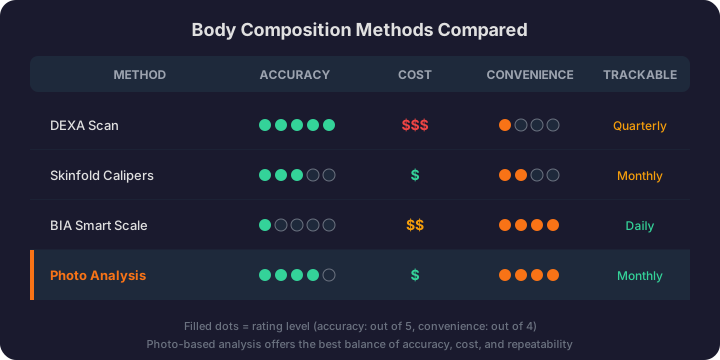
DEXA Scans Considered the gold standard. Highly accurate, but expensive ($75–150 per scan), requires a clinic visit, and exposes you to a small amount of radiation. Not practical for frequent tracking.
Skinfold Calipers Affordable and portable, but accuracy depends heavily on the person taking the measurement. Inconsistent technique leads to inconsistent results.
Bioelectrical Impedance (BIA) Built into many smart scales. Convenient but notoriously unreliable — hydration, meal timing, and even skin temperature can swing results by several percentage points.
Smart Photo-Based Analysis A newer approach that uses your physique photos to estimate body composition, assess muscle distribution, identify weak points, and evaluate proportions — all from five standard photos taken at home.
This is the approach HyperBody uses. You upload five photos (front relaxed, front flexed, back relaxed, back flexed, and side profile), and receive a detailed report covering body fat estimation, muscle distribution scores, symmetry analysis, weak point identification, and actionable recommendations — all without leaving your home.
The key advantages are accessibility and repeatability. You can re-analyze monthly under the same conditions, giving you consistent, comparable data over time.
The Power of Monthly Tracking
A single body composition analysis gives you a snapshot. Monthly tracking gives you a trajectory — and trajectories are where the real insights live.
When you analyze monthly, you can see:
- Whether your training program is actually building muscle where you need it
- Whether your cut is preserving lean mass or costing you muscle
- Whether weak points are improving or staying stagnant
- How your proportions are shifting over time
This creates a powerful feedback loop: analyze → train → track → adjust → repeat. Each cycle makes your training more targeted and your results more predictable.
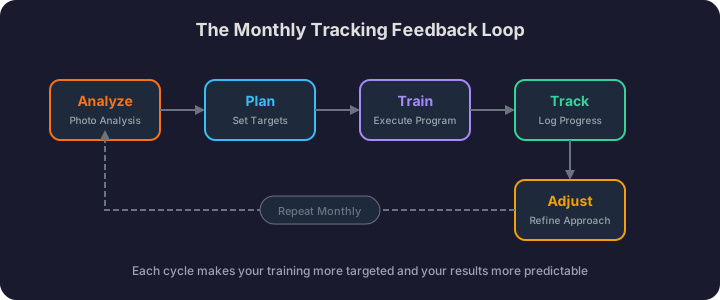
HyperBody is built around this cycle. Your monthly re-analysis doesn't just update your numbers — it feeds into your coaching program, so your training plan evolves as your body does.
Getting Started
If you want to start tracking your body composition effectively, here are some practical tips:
Use Consistent Lighting Natural or bright, even lighting shows your physique most accurately. Avoid harsh shadows or dim rooms.
Analyze at the Same Time of Day Morning, before eating, after using the bathroom — this minimizes day-to-day fluctuations from water retention, food volume, and bloating.
Take All Five Standard Poses Front relaxed, front flexed, back relaxed, back flexed, and side profile. Each angle reveals different information about your physique.
Track Trends, Not Single Data Points One analysis is useful. Three or four analyses over several months is powerful. Don't overreact to a single result — look at the direction you're heading.
Pair With Performance Data Body composition tells you what's changing. Training logs tell you why. Together, they give you the complete picture.
The scale has its place, but it's a blunt instrument. Body composition analysis gives you the detail and nuance you need to train with purpose — and to see the progress that the scale misses entirely.